



Image by Adobe Stock
Updated by the Editorial Department of *Forest Circular Economy* on August 27, 2026, at 10:50 a.m. JST
Editorial Board, Forest Circular Economy
Forestcircularity-editor
We aim to realize "Vision 2050: Japan Shines, Forest Circular Economy" promoted by the Platinum Forest Industry Initiative. We will disseminate ideas and initiatives to promote biomass chemistry, realize woody and lumbery communities, and encourage innovation in the forestry industry in order to fully utilize forest resources to decarbonize the economy, strengthen economic security, and create local communities.
In recent years, against the backdrop of growing interest in achieving a decarbonized society, regional revitalization, and well-being, there has been a rapid increase in attention toward wooden public facilities and community hubs. At the same time, information regarding leading examples, technologies, and policies related to the construction of wooden public buildings—where large numbers of people gather—is scattered across various media, making it difficult to gain a systematic understanding of how this trend is actually progressing.
This 23-page document, compiled by the “Platinum Forest Industry Initiative: Wooden City Subcommittee” of the Platinum Vision Network (a general incorporated association), summarizes four leading case studies and technologies related to wooden public facilities and community hubs, along with concepts, technologies, and institutional trends regarding wooden cities. Please use this document as a resource for planning and proposing public buildings, gathering information, and staying informed about the latest trends in non-residential timber construction.
We have systematically organized information that is useful for practical work in wood-frame construction.
・Leading Examples of Wooden Public Facilities and Community Hubs
・Technologies and construction methods used in wood-frame construction
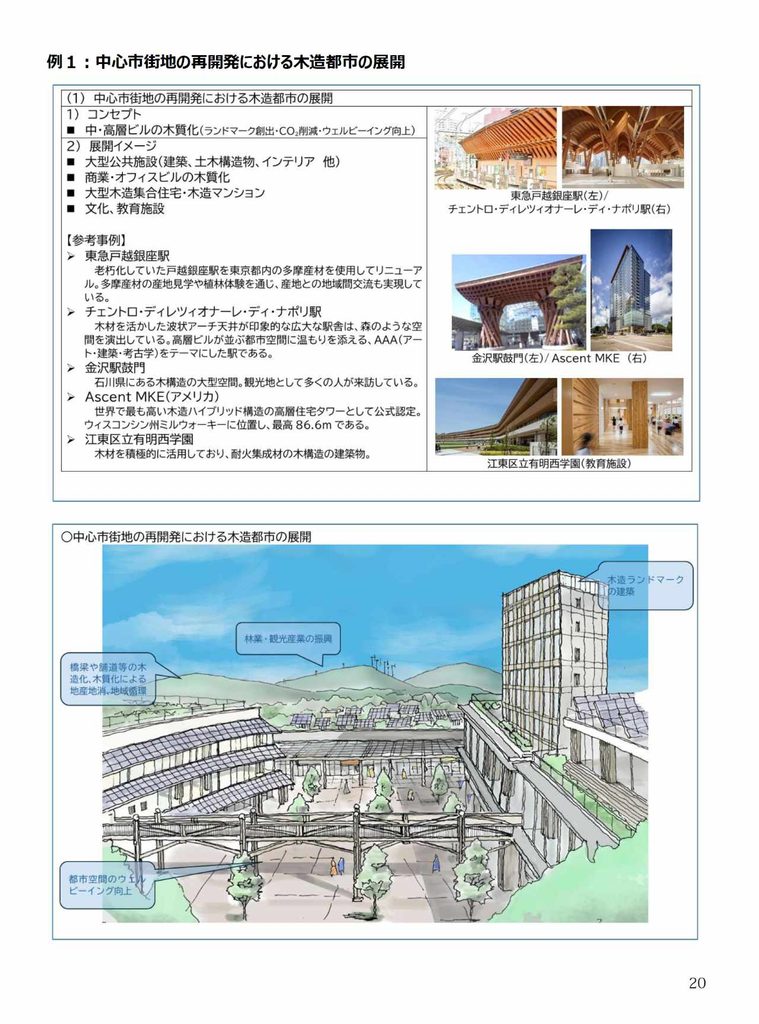
・The Concept and Future Vision of a Wooden City
・Overview of Programs and Subsidies to Promote Wooden Construction
・Latest Trends in Wooden Construction

This section highlights cutting-edge projects and technologies in wooden public facilities and community hubs, introducing their respective features, the technologies employed, and key evaluation criteria.
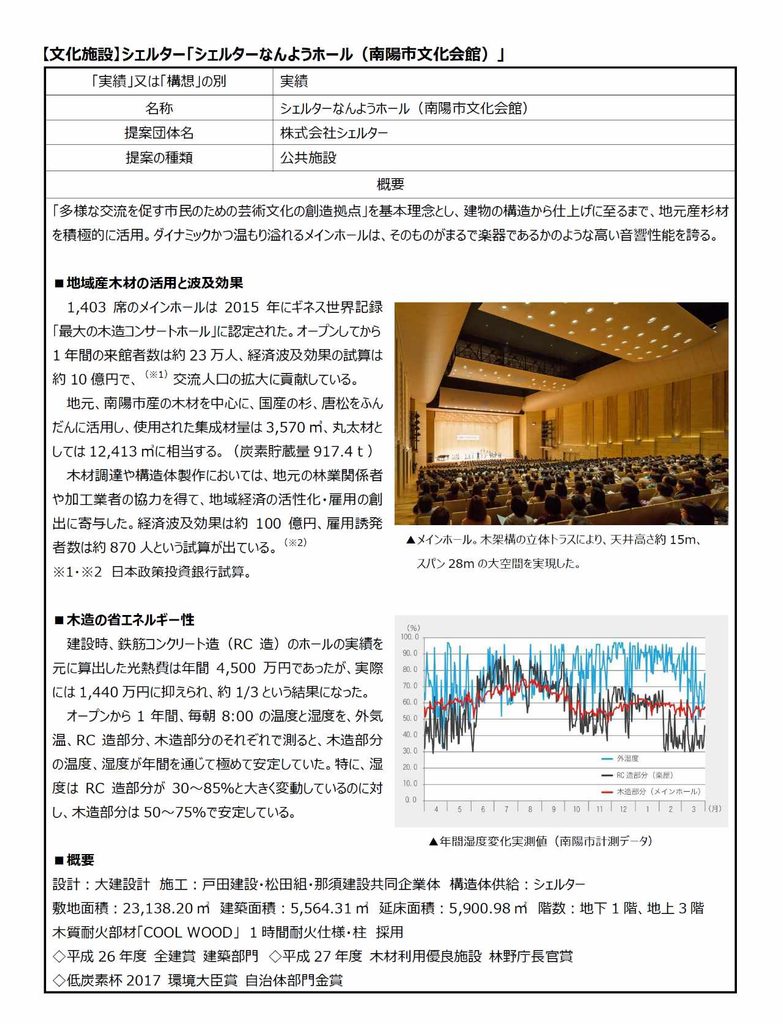
Shelter Nanyo Hall (Shelter Co., Ltd.)
A large, three-story wooden cultural hall recognized by Guinness World Records. This article explains the key design and engineering features that made it possible to create such a spacious interior through the extensive use of locally sourced cedar, as well as the unique benefits of a wooden structure.
CREVA Okuma (Shimizu Corporation)
An industrial exchange facility spearheading the revitalization of the area west of Ōno Station. It combines safety and aesthetic appeal through its unique wood-based hybrid fire-resistant technology. We introduce this large, multipurpose space where town residents and visitors can gather while enjoying the warmth of wood.
Wooden Architecture by Shimizu Hiwood® (Shimizu Corporation)
A wood-hybrid technology that meets the seismic and fire resistance requirements for medium- to large-scale, medium- to high-rise wooden buildings. This publication features case studies of its application in large-span structures, such as arenas and gymnastics venues.
(Tentative Name) Miki Community Hub (Daiwa House Industry Co., Ltd.)
A semi-fire-resistant community hub aimed at revitalizing suburban housing complexes (complex revitalization). It presents hub functions that contribute to the formation of multigenerational communities and the revitalization of the local economy, as well as approaches to co-creation with the local community.
・For those looking for examples of wooden public facilities and community hubs
・Individuals involved in planning and proposing wooden structures or public buildings
・Those who want to stay up to date on the latest trends in wooden cities and non-residential wooden structures
・Practitioners from local governments, developers, general contractors, architectural firms, and wood-related companies
・Researchers and students studying timber-frame construction and urban timber construction
Part 1: Design and Construction Case Studies of Wooden Public Facilities and Community Hubs
This section highlights cutting-edge wooden public facilities and community hubs, introducing their architectural concepts, features, and key technical aspects.
Part 2: Basics of Wooden Cities
・What Is a Wooden City?
・The Significance of a Wooden City
・Technological Advances and Institutional Support
・The Wooden City That Came to Life
・Creating a wooden city with a sense of spatial expansiveness
You can download the materials for free. Please click the button above, fill out the form with the required information, and submit it.
The URL for the download page and the password will be displayed on the "Send Complete" screen.
[Document Overview]
Format: PDF
Number of pages: 23 pages
Fee: Free
Published by: Platinum Vision Network (General Incorporated Association), Platinum Forest Industry Initiative, Wooden Cities Subcommittee
In addition, we will send registered users a free newsletter from “Forest Circular Economy” that bridges policy, industry, technology, and culture. Regarding the handling of personal information,Terms of Use and Privacy PolicyPlease check the following.
