Updated by the Forest Circular Economy Editorial Department on November 08, 2025, 11:41 PM JST
Editorial Board, Forest Circular Economy
Forestcircularity-editor
We aim to realize "Vision 2050: Japan Shines, Forest Circular Economy" promoted by the Platinum Forest Industry Initiative. We will disseminate ideas and initiatives to promote biomass chemistry, realize woody and lumbery communities, and encourage innovation in the forestry industry in order to fully utilize forest resources to decarbonize the economy, strengthen economic security, and create local communities.
Asahi Kasei has recently developed a system to streamline the application process for forest-derived J-Credits. Utilized in a demonstration test in Nobeoka City, Miyazaki Prefecture, it successfully reduced the application workload associated with credit creation by approximately 901 TP3T. By significantly reducing the operational burden, it has demonstrated a pathway toward simultaneously realizing the utilization of forest resources and regional economic circulation through digital transformation (DX).
This system leverages the company's long-cultivated expertise in data management and automation. By compiling information held by municipalities and forestry cooperatives into a database, it significantly streamlines application procedures. Complex tasks such as collecting various data, selecting candidate sites, and calculating absorption volumes are now more efficient. What previously took 1.5 to 3 months can now be completed in approximately 4 to 5 days. This enables even those without specialized knowledge to submit accurate applications quickly.
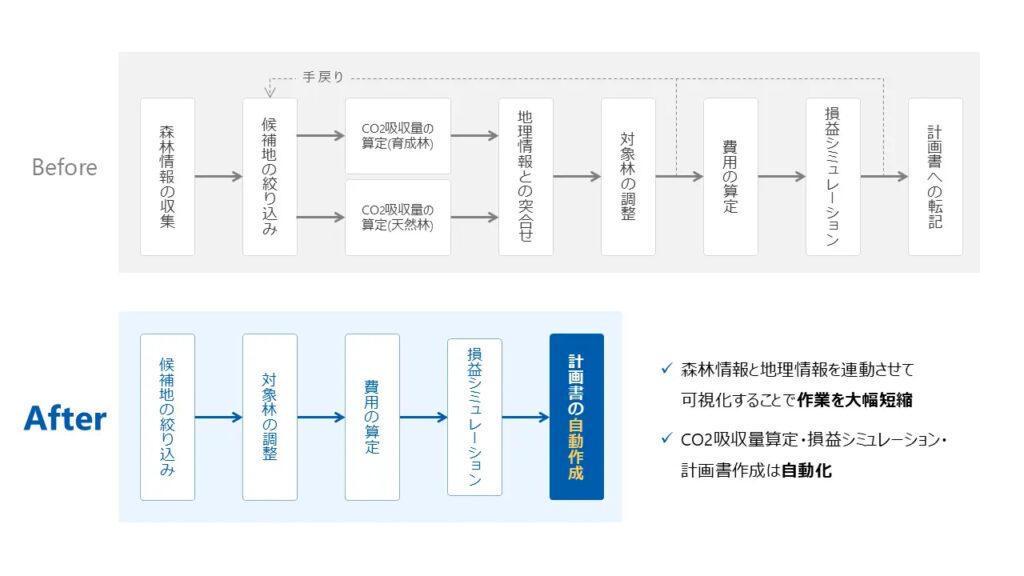
The credits issued in Nobeoka City began sales on October 1st and are projected to generate a total of 34,370 t-CO2 equivalents by fiscal year 2040. Purchasing companies gain added value beyond the carbon offset effect, including introductions to the "Forest Environmental Contribution Story" detailing the associated area and conservation impact, and the issuance of certification.
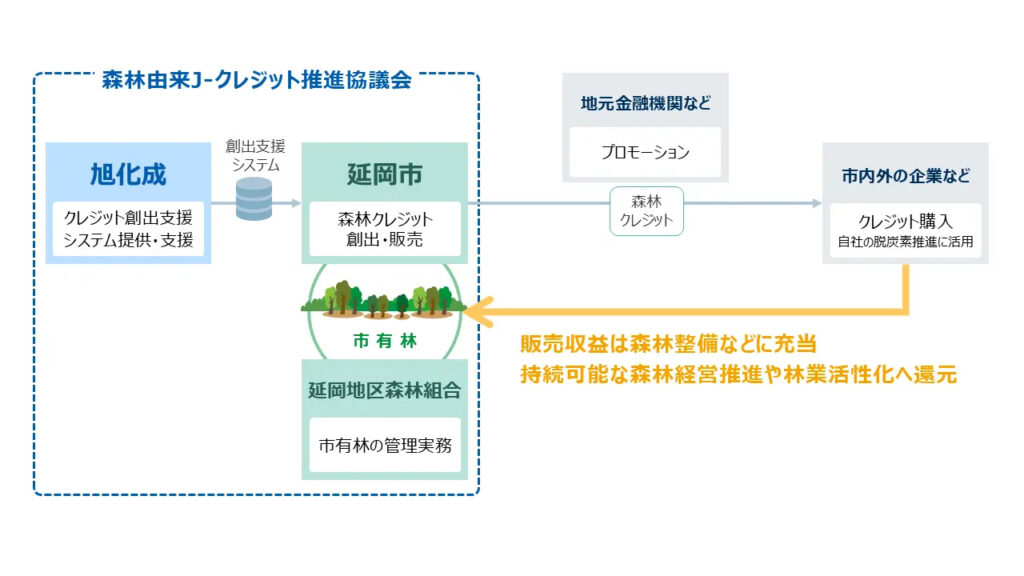
Proceeds from the sale of forest-derived J-Credits serve as a funding source for forest conservation activities, contributing to environmental preservation and revitalizing the local economy. However, there have been structural challenges, such as cumbersome application procedures and the difficulty of obtaining certification without specialized knowledge. In fact, Nobeoka City once attempted to create credits independently but was forced to abandon the effort midway.
As part of its regional contribution to Nobeoka City, the birthplace of the company, Asahi Kasei has been working since 2023 to create forest credits in collaboration with Nobeoka City, the Nobeoka District Forest Owners' Association, and others. This activity has now culminated in the development of this system. Going forward, the company plans to consider deploying this system to municipalities and companies, primarily within Miyazaki Prefecture, as well as utilizing it internally to achieve carbon neutrality.
This public-private partnership initiative serves as a model case demonstrating how DX-driven efficiency can unlock new possibilities for organizations that previously struggled to generate J-Credits under conventional frameworks. Accelerated utilization of forest resources, coupled with the reinvestment of proceeds into sustainable forest conservation activities, is expected to contribute to both regional economic development and decarbonization efforts.