courtesy of takeda@schrodingers.jp / photograph
A Forest-Based Landscape Approach: Defining "Nature Positivity" in Watersheds
Updated by Takanobu Aikawa on March 25, 2026, 10:31 AM JST
Takanobu AIKAWA
PwC Consulting Godo Kaisha
Senior Manager, PwC Intelligence, PwC Consulting LLC / With a background in forest ecology and policy studies, he has been extensively engaged in research and consulting for the forestry and forestry sectors for the Forestry Agency and local governments. In particular, he contributed to the establishment of human resource development programs and qualification systems in the forestry sector in Japan, based on comparisons with developed countries in Europe and the United States. In the wake of the Great East Japan Earthquake, engaged in surveys and research for the introduction of renewable energy, particularly biomass energy; participated in the formulation of sustainability standards for biomass fuels under the FIT system; since July 2024, in his current position, leads overall sustainability activities with a focus on climate change. He holds a master's degree in forest ecology from the Graduate School of Agriculture, Kyoto University, and a doctorate in forest policy from the Graduate School of Agricultural Science, Hokkaido University.
In July 2026, the 2nd Global Nature Positive Summit will be held in Kumamoto, Japan. Organized by the Nature Positive Initiative and the Japanese Committee of the International Union for Conservation of Nature, ICLEI Japan, the Global Biodiversity Framework (GBF) will be assessed at the 17th Conference of the Parties (COP17) to the UN Convention on Biological Diversity to be held in Yerevan, Armenia, in October 2026. This summit will be preceded by an assessment of the progress of the Global Biodiversity Framework (GBF). This summit will be preceded by a discussion on the contributions of corporations, financial institutions, and local governments.
One of the key themes is the "landscape approach" to the practice of nature positivity. One of the reasons why this summit is being held in Kumamoto in the first place is that the landscape approach to protecting and utilizing water resources is being promoted through public-private partnerships. The excursion after the conference will include a tour of the landscape in a watershed unit from Mt. Aso to the Ariake Sea and Yatsushiro Sea.
On the other hand, the term "landscape approach" is not very familiar to forestry and forestry professionals in Japan. Therefore, this paper will discuss the development of the landscape approach concept and the direction of "nature positivity" in the Japanese landscape, including forests.
Landscape" is translated as "landscape" in Japanese, and refers to "an overall system of spaces in which heterogeneous ecosystems (landscape elements), such as forests and grasslands, are distributed in a mosaic-like pattern.
Jeffrey Sayer, one of the proponents of the landscape approach, wrote in a 2013 paper that it "provides tools and concepts for allocating and managing land to achieve social, economic, and environmental goals in areas where agriculture, mining, and other productive land uses compete with environmental and biodiversity goals approach". In other words, it aims to optimize the entire space by coordinating interests within a certain space (landscape), rather than aiming to optimize development use and conservation separately and individually.
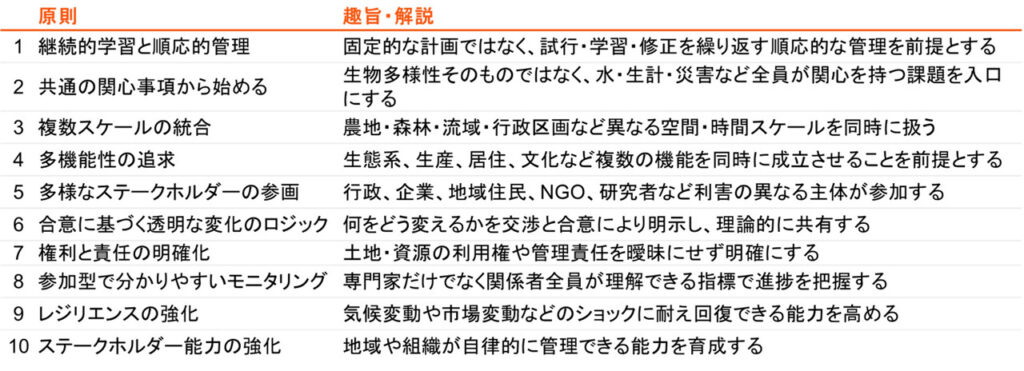
It is important to note, however, that the answer to the question of "what is best for the whole" is not a single scientific determination, but is derived as a result of consensus building among the parties involved. To this end, Sayer and his colleagues have devised 10 principles for a landscape approach (Table). The principles are organized in such a way that they are helpful in specifically using the landscape level to develop an area, such as "pursuing multifunctionality" based on "a transparent logic of change based on consensus" with "diverse stakeholder participation.
For forestry and forestry professionals, the idea of contiguous space itself is not new.
For example, in order to maximize the various functions of forests, "zoning" is used to classify the roles of forests according to the characteristics of each location. In Japan, forests are divided into two main categories: "production forests," which prioritize timber production, and "environmental forests," which emphasize water source irrigation, prevention of mountain disasters, and other public benefit functions, and to which guidance measures are applied. Institutionally, zoning based on the above approach has been implemented in the municipal forest development plans prepared by all municipalities.
However, these adjustments are only made within forests, and are considered within the framework of other land use categories, such as agricultural lands within the Agricultural Land Law, rivers and their surrounding environment within the River Law, and coasts within the Coastal Law. Therefore, it is fair to say that there is currently no administrative tool such as a land use master plan that coordinates among multiple land use purposes such as agriculture and residential land development, as envisioned in the landscape approach.
On the other hand, in practical terms, there are several studies and initiatives that are aware of the term "watershed" to describe the connections from forests to farmland, grasslands, urban areas, and the sea through rivers. For example, a well-known initiative to protect oyster farms in Miyagi Prefecture involves the maintenance of upstream forests that support fishing resources by supplying nutrients.
Interestingly, "watersheds" are also mentioned in the "SWGs Declaration: Toward a future of sustainable wellbeing through harmony among people, society, and the Earth," which was proposed in October 2025 as a Japan-originated international agenda creation. The SWGs (Sustainable Well-being Goals), which are envisioned as the global agenda for the post-SDGs era, are based on the concept of "harmony among people, society, and the Earth," and the watershed landscape is considered appropriate as a unit of activity for this purpose.
It is important to note, however, that what is considered "positive" at the watershed level is decided on a bottom-up basis, that is, "starting with issues of common interest" of the stakeholders, as stated in the 10 principles. Each region must decide what it wants to conserve and why it is positive to conserve it.
In many of these approaches, forests play an important role as landscape components. For example, in Minakami Town, Gunma Prefecture, and Minamisanriku Town, Miyagi Prefecture, for the conservation of golden eagles, efforts such as cutting down artificial forests to create feeding grounds and promoting the conversion of forests to broad-leaved trees are considered "positive," and activities are carried out with the participation of nature conservation groups and local councils.
The objective of these golden eagle conservation projects is actually "sustainable community development" as well, and it is hoped that local forest and forestry officials will actively participate to achieve the goal of "passing on abundance and hope to future generations" set forth in the SWGs. (Takanobu Aikawa, Senior Manager, PwC Intelligence, PwC Consulting, LLC)
*References
... Sayer et al. (2013) ”Ten principles for a landscape approach to reconciling agriculture, conservation, and other competing land uses. ”
interpoint (interword separation) The Japanese Society of Landscape Ecology Website(Viewed March 10, 2026)
interpoint (interword separation) SWGs Declaration - Towards a future of sustainable wellbeing in harmony with people, society and the planet