Sawako Miura / photograph
Commercialization of the "mass balance method" for bionaphtha imports by major domestic petrochemical companies.
Updated by Taro Kamagata on May 20, 2026, 8:15 PM JST
Taro KAMAGATA
(Platinum Initiative Network, Inc.
After graduating from Keio University with a degree in economics in 1982, he joined Toppan Printing Co. In 1988, he moved to Mitsubishi Research Institute, where he was in charge of urban and regional management and public-private partnerships (PPP, PFI, etc.). He later became an executive officer and served as Director of the Regional Management Research Division, Director of the Platinum Society Research Division, and Managing Executive Officer and General Manager of the Research and Development Division, etc. He was seconded to Mitsubishi Research Institute DCS as Senior Managing Director in 2018, retired as an officer of Mitsubishi Research Institute in 2021, and became an advisor to Platinum Initiative Network in 2022. Leader of the Secretariat of the Platinum Forest Industry Initiative.
In the previous issue, we introduced examples of overseas companies producing biofuels and other products using woody biomass resources. This time, in contrast, we will introduce the efforts of a domestic company that has started commercial sales using the mass balance method (*Note 1) while importing bionaphtha and other materials from overseas companies and utilizing them as chemical raw materials.
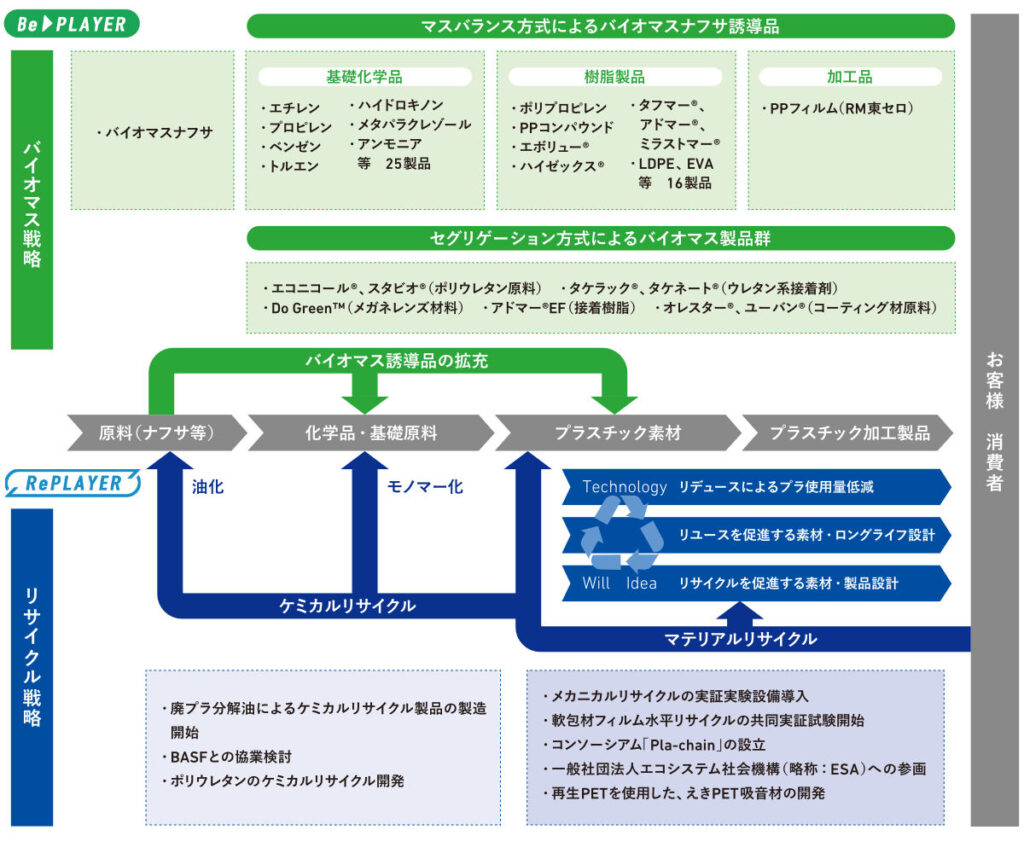
Mitsui Chemicals was one of the first companies to take advantage of bionaphtha imported from overseas for the production of chemical raw materials. In 2021, the company introduced biobased hydrocarbons (so-called bionaphtha) from Finnish energy company Neste into its naphtha cracker at its Osaka Plant.
Utilizing the mass balance method based on ISCC PLUS (*Note 2), we have been commercially developing "renewable raw material quota" product lines such as olefins and phenolic products, etc. After 2022, we have expanded the product lines to include biopolypropylene and biophenolic chains (BPA, epoxy resin, etc.). Neste is the supplier. In addition to Neste, our supplier, we are expanding mass production and sales in cooperation with Toyota Tsusho, which is responsible for supply chain coordination, and Prime Polymer, which manufactures biopolypropylene.
The company is also actively engaged in "material recycling," in which waste plastics and other materials are reused as raw materials, and "chemical recycling," in which used plastics and other materials are chemically and thermally decomposed back into raw materials and monomers to be used again as plastics and chemicals. In 2024, pyrolysis oil made from waste plastics will be fed into a cracker at the company's Osaka Plant, and the production and sale of derivatives (chemicals and plastics) derived from chemical recycling using the mass balance method has also been started.
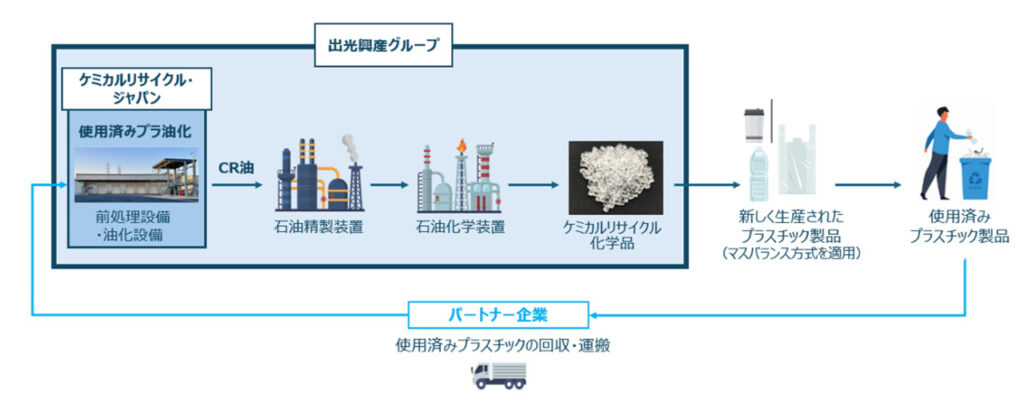
Idemitsu Kosan has begun to procure biomass naphtha from overseas and develop bio-chemicals in a mass-balance manner, taking advantage of its integrated value chain from petroleum refining to basic chemicals. Specifically, the products include biostyrene monomer/biopolystyrene and bio-paraxylene. We are building supply chains at our bases, including overseas, and have established a system to produce biopolystyrene from biostyrene monomer at Idemitsu SM and Petrochemicals in Malaysia.
In April, Chemical Recycling Japan, a subsidiary of the company, started commercial operation of an oil chemical recycling facility (used plastic processing capacity: 20,000 tons/year) at its Ichihara Works, which contributes to the recycling of used plastic in Japan.
Resonac, in collaboration with Neste and Marubeni, is moving forward with a plan to supply renewable olefins and their derivatives to the market on a mass balance basis by feeding Neste RE, Neste's renewable feedstock, into an ethylene plant at the Oita Complex. Use of the feedstock is scheduled to start in June 2024.
The biomass feedstock "Neste RE" produced by Neste will be supplied to the Oita Complex, where Resonac has an ethylene plant. The Oita Complex has the flexibility to process a wide variety of feedstocks, and although petroleum-derived feedstock has been used in the past, this initiative is expected to reduce greenhouse gas emissions by replacing some of the feedstock with biomass-derived feedstock.
All three companies, Resonac, Marubeni, and Neste, are ISCC PLUS certified. Using the mass balance method based on this system, Resonac and Neste will manufacture and sell products with biomass certification, and Marubeni will play the role of supply chain establishment and logistics management in this collaboration. Marubeni will be responsible for the supply chain and logistics management of the collaboration.
Thus, commercial sales using the mass balance method are gaining momentum, with major domestic petrochemical companies taking the lead in importing biomass fuels from overseas and utilizing them as chemical feedstock. However, at this point in time, we have yet to see a case in which a domestic biomass resource has been utilized and commercialized as a chemical feedstock.
On the other hand, there has been a gradual move toward commercialization of chemical recycling, which recycles used plastics in Japan, partly due to government policies.
There are still no examples of commercialization of utilizing domestic biomass resources as chemical feedstock. While the use of imported biomass fuels as chemical feedstock is an effective way to promote decarbonization, there is an abundance of forest resources in Japan that are not being effectively utilized. In Japan, which has been highly dependent on imported resources, it is hoped that commercialization will be promoted in the future by utilizing forest resources, which are abundant domestic biomass resources. (Taro Kamagata, Advisor, Platinum Initiative Network)
*Note 1
mass balance systemThe method of assigning a characteristic to a portion of a product when the product is made from a mixture of sustainable and non-sustainable feedstocks such as biomass and renewable feedstocks, depending on the input percentage of sustainable feedstock that has been input.
*Note 2
ISCC PLUS ISCC stands for "International Sustainability & Carbon Certification," an international certification system that ensures that biomass, renewable raw materials and products are sustainable and properly managed throughout the supply chain. ISCC PLUS covers products from outside the EU, not only biofuels and products, but also recycled raw materials and products, food, feed, and technical and chemical applications. Among other things, the program is recognized worldwide for certifying the sustainable use of biomass or recycled raw materials from waste in the chemical and processing industries (e.g. packaging industry).