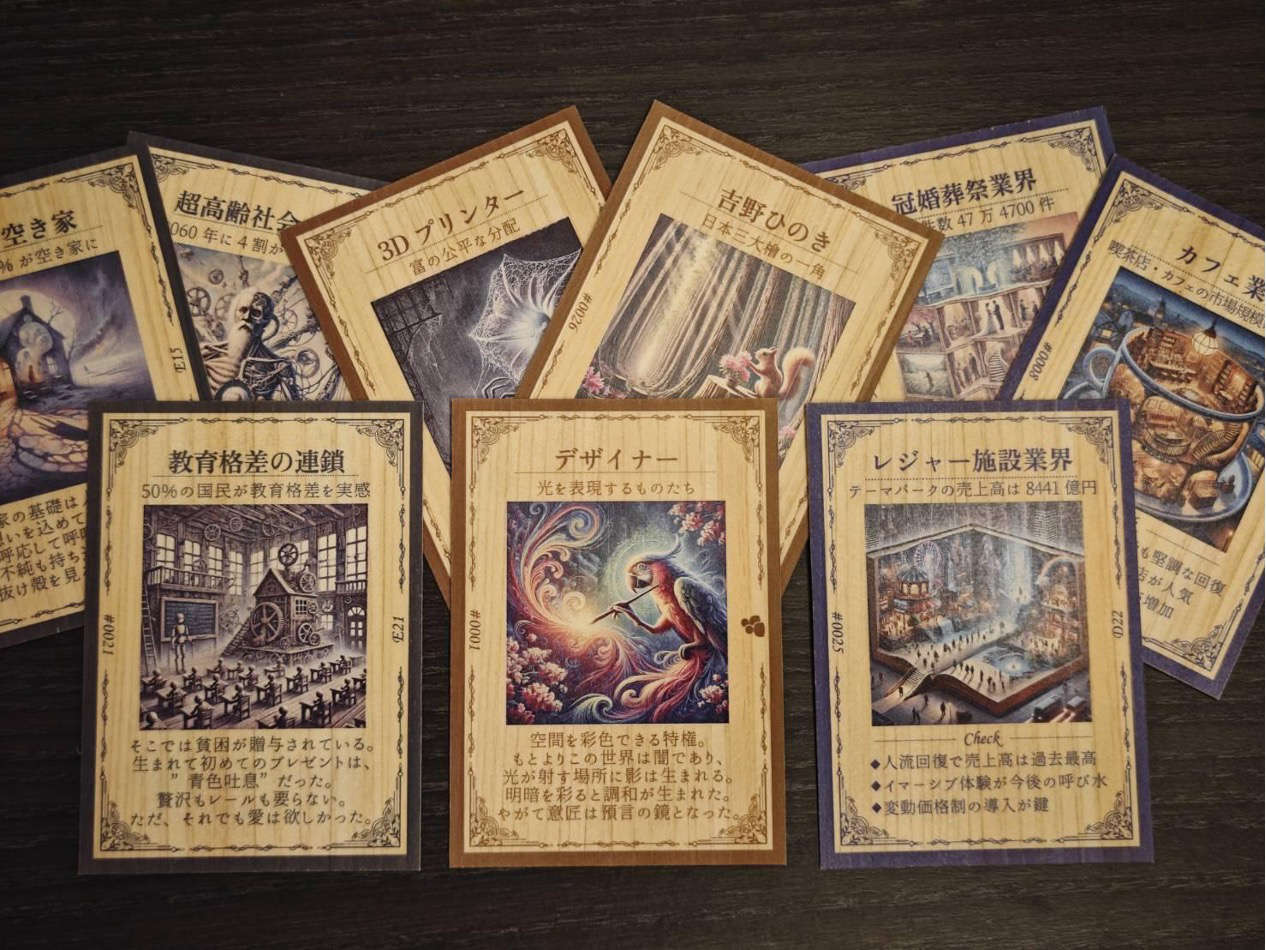
Photo by Kazuhiro Aoki
[The Priest's View] Could a wood-based card game be a gateway to dialogue connecting forests and people?
Updated by Kazuhiro Aoki on June 01, 2026, 9:28 AM JST
Kazuhiro AOKI
Representative Director, WSense Corporation / DELTA SENSE Production Committee
Representative Director, WSense Corporation / DELTA SENSE Production Committee Born in Aizuwakamatsu City, Fukushima Prefecture. From a family background of flower arrangement, tea ceremony, and Noh theater, he has been exposed to Japanese culture from an early age. His interest in wood began when he witnessed a shrine carpenter "sharpening a plane" and became aware of the depth of the craft. Currently, based on the knowledge he gained as a Shinto priest, he is promoting initiatives that lead to the public interest. He is a member of the Tokyo Junior Chamber of Commerce, holds a graduate degree and an MBA (Master of Business Administration), and has been a Boy Scout and a soccer player since he was 4 years old.DELTA SENSE Official HP WSense Corporation
When we think of the term "circular forest economy," we tend to focus on "how to use trees" and "how to increase the value of timber.
Of course, that is an important perspective.
Log it, use it, plant it, and grow it.
Incorporating this cycle into the economy and creating a state in which forests are cared for sustainably is an indispensable challenge for the future of society.
However, as a priesthood member and creator of a woody card game called DELTA SENSE, I have another question.
The question is whether trees can really be said to have circulated simply because they have been “used.
It is processed as wood, becomes a commodity, and reaches someone.
To that extent, it is indeed a material cycle.
But did the person who touched the tree think about the forest?
Do you remember the community?
Have you noticed the relationship between your life and work and the forest?
Did it inspire you to dialogue with someone and take the next action?
Only when that is included will trees begin to have real meaning in society.
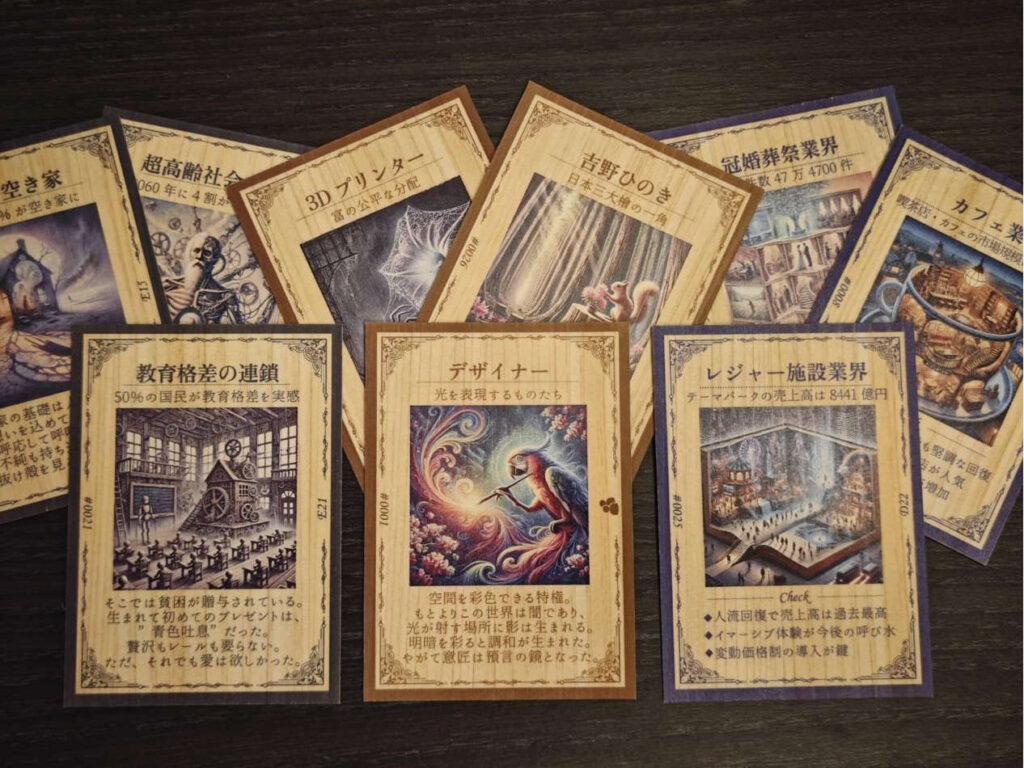
DELTA SENSE, which I am working on, is an interactive card game using wooden cards.
The card has three perspectives: "phenomenon," which represents social issues and signs of the future; "reality," which represents the resources and essence that support these issues; and "space," which represents the worldview and possibilities that are created by connecting these three perspectives.
Participants draw cards, combine them, and formulate questions from them.
For example, combine local issues with corporate resources.
We overlap the social changes of the future with the technology we have.
Or, we find new relationships between people, things, land, and memories that we usually think of separately.
DELTA SENSE's goal is not to provide the correct answer.
Rather, it is to bring to light assumptions that were not seen or discomfort that was not verbalized before jumping immediately to the correct answer.
We feel that this is a perspective that is deeply related to the forest circular economy.
The value of a forest cannot be told by numbers alone.
Carbon fixation, lumber volume, price, and distribution volume.
Of course, they are important.
However, forests are more than just a resource.
The forest is time.
Memory.
It is a place to store water, a place to condition the air, and a backdrop for community activities.
It is also a mirror for humans to consider their distance from nature.
Despite this, we city dwellers tend to view forests as something distant.
When we hold a wooden product in our hands, it is difficult to imagine where it came from, what kind of hands it passed through, or why it was necessary to use that tree.
Herein lies one of the difficulties of the forest circular economy.
The value of the forest exists.
Some people try to keep the trees alive.
Some businesses in the region are taking on the challenge.
However, there is a lack of “entry points” for city residents to receive this value as their own.
I believe that a small tool, a wooden card game, could be an entry point.
Cards can be picked up.
They can be lined up.
It can be placed between people.
And strangely enough, just having one card there makes people a little easier to talk to.
This card is similar to our current community agenda."
This resource could be in our company."
This combination would make for a great new project."
I realized that I had taken the word
In this way, wooden cards are not just a piece of playground equipment, but a catalyst for dialogue.
And the moment that dialogue is created, wood is no longer just a material.
Be the one to change people's perceptions, create relationships, and trigger action.
I feel that the role of this "dialogue" could be emphasized more in promoting the forest circular economy.
Because circulation is not just about things.
Money turns around.
The wood turns.
Resources will be turned around.
It is also a cycle.
However, as a prerequisite for this, one's attention must be turned.
Understanding must turn.
The question must turn.
And the meaning of our involvement in the forest must be handed on to someone else.
In this sense, DELTA SENSE is an attempt to change the forest circular economy from something to know to something to think about.
Many people don't know what they can do when they hear the term "forest circular economy.
But when you pick up a wooden card, talk to someone about it, and connect it to your work and community, the words gradually become your own.
It seems so far away when people say "protect the forest."
But when asked, "With whom and what kind of future do you envision using this tree?" one can begin to talk.
I think this difference is very significant.
I believe that increasing the value of wood does not necessarily mean only making it an expensive product.
To change the consciousness of those who come in contact with the trees.
More people should imagine the background of the forest.
More people should think about how to get involved with the community.
It is also an act that increases the value of the tree.
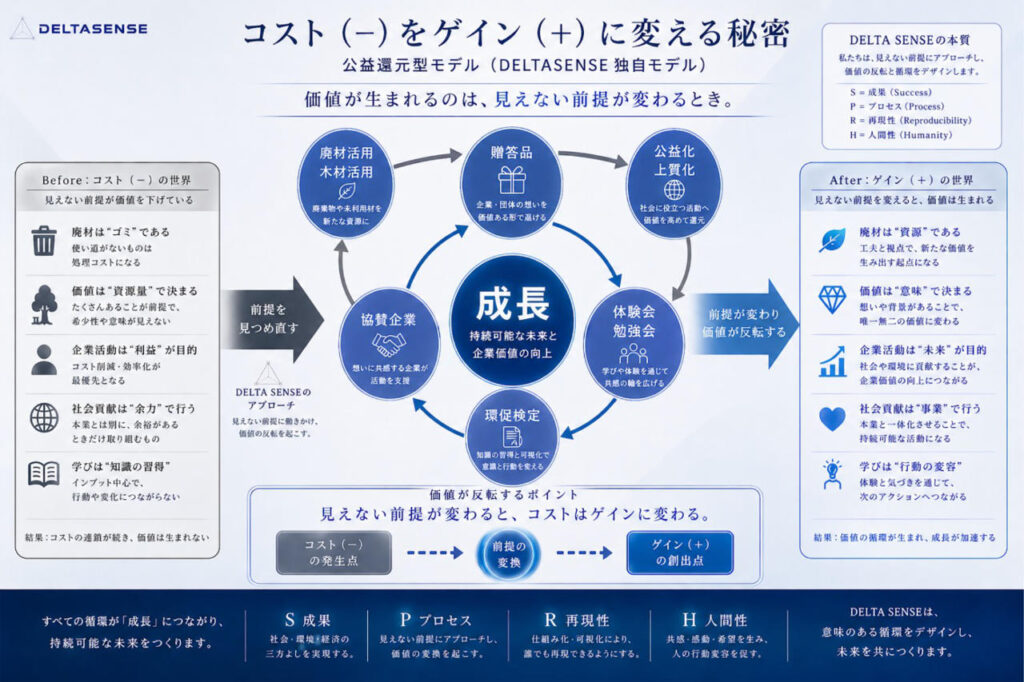
The same is true for scrap wood and local lumber.
Wood, which is treated as surplus, takes on a new meaning when it becomes a vessel for generating questions.
It is both an upcycle of matter and an upcycle of meaning.
Implementing a forest circular economy requires institutions, technology, distribution, and funding.
But at the same time, there must be an entrance for people's hearts to turn toward the forest.
That entrance does not necessarily have to be a big one.
A single wooden card.
One question.
A short dialogue with someone.
From there, the relationship between the forest, the city, and people is gradually re-knitted.
Forests are questions before they become timber.
And trees are the medium that connects people to each other before they become commodities.
Through a little wooden card game called DELTA SENSE, I continue to explore the possibilities.
In the second year of this "Circular Forest Economy," we hope that opportunities to share knowledge on the web, meet people in real places, and engage in dialogue around trees will further expand.
We think about the value of forests together, rather than just telling people about them.
Receive wood as a question, not just a use.
Beyond that, a new culture of forest circular economy will grow.
(President and CEO, WSense Inc. / DELTA SENSE Production Committee, Kazuhiro Aoki)