


Preparing for Increasingly Severe Forest Fires at Home and Abroad: Using Economic Mechanisms Such as Insurance to Build Fire-Resilient Forests
Updated by Takanobu Aikawa on September 8, 2026, at 12:13 p.m. JST
Takanobu AIKAWA
PwC Consulting Godo Kaisha
Senior Manager, PwC Intelligence, PwC Consulting LLC / With a background in forest ecology and policy studies, he has been extensively engaged in research and consulting for the forestry and forestry sectors for the Forestry Agency and local governments. In particular, he contributed to the establishment of human resource development programs and qualification systems in the forestry sector in Japan, based on comparisons with developed countries in Europe and the United States. In the wake of the Great East Japan Earthquake, engaged in surveys and research for the introduction of renewable energy, particularly biomass energy; participated in the formulation of sustainability standards for biomass fuels under the FIT system; since July 2024, in his current position, leads overall sustainability activities with a focus on climate change. He holds a master's degree in forest ecology from the Graduate School of Agriculture, Kyoto University, and a doctorate in forest policy from the Graduate School of Agricultural Science, Hokkaido University.
Large-scale forest fires have been occurring one after another around the world. In Japan as well, large-scale forest fires occurred for two consecutive years starting in 2025 along the Pacific coast of Iwate Prefecture. As high temperatures and dry conditions are expected to intensify due to climate change, efforts to create fire-resilient forests must be implemented by building a body of scientific evidence and utilizing economic mechanisms such as insurance.
Many people probably feel that they’ve been seeing more news reports about large-scale wildfires. In fact, wildfires broke out in Europe and North America during the summer of 2026, when heat waves struck those regions.
Surprisingly, however, no clear upward trend has been observed in the area affected by wildfires occurring in forests and grasslands. However, a closer look at the breakdown reveals that while wildfires in grasslands are on the decline, those in forests have remained stable or shown a slight increase, and large-scale wildfires have become more frequent.
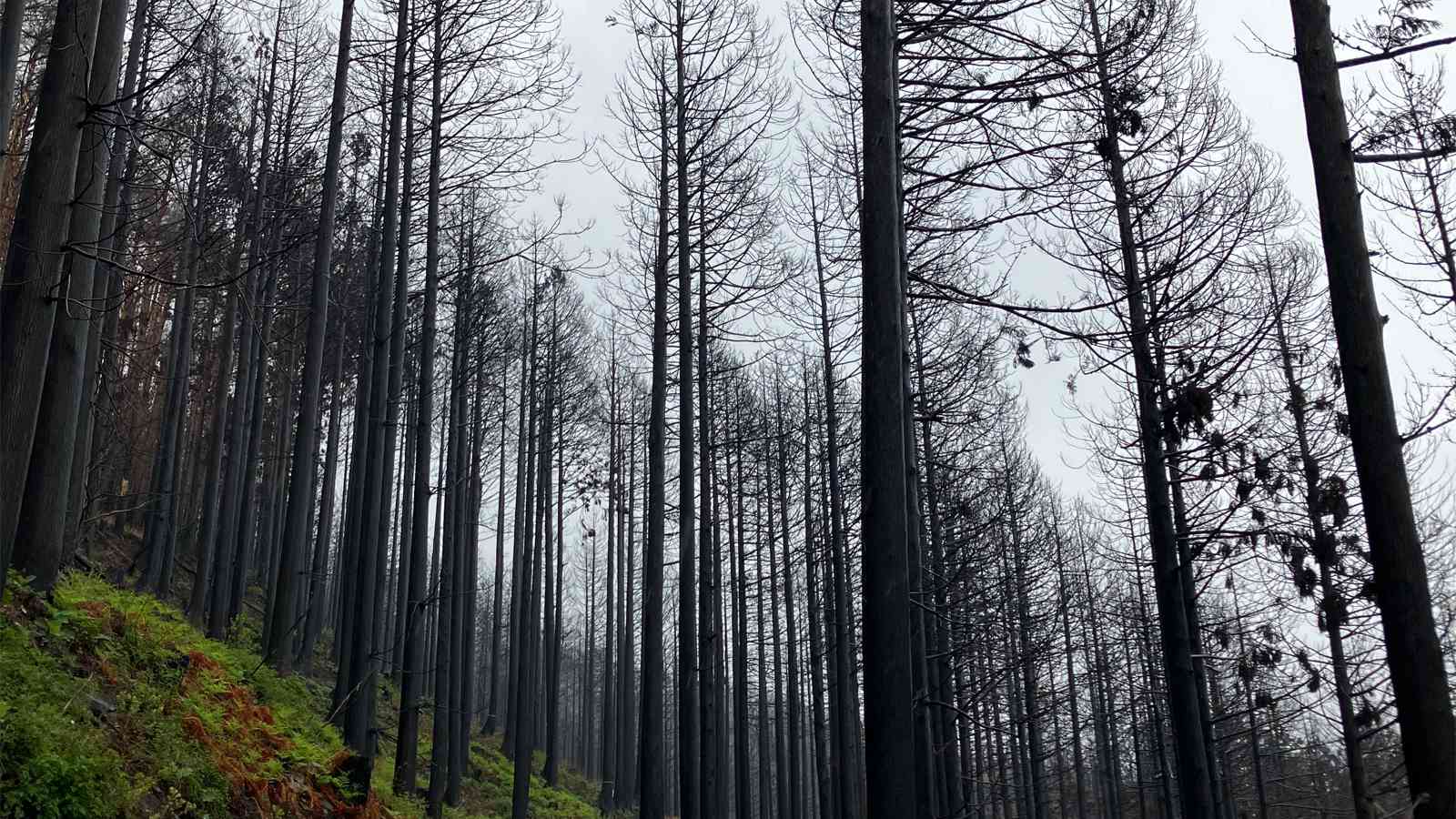
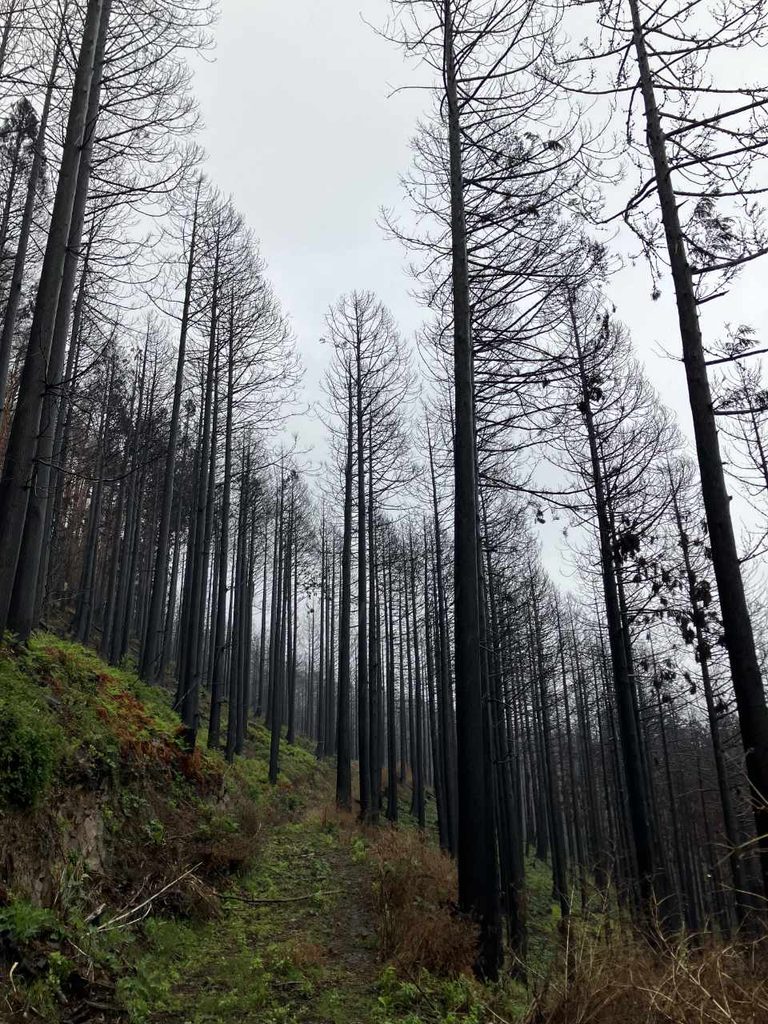
In Japan, however, the number of fires has been on a downward trend since the 1970s, with approximately 1,000 fires occurring over the past decade; thanks in part to the humid climate, large-scale forest fires have been rare. However, in 2025, a total of four large-scale wildfires occurred in Ofunato City, Iwate Prefecture; Okayama City, Okayama Prefecture; Imabari City, Ehime Prefecture; and Miyazaki City, Miyazaki Prefecture—all of which were severe enough to warrant evacuation orders for residents. The fire in Ofunato City was particularly large, burning an area of 3,370 hectares and becoming the largest fire since the Heisei era began (Photo 1). Furthermore, in April of the following year, 2026, a fire broke out in Ōtsuchi Town, also in Iwate Prefecture, burning 1,633 hectares, making it the second-largest fire since the Heisei era, following the one in Ōfunato City.
Thus, it can be said that Japan, too, needs to take measures to prevent forest fires from occurring and spreading.
(1) Prevention of Accidental Fires Caused by Human Action
First, it is necessary to develop countermeasures based on the fact that most forest fires in Japan are caused by human activity. According to data from the Fire and Disaster Management Agency, the causes of forest fires in Japan, on average from 2020 to 2024, were campfires (32.5%), controlled burns (18.9%), arson (7.7%), cigarettes (4.1%), matches and lighters (2.7%), among others. Considering that the damage from the fire in Ofunato City exceeded 10 billion yen, it is necessary to strengthen efforts to prevent human-caused fires, even in cases of accidental ignition.
Consequently, in the wake of the fire in Ofunato City, it was decided to promote wildfire prevention through measures such as the timely issuance of “Forest Fire Advisories” and “Forest Fire Warnings” by municipal leaders. Furthermore, under the Forest Act, a fine of up to 500,000 yen may be imposed for causing a fire through negligence.
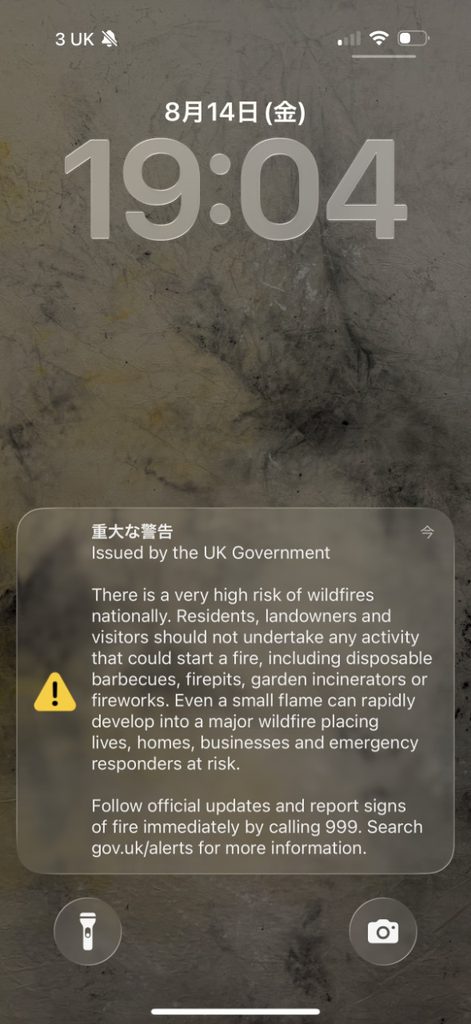
While forest fires can sometimes be caused by lightning strikes, it is true in other countries as well that many are caused by human activity. I was in the United Kingdom in mid-August, and on the evening of August 14, as the fire risk rose, an alarm sounded on my smartphone (Photo 2). The alert urged people to refrain from outdoor barbecues, yard burning, and fireworks. Strengthening measures to prevent human-caused fires in this way is a shared effort that is prioritized worldwide.
(2) Creating Fire-Resilient Forests
Next, we need to consider ways to manage forests so that fires are less likely to occur, or, if they do occur, so that they do not escalate into major blazes. To achieve this, we should scientifically explore methods suited to Japan’s climatic conditions and forest conditions.
Most forest fires start as “ground fires,” fueled by organic matter on the forest floor, such as fallen leaves, dead branches, underbrush, and shrubs. When adverse conditions—such as strong winds, as in the case of Ofunato City—converge, the fire can develop into a “crown fire,” in which the entire tree burns.
In Japan, it is known that when there is a large volume of foliage and less solar energy reaches the forest floor, the moisture content of combustible materials is maintained, thereby reducing the risk of surface fires. Therefore, it is important to conduct appropriate thinning to ensure that individual trees retain sufficient foliage. On the other hand, forest stands that have not been sufficiently thinned may result in a darker forest floor, but they may also have inferior soil retention capacity and water conservation functions. Therefore, it is important to note that such stands may not be able to fully perform their comprehensive public benefit functions and, in some cases, may even trigger other disasters such as landslides.
However, if extreme weather conditions—such as a prolonged absence of rain—persist, it is difficult to prevent the forest floor vegetation from drying out, regardless of the forest’s condition. Therefore, while preventing the initial outbreak of fire, as mentioned above, is of primary importance, the establishment of firebreaks to prevent the spread of fire is also considered effective. While paved roads are recommended as firebreaks, unpaved forest roads or access roads may be sufficient for preventing surface fires. However, in either case, maintenance and management are necessary to ensure they are not overgrown with shrubs or grasses that dry out easily.
It is also well known that certain types of evergreen trees have long been recognized for their ability to prevent fires from spreading or to slow the rate at which fires spread. Planting these trees—primarily those native to the region—in areas where fire spread needs to be contained, such as between residential areas and forests or along ridgelines, may be an effective strategy.
(1) Utilizing Insurance as a Funding Source for Activities to Create Fire-Resilient Forests
On the other hand, the planting of evergreen trees to serve as firebreaks is not yet widespread, and it is unlikely to spread spontaneously in the many small, privately owned forests in Japan.
What we would like to explore, then, is the use of economic mechanisms. Specifically, this involves paying entities or for work that involves creating scientifically proven disaster-resilient forests. This is generally referred to as “Payment for Ecosystem Services (PES),” but the challenge lies in how to secure the necessary funding.
Insurance mechanisms may offer potential for preventing forest fires. Generally speaking, insurance can be used as a tool to encourage the mitigation of damage caused by natural disasters. Specifically, by creating risk maps and other measures, risk information can be provided for individual properties and locations, and negative incentives can be created by reflecting this information in insurance premiums. Conversely, offering premium discounts when forest management practices aimed at preventing or mitigating forest fires are implemented creates a positive incentive. This is similar to how, in auto insurance, drivers with a “gold license” (i.e., a clean driving record) receive a premium discount, which serves as an incentive to practice safe driving.
Furthermore, for insurance companies, if they can reduce the frequency of fires and the scale of damage—and thereby lower insurance payouts—it becomes worthwhile to invest in such initiatives. In fact, in the western United States, where insurance payouts for wildfires have reached astronomical levels, such measures are already being considered. Given that home fire insurance providers are beginning to withdraw from areas with high fire risk and densely packed housing, it is highly likely that new schemes will gain widespread adoption.
(2) Initiatives Led by Local Communities
In Japan, there is a state-run forest insurance system based on the Forest Insurance Act that provides coverage for damage to forests themselves. The insured amount is determined based on tree species and forest age, and disaster risks such as wind damage, flood damage, and snow damage—which are covered in addition to fire—are not factored into the calculation. Reflecting these risks in the insured amount requires the accumulation of scientific data, and it is hoped that future research will provide the necessary foundation.
On the other hand, there are many measures—such as issuing advisories and warnings, promoting fire prevention awareness, strengthening community patrols, and establishing firebreaks—that can only be implemented when local communities take the lead. In these efforts, state-run forest insurance programs and insurance companies that provide fire insurance for local homes could collaborate with local governments, community fire departments, and forestry stakeholders to build fire-resilient communities and forests, with the goal of reducing damage and insurance payouts. Beyond fire prevention, this approach could also serve as a regional platform to support and promote various disaster mitigation activities and a wide range of ecosystem services at the local level. (Takanobu Aikawa, Senior Manager, PwC Intelligence, PwC Consulting LLC)
*References
・ Samborska, V., et al., (2024) “Wildfires”OurWorldinData.org (accessed August 26, 2026)"
・ National Park Service website “Wildfire Causes and Assessments”(Accessed August 26, 2026)”
・ Koji Tamai (2025), “On the Large-Scale Forest Fire in Ofunato City” (Forest Insurance Newsletter No. 39)
・ Kagoshima Prefecture Website: “Examples of Initiatives (Utilizing the Fire-Prevention Functions of Trees)”
・ OECD (2023), “Enhancing the Insurance Sector’s Contribution to Climate Adaptation,” OECD Business and Finance Policy Papers, OECD Publishing, Paris, https://doi.org/10.1787/0951dfcd-en.
・ The Nature Conservancy with Willis Towers Watson, Sarah Heard (2021) “Wildfire Resilience Insurance: Quantifying the Risk Reduction Achieved Through Ecological Forestry with Insurance”
