Rationalizing construction in an era of labor shortages: Four conditions for the spread of wooden construction
Updated by Sogo Kato on February 16, 2026, 10:30 PM JST
Sougo KATO
Leaf Rain Co.
After working for a financial institution researching companies in the high-tech field, he worked as a supervisor at a landscape construction site before setting up his own business. He is interested in the materials industry, renewable energy, and wood utilization, and in recent years he has been writing about the forestry industry. With his experience of working in the forests in the past, he aims to write articles that explore the connection between the realities of the field and the industrial structure.
first (of all)1stIn the following section, we will summarize the construction advantages that wood construction has against labor shortages and skill saving,2ndIn the following section, we identified construction issues that make wood construction perceived as "unwieldy" on site. However, the issues identified are not unique to wood construction, but are structural problems of the Japanese construction industry as a whole, which has been dependent on on-site coordination.
In this paper, we will discuss the conditions for the spread of wood construction from the viewpoint of the construction site by overlaying the construction advantages of wood construction and the structural issues faced by Japanese construction sites. In conclusion, under the constraints of the Japanese construction site, the following four points must be met simultaneously if wood construction is to become widespread: 1) To what extent can the construction process, for which there is a serious labor shortage, be replaced; 2) To what extent can on-site processes and personnel be compressed; 3) Can quality be stabilized by reducing on-site "making" work; and 4) Can processes be kept within the scope that construction management can grasp and control? These four points must be satisfied simultaneously.
What is important is to identify the processes where labor shortages are apparent and to what extent they can be transferred upstream (to design and factories). In Japan, manpower shortages are becoming more serious for jobs that require specialized skills and processes that require long hours and heavy labor, such as RC and S construction, which are highly dependent on formworkers, reinforcers, and plasterers, and there is a large division between different types of work.
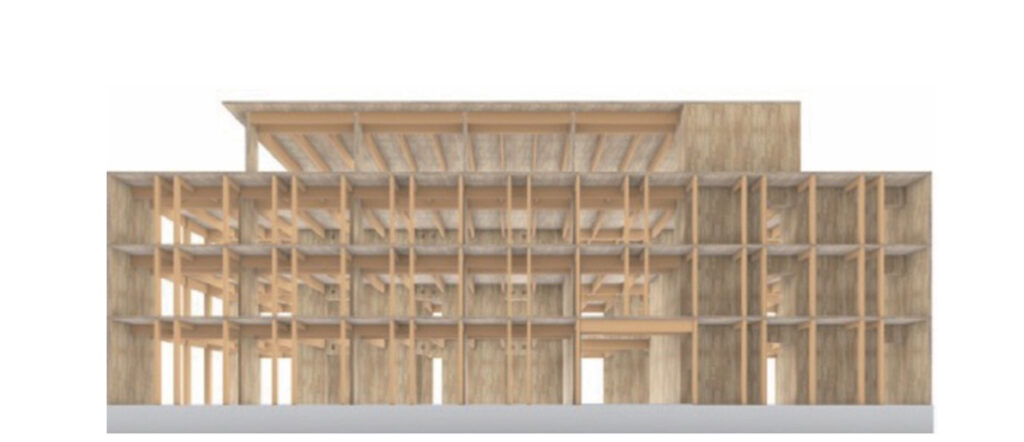
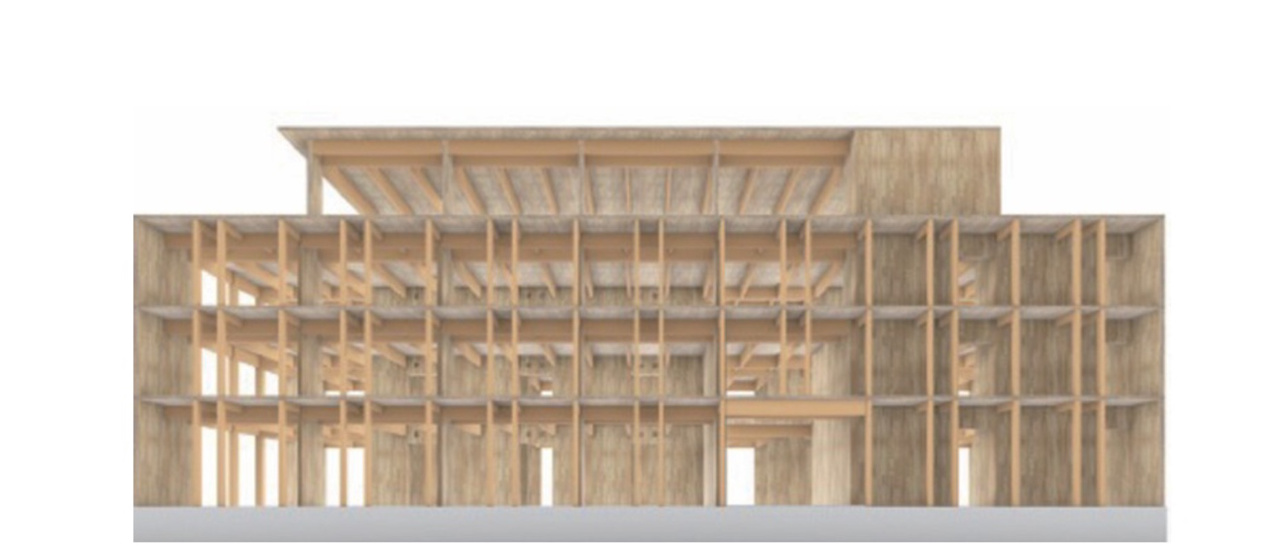
In wood construction, it is easy to shift the work from "fabrication" to "assembly" by assuming factory processing. Pre-cut lumber and CLT panels are mainly for positioning and fixing, and can easily replace some of the skilled skills and on-site judgment. The effectiveness of wood construction depends not on the reduction of workload per se, but on the extent to which processes and roles where labor shortages are concentrated can be replaced at the design and fabrication stages.
The next most important factors are process shortening and simplification of manpower allocation. The more the process is subdivided and the construction period is lengthened, the greater the need for coordination between construction types. If wood construction can be delivered with member accuracy ensured, it is easy to compress the time from erection to completion of the building frame.
Process compression is a prerequisite for turning the entire industry around so that personnel and management resources are not tied up on a single site for long periods of time in the face of ever-increasing labor shortages. In addition, the design of the structure as the actual structural material reduces the number of processes such as interior underlayment, boards, cloth, etc., as the structure also serves as the finish, and the integration of the frame and interior makes it easier to draw out the overall effect of process shortening.
In Japan, there remains a culture of "making adjustments while building" in the construction phase for areas that cannot be fully determined in the design phase, resulting in quality variations, rework, and construction management burdens. Wooden construction is based on factory processing, which makes it easy to determine dimensional accuracy in advance and reduce quality fluctuations.
In addition, it is not only the wood itself that is prone to quality problems, but also the process of layering multiple materials and work types, such as painting and mortar. The process of layering and finishing multiple materials is itself prone to contamination and work that requires adjustments to the surrounding environment. Therefore, the key to quality stability lies in the extent to which the adjustment work that occurs on site and the processes that produce stains can be reduced.
Finally, it is important to keep the process within the scope of construction management's ability to grasp and control the entire process. The labor shortage is not only affecting craftsmen, but also construction management. While workers are increasingly multitasking in such areas as documentation and external coordination, overtime regulations are being strengthened. As a result, the time to make decisions and corrections ahead of time is being lost.
In wood construction, the more organized the processes are, the lighter the burden structure of construction management becomes. If the number of processes and concurrent work types are reduced, the amount of information and the number of times decisions need to be made can be reduced, and the risk of confusion on site can also be reduced. In order for wood construction to spread, it is essential to abandon the assumption that "things can be managed on site," to organize the processes and management targets upstream, and to construct the current construction process within a manageable scope.
The four conditions outlined in this paper are the conditions for the realistic diffusion of wood construction under the constraints of the construction site, and although there are many issues to be discussed, such as the supply system and cost of CLT, the degree of design certainty, and the construction environment in Japan with its frequent rainfall, the building is ultimately realized at the construction site.
In this sense, the four conditions of (1) replacing understaffed processes, (2) compressing processes and personnel, (3) reducing on-site coordination, and (4) ensuring manageability are the minimum feasible conditions from the construction side for wood construction to become the "construction method of choice" in the Japanese construction industry. (Sogo Kato, Forestry Writer, Leaf Rain Co.)