Sawako Miura / photograph
Let's reduce the number of times we "touch" wood, from logs to wood products: Reviewing the multi-stage structure of commercial and logistics flows.
Updated by Yasunao Kobayashi on May 21, 2026, 9:14 PM JST
Yasuhisa KOBAYASHI
Alpha Forum, Inc.
President of Alpha Forum, Inc. and Steering Committee Member of the Platinum Forest Industry Initiative. Ltd. in 2001, taking advantage of the company's venture support program. In September 2023, he received the Wood Use System Research Association Award.
It is said that lumber is a mass of transportation and logistics costs. The logs are cut down from the forest, generally cut into 2 to 4 meter logs, and then gathered at a mountain site where they are loaded onto trucks and trailers that can be driven on public roads and transported to log markets, sawmills, and plywood mills for unloading. During this process, the logs are sorted into A lumber (for sawmilling), B lumber (for plywood), and CD lumber (biomass). The grapple grabs and loads the logs several times for sorting. Before being auctioned at the market, barked logs are grabbed several times by the grapple, and the bark around the center of the log is often stripped off. The figure below shows an overview of the general processing and distribution process, but the supply chain is long before the logs become the final product.
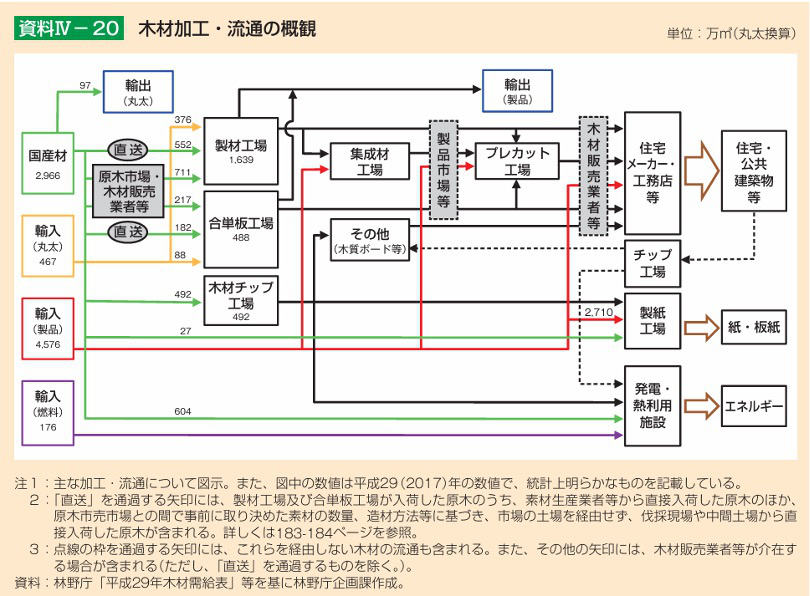
The forestry side wants us to "buy all the material production from the forests...can we have a stable supply of only A lumber, or can you supply us with ● tons of fuel chips every month? But from the forestry industry's point of view, there is a risk of ∽ (proportionally) increasing the amount of labor. By purchasing the entire amount, the logs will also be cheaper.
From a needs-oriented perspective, there is a way to select only the necessary materials for harvesting and to conduct lean material production operations. While this approach is not to hinder or deny this approach, the most efficient way to conduct felling and removal operations is to "produce materials according to the conditions of the forest. Seed-oriented approach is better, in which materials produced by the forest are used without surplus in the area of a prefecture or so.
Direct delivery of only A or B logs is acceptable, but if the C to D logs (thin and knotty) near the top of the tree that cannot be purchased there are sold at the log market, the unit price will be lower. In some cases, when the unit price is low, the consignor (the party that sells the logs to the market) will buy back the logs themselves (ex-fall).
Let us consider commercial distribution separately from logistics. Commercial distribution (purchasing and selling on vouchers) is more likely to be a multi-step process for products after processing, and often passes through multiple companies, including primary wholesalers, secondary wholesalers, and lumber dealers. Why?
Commercial distribution has the function of credit enhancement for sales and purchases. If you sell this product on credit, will you receive the money in the following month? This is the credit function. Wooden house construction can take several months from start of construction to completion, and depending on the cash flow during that time, it may be difficult to settle accounts payable. A construction company with a low credit rating may not be able to purchase materials, which means that the client may not be able to order the construction of the house. Here, it is the wholesaler that has the banking (credit) function. Wholesalers have established credit lines to sell building materials and lumber to construction companies based on their longstanding relationships with construction companies and builders, and they do business within these lines. How much building materials and lumber can the construction companies and builders purchase? The extent to which building materials and lumber can be purchased by construction companies and builders is determined by the wholesalers. The relationship between lumber mills and primary wholesalers, and between primary wholesalers and secondary wholesalers, is basically the same.
The reason for the multi-step process is that there are differences in the volume of timber transactions and solvency of each company as a company.
Few lumber wholesalers continue to purchase from a single large sawmill, but they must be prepared to live with their suppliers as a community of fate. Many wholesalers try not to purchase more than 20% of their lumber from a single supplier, because they believe that if the supplier were to disappear, it would have little impact on their own business. Even if a supplier does not go bankrupt, they must be prepared to stop supplying goods.
The relationship between the forestry industry and sawmills is similar. From the perspective of the forestry industry, the sawmill is a company that buys logs, but at the same time, the sawmill should be considered a forestry company that sells logs to the forestry industry. It is not a question of who is superior or in control, but rather of mutual respect for each other in the cooperative relationship. In the region, forestry cooperatives tend to be the main supplier of materials (logs), but as the production and utilization of local timber is expected to increase in the future, it is likely that relationships with local forestry companies and forest owners will be reconstructed.
We should change our thinking that forestry and the lumber industry are complicated and unfamiliar, that we inherited our forests from our parents and don't need to think about it because we are covered by the forestry cooperative just like our parents... We should change our thinking. Although you may not live near a forest, you should reaffirm your awareness and responsibility as the owner of a forest. The conservation of forests is a public service that also serves as a resource for water source recharge, biodiversity, and tourism in terms of scenery. As a member of the community who owns the local forests, I would like you to participate in the revitalization of the community.
Grab a log, select a tree, grab it again, load it onto a trailer, etc.... How much does it really cost to grab a log once, put it down, and grab it again?
Both logs and wood products are traded at a unit price per cubic meter. For logs, one cubic meter is 50 cm in diameter at the end and 4 m in length. For logs, one cubic meter is equal to four logs with a 25-centimeter end diameter and four meters in length. A heavy equipment called a grapple is used, which requires about 10 liters of diesel oil per hour. There are also maintenance and labor costs for the heavy equipment. According to my calculations, the cost of grabbing the trees once for selection, setting them down, and grabbing them again is 700-900 yen/cubic meter. So this is repeated many times while going through logistics and commercial distribution.
Then, one of the most inexpensive ways for the forestry side to provide this service is to sell it at the mountain landfill. We think it is reasonable to have the entire amount of material produced according to the forest management plan taken from the yamadoba, either without selection or divided into about two types, construction timber and biomass timber. The owner of the forest can sell directly to the consumer for "●● yen. Since forest owners are often amateurs, a person who advises them in the capacity of an asset manager would be present, but the system would allow, for example, sawmills and pre-cut businesses to purchase directly from the owner. The advice is to appropriately inform the forest owner how much money will be left after deducting material production costs (e.g., operation planning, felling, removal, etc.) if the timber is sold for a certain price.
Generally, the logs are bought by a transporter, then wholesalers and others enter the distribution channel, after which the logs are sold to sawmills and others. The pre-cut business buys the logs, the "A" lumber is sold to a sawmill for millwork, and the biomass lumber is sold to a wood chip mill, which should break even. Considering the fact that the actual processing business can earn a 15-20% profit on each log it purchases, and that the number of times it is grabbed by heavy machinery increases, it is possible for pre-cutters to purchase local timber from the raw materials on the mountain soil. Of course, we do not expect this to be a quick transition due to various business practices, but we believe it is a possible form if an asset management person who can grasp the credit and overall cost of the transaction and distribute the profits of those involved functions.
How about assuming a minimum commercial flow to reduce the number of times trees are selected at each location and transshipped to trucks and trailers? We would like to try to minimize travel distance and transshipment.... As a result, more money will remain in the region. (President, Alpha Forum, Inc. and Yasunao Kobayashi, Steering Committee Member, Platinum Forest Industry Initiative)