Regional national universities become hubs for social implementation - addressing local challenges with data and practical experience
Updated by Hiroshi Komiyama on May 22, 2026, 7:04 PM JST
Hiroshi KOMIYAMA
(Platinum Initiative Network, Inc.
After serving as Professor at the University of Tokyo, Dean of the Graduate School of Engineering and Dean of the Faculty of Engineering, and President of the University of Tokyo (28th), he was appointed Chairman of the Mitsubishi Research Institute in 2009, and Chairman of the Platinum Initiative Network in 2010 (to be incorporated as a general incorporated association in 2022). Other positions include President of the STS Forum, Chairman of the Association for Super-Education, Chairman of the United Nations University Cooperation Foundation, Chairman of the International Science and Technology Foundation, and Chairman of the Heat Pump and Thermal Storage Center Foundation. He also received the Dubai Knowledge Award (2017), the Order of the Star of Solidarity of Italy (2007.) and "Information and Communication Month" Commendation from the Minister of Internal Affairs and Communications (2014), the Zaikai Award Special Prize (2016), and the Commendation for Merit in Promoting a Maritime Nation (2016), among many other national and international awards.
I was invited to speak at the Nikkei Regional Development Forum "Creating Wooden Town Development and Realizing Forest Circular Economy" held in Okayama City in March, and experienced firsthand the enthusiasm of top executives from industry, government, academia, and money coming together to face the challenge of social implementation. In these turbulent times, the mission required of local national universities in the future is to become "hubs for social implementation" to solve the problems of local communities. The practices of Okayama University, which incorporates the grand vision of a circular forest economy into its education and human resource development, will serve as a solid model for this mission.
What is the role of universities? When I was in charge of the "Center of Innovation (COI) Program" of the Ministry of Education, Culture, Sports, Science and Technology/JST for 10 years, I strongly encouraged local universities and other institutions to take on challenges by adhering to the policy of "making social implementation the evaluation axis. University autonomy is not a gift from heaven, but something that can only be achieved if society is satisfied with it. The raison d'être of a university can only be realized if the structure of the university as a source of knowledge is put in place so that society can turn to it in times of need. The way for local national universities to survive is to become a university that is trusted by the local community.
How much of an impact can be made when local universities and communities are connected by trust? Let me tell you with concrete numbers.
Hokkaido University collaborated with Iwamizawa City on a project to accumulate, analyze, and utilize personal data on pregnant women. As a result of thorough personalized care based on the data, the percentage of low birthweight babies (under 2500 grams) was reduced from 10.4% to 6.3% in the four years from 2015.
Hirosaki University has succeeded in predicting the onset of diabetes and other diseases three years later with a high degree of accuracy by utilizing a vast amount of health big data, "about 3,000 items per person," accumulated from local residents over the past 20 years. As many as 24 joint research courses were also gathered from companies. By creating a track record of solving local problems, the university gains the trust of the local community, which in turn attracts funds from the private sector. This is the ideal image of a university.
And what I found most promising at the recent forum was that Okayama University is moving forward as a player in the social implementation of "wood-frame urban development and circular economy in forests".
One of the major obstacles to promoting urban wood construction in Okayama and creating demand for local timber is the cost and time required to ensure the strength and fire resistance of the timber. In response, Okayama University is collaborating with Meiken Kogyo, a local company that supplied 70% of the CLT for the Expo's large roof ring, to conduct research on the practical application of a "pure wood fire-resistant structure" that uses only wood to stop fires. In addition, in collaboration with Life Design Kabaya, a downstream company, we are working to create a database of wood species, dimensions, and costs for wooden components based on pre-cut data of wooden buildings. We are trying to connect the supply chain of the forest industry by digitally "visualizing" downstream demand.
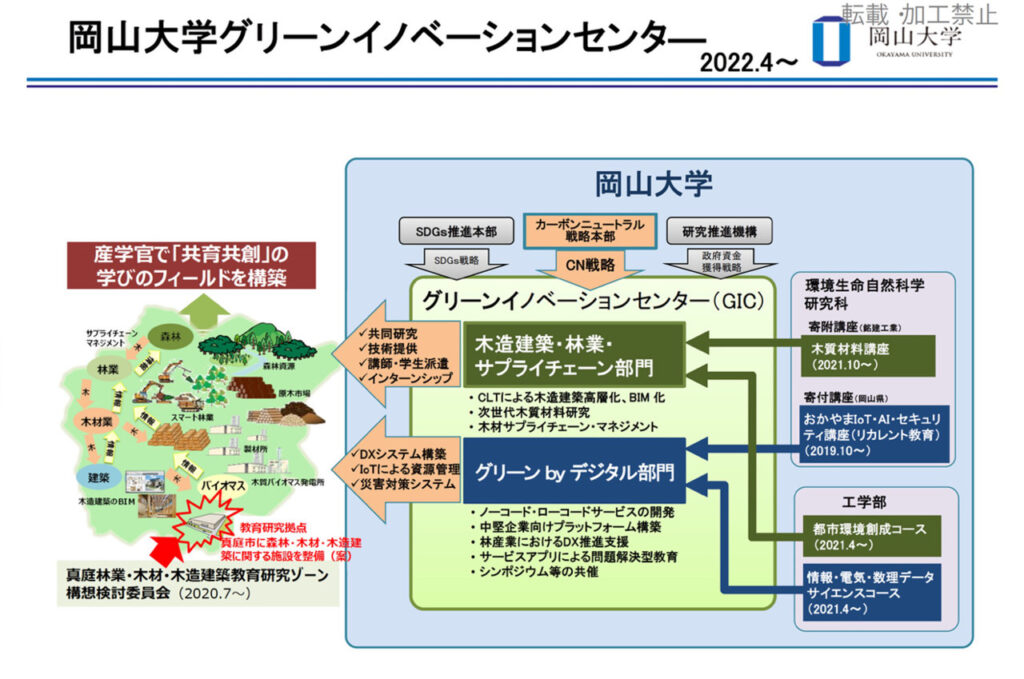
In Maniwa City, a forestry area, a satellite campus will be established in 2025 by improving part of the agricultural training building at the former Okayama Prefectural Maniwa High School Kuse site, which will be closed in 2024. The director and vice president of the Green Innovation Center will also participate in this project, and a system to promote social implementation has been established. The campus will also serve as a center for interaction involving young people and local residents, such as in recurrent education for construction professionals and SDGs education in which food waste is recycled into liquid fertilizer.
Although not internationally renowned, a national university trusted by the local community can serve as a hub for technological development, data utilization, and human resource development, and can lead the way in solving local issues. Okayama is an example of this practice. If all national universities in Japan learn from this model, it will be a solid step toward the revitalization of Japan's regions. (Hiroshi Komiyama, Chairman of Platinum Network and Honorary Editor-in-Chief of "Forest Circular Economy")
*Related Articles
The top executives from industry, government, academia, and academia are determined to create demand and reform the supply chain in order to implement wood-frame urban development in society.
The Okayama Model": Transforming Japan into a Nation Self-Sufficient in Resources and Urban Wood Construction, Challenged by Industry, Government, and Academia [Report on the Symposium on Forest Circular Economy, Part 1
Strong Cooperation among Leading Players in Industry, Government, and Academia to Fully Utilize Okayama's Forest Resources [Forest Circular Economy Symposium Report, Part 2
*Reference link
Green Innovation Center, Okayama University