
Image by Unsplash
Updated by "Forest Circular Economy" Editorial Board on April 01, 2026, 8:52 PM JST
Editorial Board, Forest Circular Economy
Forestcircularity-editor
We aim to realize "Vision 2050: Japan Shines, Forest Circular Economy" promoted by the Platinum Forest Industry Initiative. We will disseminate ideas and initiatives to promote biomass chemistry, realize woody and lumbery communities, and encourage innovation in the forestry industry in order to fully utilize forest resources to decarbonize the economy, strengthen economic security, and create local communities.
*Previous article here
Innovation in Material Production Learning from Austrian Forestry: 2] "Roadside Forestry," which reduces logging costs by reducing the density of forest roads to three times that of Japan
Generally, logs in Japan are transported from the mountainous areas to sawmills via log markets or intermediate landfills. In this process, inspection, stacking, market fees, and repeated transportation costs add up to a total cost of approximately 4,400 yen per cubic meter. Mr. Kuboyama of the Forestry and Forest Products Research Institute of the Forestry Research and Development Institute of the National Institute of Forestry Research and Development (NRIFRI) points out that, "In some cases, the measurement is done three times, costing as much as 2,000 yen. With such high distribution costs, it is not surprising that forest owners receive less money for their timber than they would otherwise receive for the price of a log, which is estimated to be around 12,000 yen. The distribution system is the bottleneck that has discouraged forest owners from managing their forestry businesses and has caused Japan's forestry industry to stagnate.
In contrast, the Austrian log trade is simple and uniform. The standard is "sale at the end of the forest road," with direct delivery to the mill. Instead of multiple stages of distribution as in Japan, a system has been established whereby logs are transported directly from the mountains to sawmills and board mills in truckloads (approximately 27 cubic meters per full trailer) as a basic unit.
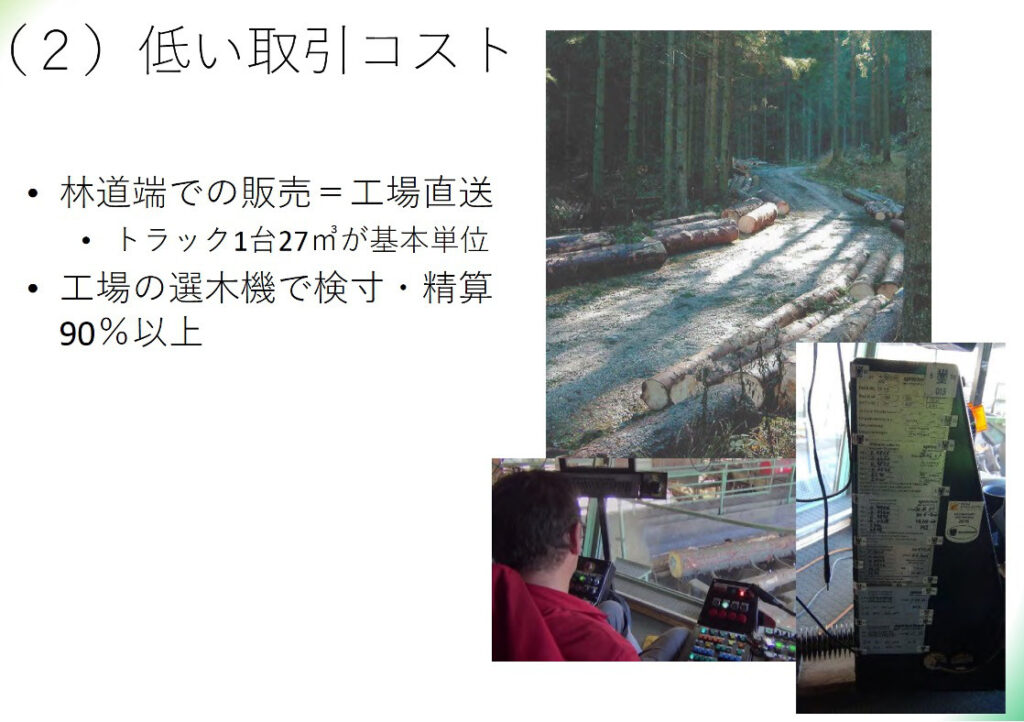
The decisive factor behind this simplification is the "uniformity of inspection. In Austria, more than 90% of logs used for industrial purposes are automatically measured and paid for by a sorting machine at the mill. The sorting machines sort logs by diameter and quality in one-centimeter increments, and the data is used to make payments in a short period of time. To ensure the transparency of the measurement data, which is a concern, the system incorporates "unannounced audits" by a certification body to ensure a high level of trust between the owner and the mill.
Even more interesting is the management approach of forest owners. In some cases, owners ask the forestry cooperative federation (WV) to negotiate on their behalf, while in other cases, it is not uncommon for owners to market directly to mills and develop their own sales outlets in pursuit of higher profits. Mr. Kuboyama analyzes that the owners are very serious about how much they can sell their logs for, and this high level of awareness supports the transparency and efficiency of the distribution process.
Improved transportation efficiency is another major pillar of Austria's competitiveness. In Japan, trucks of about 12 tons (with a payload of about 15 cubic meters) are commonly used on forest roads, but in Austria, "full trailers" with two connections play a leading role. This allows each vehicle to carry 25 to 30 cubic meters of payload, about twice as much as in Japan.
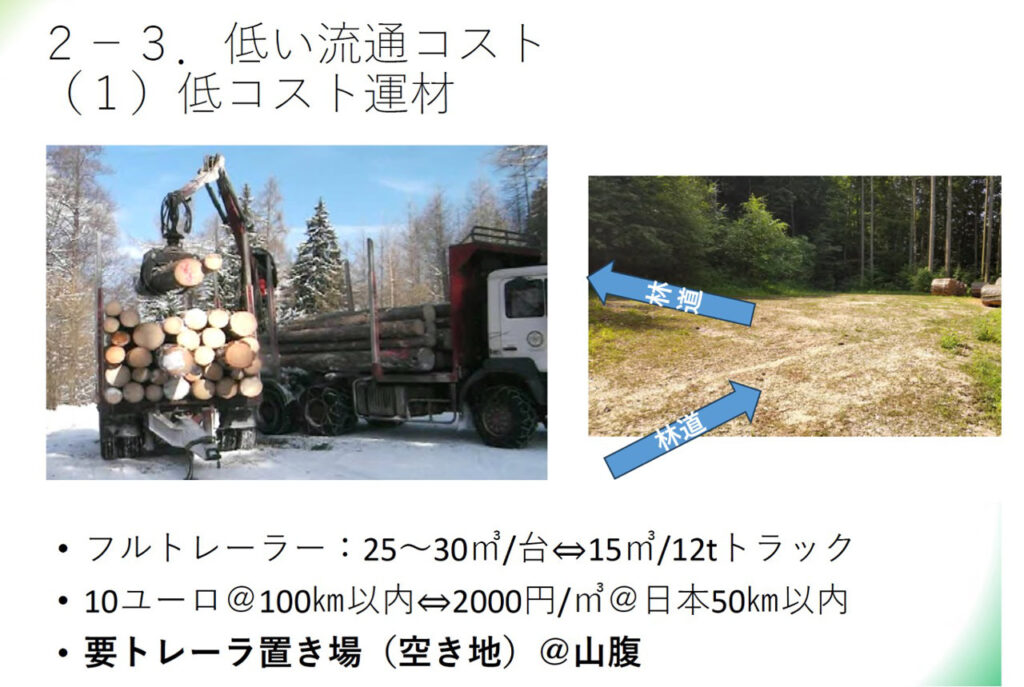
Thanks to more efficient transportation, the cost of transporting materials is kept within 10 euros (about 1,800 yen) within a 100-kilometer radius. Considering that the cost of transporting materials within a 50-km radius in Japan is approximately 2,000 yen/cubic meter, the difference is obvious. Of particular note are the hardware innovations that make the operation of such large vehicles possible. In Austria, vacant lots are designed in advance at curves of forest roads in the mountains to allow trailers to turn around and wait. The fact that such detailed investment in infrastructure has resulted in huge cost reductions in overall logistics is extremely instructive for Japan.
The results of cost reductions in harvesting and distribution are directly linked to the ultimate profit of the forest owner. In Austria, the elimination of waste in distribution has resulted in the maintenance of high prices for standing timber, which provides sufficient income for the owner. This is the source of funds that the owners use for further reinvestment and logging.
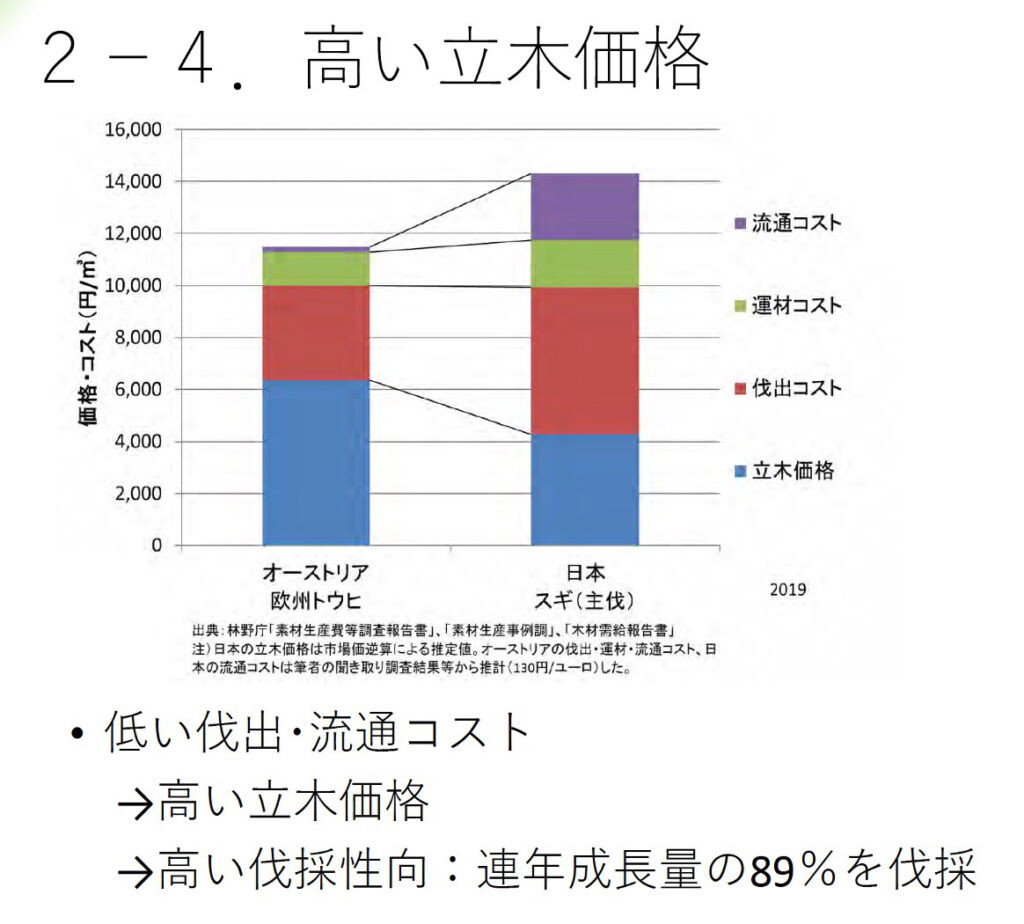
As a result, Austria maintains a high logging propensity, "harvesting 89% of the annual growth. This is an ideal model for recycling resources while utilizing them economically, rather than simply storing them. The cost of afforestation itself is also kept at around 100,000 yen/ha by focusing on natural regeneration, and even when large owners plant trees, the low cost of afforestation and nursery makes it possible for them to operate their businesses successfully.
On the other hand, Austria is not resting on its laurels. In recent years, climate change has exposed the vulnerability of spruce, a key tree species, to global warming, causing extensive damage. As a result, Austria is now promoting the conversion of its spruce forests to broadleaf trees that are closer to the natural vegetation (mixed forests), a trend that Japan cannot afford to ignore.
Mr. Kuboyama asserts that cost reduction is fully possible in Japan. However, he strongly warns that "reducing deer density" is a prerequisite when discussing the reduction of the number of trees planted and the efficiency of integrated operations. The current high cost of deer fences and other protective measures would offset any gains in efficiency.
At the end of his speech, Mr. Kuboyama briefly summarized his expectations for Japan's future.
Now that labor is becoming scarce, we need to dramatically increase labor productivity through innovation. This will allow us to pay the right wages to forestry workers and lower costs at the same time. There is still much room for improvement in Japan, and the potential is extremely high.
What Austria has proven is the value of optimizing forestry as a total system that does not confine itself to work in the mountains, but includes logistics, trade, and even sawmills. Can we implement this process innovation and create a system that returns profits to forest owners? This will be the difference between whether or not Japan's forestry industry can transform itself into a "growth industry.
Yushi Kuboyama's columnthis way (direction close to the speaker or towards the speaker)
■Reference Books
Wood Science Lecture 10: Biomass (Kaiseisha)
Forest Future Conference (Tsukiji Shokan)
Forest Products (Kyoritsu Publishing)