Photo by Kotaro Nagasawa
A cyclical worldview connecting the Jomon, Ainu, and Matagi.
Updated by Kotaro Nagasawa on May 11, 2026, 5:28 PM JST
Kotaro NAGASAWA
(Platinum Initiative Network, Inc.
Born in Tokyo in 1958. Former Senior Managing Executive Officer of Mitsubishi Research Institute. During his tenure, he was mainly engaged in research and studies on infrastructure and social security. During his first few years with the company, he was involved in projects related to flood control, and learned from many experts on river systems at the time to think about the national land on a 100- or 1,000-year scale. Currently, he is an auditor of Jumonji Gakuen Educational Corporation. He is also a part-time lecturer at Tokyo City University. Co-authored "Introduction to Infrastructure" (Nikkei BP, 2017), "New Strategies from the Common Domain" (Diamond, 2021), and "40 Years After the Return" (Heibonsha, 2023). D. (Engineering).
The potential natural vegetation in Japan is considered to be evergreen broad-leaved in southwestern Japan and deciduous broad-leaved in northeastern Japan. The former are also called terrestrial broadleaf forests and gave birth to the "theory of terrestrial broadleaf forest culture.Previous ColumnI touched on this in the following section. So, how have the nature and culture of the deciduous broadleaf forest zone - especially the beech zone - been perceived?
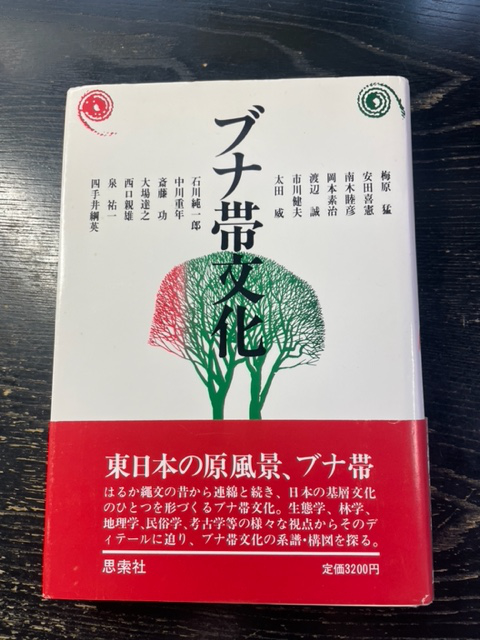
In this issue, we will focus on one of these books, "Beech Belt Culture" (Shisosha 1985). The book is a collection of thirteen small volumes (with one co-authored volume) by fourteen authors, including a philosopher, an environmental archaeologist, a paleobotanist, a plant taxonomist, and an archaeologist. It is presented in the form of a collection of papers. Since it is difficult to summarize the entire book, I would like to focus on two articles that I read with particular interest: Takeshi Umehara's "Deep Culture of Japan: The Worldview of People Living in the Beech Belt" and Yoshinori Yasuda's "Natural History and Civilization of Beech Forests in the East and West. This time, I will focus on the former.
Takeshi Umehara, the author of the first chapter of this book, cites his own book "Deep Japan: Exploring Jomon and Ezo Culture" (Kosei Press, 1983) at the beginning of the book, and states that the Jomon is deep in the heart of Japanese culture. He goes on to say that the Jomon culture remains in the culture of northeastern Japan, especially in the Ainu culture.
Let me quote from Umehara's statement. There was once a "theory of shiny-leaved forest culture," which attempted to understand Japanese culture based on Jomon culture, but I found it somewhat unconvincing. I felt that the Jomon culture was not satisfactory, because although many shiny-leaved forests are found in western Japan, there were very few archaeological sites in western Japan during the Jomon period, and the area was rather underdeveloped. If the Jomon culture flourished in eastern Japan, but there are few evergreen forests in eastern Japan, then the theory of evergreen forest culture cannot function adequately, at least in relation to the theory of Jomon culture. In order to fully develop the theory of Jomon culture, attention should be paid to deciduous broadleaf forests (beech belt) represented by beech and Quercus crispula rather than to evergreen forests.
During the Jomon period, 90% of the population was concentrated in eastern Japan. Jomon remains are overwhelmingly found in eastern Japan. The broad-leaved forest zone in western Japan is dark and humid, making it difficult to live there. In contrast, Umehara says, the deciduous broad-leaved forest zone in eastern Japan was much more advantageous as a place for hunter-gatherers to live. In "Shoyo Jyurin Bunka (Culture of Deciduous Forests)," Tatsuo Kira comments, "How could they have developed such a land (shoyo jyurin-zone)? This is a perfect example of what I am talking about.
The terrestrial forest zone, however, had vast plains and abundant water. That is why, after the arrival of rice paddy cultivation technology, the lands with the lowest productivity until then, such as the Tsukushi Plain and Kawachi Plain, became the richest rice-producing lands. During the 600 years from the 3rd century B.C. to the 3rd century A.D., a reversal of productivity occurred between eastern and western Japan. The development of rice paddies progressed in the humid, flat terrestrial terrestrial forest regions. Umehara believes that paddy rice cultivation areas spread out from southwestern Japan, where the first countries were established, and these countries were merged and unified into the Yamato Imperial Court.
What Umehara pursues is the worldview of the Jomon people. He seeks to understand this in the customs of the Tōhoku and Ainu peoples. Among them, he believes that the Ainu "bear-sending (iyomante)" event may provide the most important key to understanding the Jomon worldview.
Bear sending is a ceremony to send the soul of a bear, the prey of a hunt, to heaven. For the Ainu, the bear is the owner of the same spirit as humans. Their spirits live in a corner of the heavens, separated from human spirits. When they appear on earth, some of the spirits masquerade as bears. Why? To give their flesh to human beings. Umehara interprets animals as beings that appear in disguise with miyage ("body (mi)" + "give (yange)" = "miyange" ≒ "souvenir"). The human who receives its flesh sends its soul back to heaven in a polite ceremony. The soul is then sent back to heaven in a polite ceremony, along with "souvenirs" from the earthly world, such as dumplings, sake, and snacks.
The same is true for trees. Some spirits appear on earth as giant trees. When the Ainu cut down that tree, they pray and thank the tree for its life. Humans in the hunter-gatherer period, rather than in the Jomon period, probably did not think of humans as distinct from other plants and animals. It was probably only after the beginning of agriculture and pastoralism that humans began to think that they had the right to dominate plants and animals, Umehara notes.
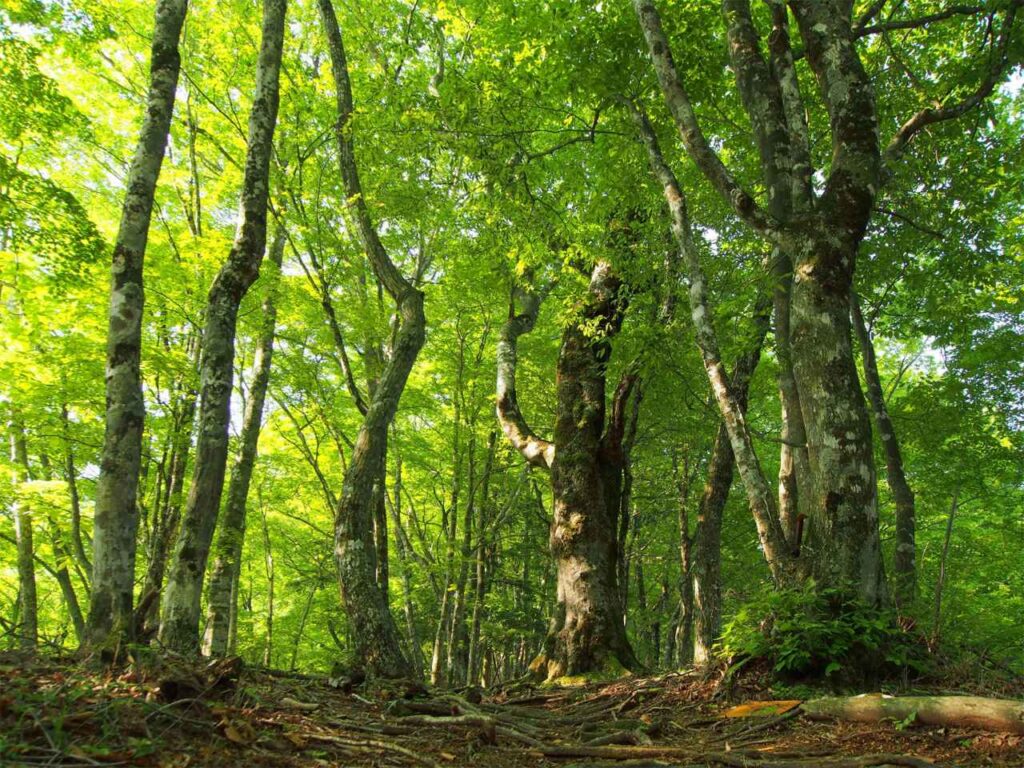
Chapter 7 of this book is "The World of the Matagi" by Junichiro Ishikawa (Folklore). Matagi are people who are engaged in gathering forest products, river fishing, and farming from spring to fall, and hunting exclusively during winter. Their villages were scattered in the beech forests north of the Kanto region. Hunters in the broadleaf forests of southwestern Japan are generally called "hunters. They are engaged in field cultivation, including slash-and-burn farming, during the agricultural season, and hunt in the winter.
Bears are the main prey of matagi. Bears are widespread in the beech forest zone. Ishikawa believes that the primary condition that allows beech forests to support bears is the food they provide (acorns, etc.), and that the lack of wild boars is probably due to the heavy snowfall. Wild boars do not hibernate and cannot survive in heavy snowfall. Wild boars are widely found in shrubby forest zones. Deer and wild boar are the prey of hunters in western Japan.
Bear hunting takes place in early spring. Matagi form groups of 8 to 10 people and stay in the mountains for about 10 days to hunt undisturbed. There are several contraindications to this behavior. For example, a bear with white claw roots is sacred and must not be hunted. If a pregnant bear is caught, a special ritual is performed to ask for forgiveness from the mountain gods. In some areas of the Hokuriku region, hunters who accidentally catch an impregnated bear are required to leave all their hunting gear behind and never pick it up again. In other words, they are out of business in an instant. Ishikawa believes that at the bottom of this rule is the wisdom of resource management that helps and encourages the rebirth of animals.
The authors of this book are unanimous in saying how the beech forest zone is rich in natural food resources. The diverse sources of animal protein include grains (such as Japanese millet), vegetables (such as radishes), wild vegetables, mushrooms, nuts (such as walnuts), fish (such as salmon), and even bears.
In addition to bears, there are animals such as Japanese squirrels and Japanese serows, birds such as golden eagles and bear hawks. Insects such as woodlice and midges, which burrow into dead beech trees, and sowbugs and ground beetles, which live in the soil and decompose fallen leaves, form a complex but unified ecosystem that is part of the world, and humans are a part of it.
Here we return to the writings of Takeshi Umehara. He prefaces this with something that I have not yet fully thought through. I believe that the Beech Belt culture has a worldview in which "everything is cyclical.
In pre-agricultural societies, the worldview would not have differed greatly between the East and West of the earth. This is based on the belief that human beings are essentially the same as animals and plants. In Japan, where agriculture was introduced late, the influence of hunter-gatherer and Jomon culture must have remained for a long time.
Deciduous trees sprout buds in the spring, which turn into green leaves, which bear fruit and fall in the fall. A single tree lives and dies over the course of a year. The Ainu believe that a new sun is born (rises) each morning and dies (sets) in the evening. The spirits of living creatures also come and go between heaven and earth in the cycle of life and death. This is the Jomon worldview and the Beech Belt worldview. The Jomon do not see the world from the perspective of human beings, but rather they see human beings within the great cycles of the world. =Continue to Part 2 (Kotaro Nagasawa, Director, Platinum Initiative Network)
*Honorifics omitted in the text.
*Note: This book was published in 1985, and some of the academic terms and findings in the text are expressions based on the state of research at that time.