


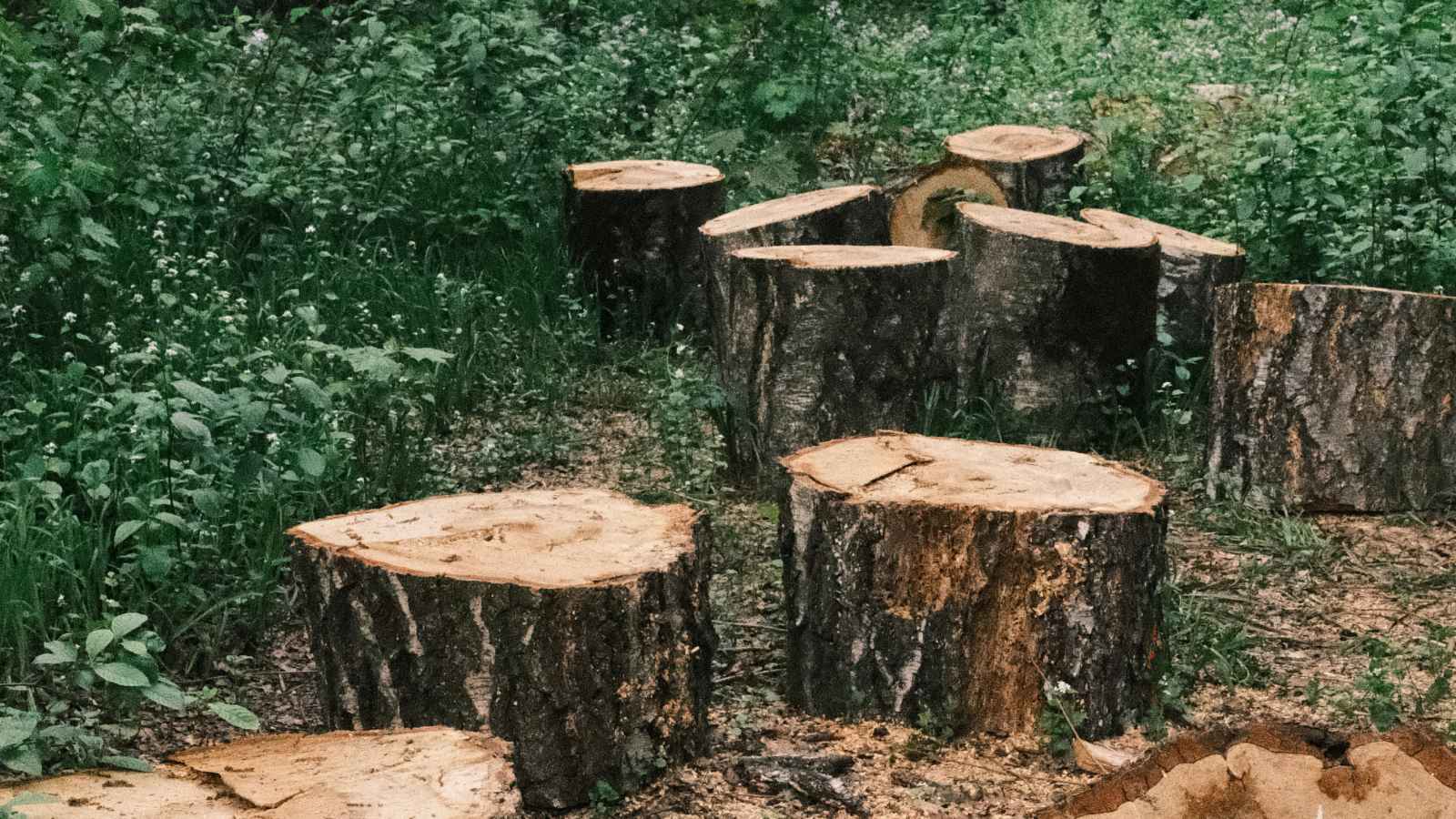
Image by Unsplash
[The Priest’s View] Is a Forest Better Protected the Less It Is Cut? — Rethinking How to Pass on Our Forests 100 Years from Now Through Japan’s New Basic Plan for Forestry
Updated by Kazuhiro Aoki on August 31, 2026, at 8:16 p.m. JST
Kazuhiro AOKI
Representative Director, WSense Corporation / DELTA SENSE Production Committee
Representative Director, WSense Corporation / DELTA SENSE Production Committee Born in Aizuwakamatsu City, Fukushima Prefecture. From a family background of flower arrangement, tea ceremony, and Noh theater, he has been exposed to Japanese culture from an early age. His interest in wood began when he witnessed a shrine carpenter "sharpening a plane" and became aware of the depth of the craft. Currently, based on the knowledge he gained as a Shinto priest, he is promoting initiatives that lead to the public interest. He is a member of the Tokyo Junior Chamber of Commerce, holds a graduate degree and an MBA (Master of Business Administration), and has been a Boy Scout and a soccer player since he was 4 years old.DELTA SENSE Official HP WSense Corporation
When we hear the phrase “protecting the forest,” what comes to mind?
Plant trees. Stop logging. Leave the forest untouched by human hands and let it remain in its natural state.
There is a clear dichotomy here: “Cutting down trees = destroying nature” and “Leaving trees standing = protecting the forest.”
However, when you actually look at Japan’s forests, you see a reality that cannot be explained by these two options alone.
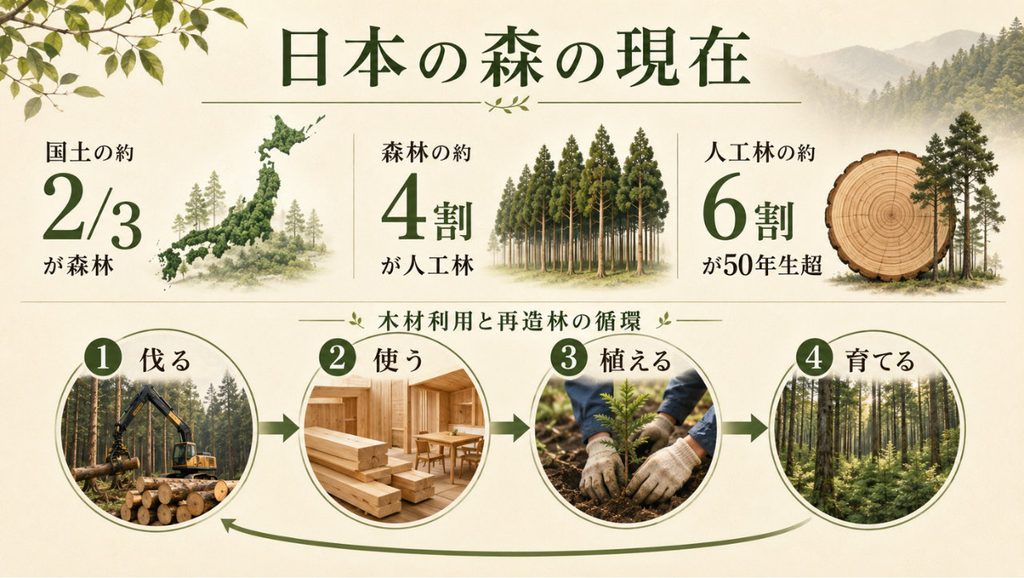
Forests cover about two-thirds of Japan’s land area, and approximately 40 percent of that—about 10.09 million hectares—consists of planted forests. Many of these were established from the postwar period through the era of rapid economic growth, and about 60 percent of them are over 50 years old, having now entered their prime harvesting period.
The new Basic Plan for Forests and Forestry, approved by the Cabinet in June 2026, also set forth the vision of “Toward a ‘Forest Nation and City of Wood’ That Will Last for a Hundred Years.” The plan outlines more than just policies for protecting forests. Rather, it embodies a philosophy of ensuring reforestation in forests suitable for forestry, increasing the supply of domestically produced timber, and fostering a virtuous cycle between timber utilization and the creation of healthy forests.
In other words, we need to use trees in order to protect the forest.
Here lies a small contradiction that challenges our understanding.
Of course, this doesn’t mean that “the more trees we cut down, the better.”
Natural forests, forests important for biodiversity, and planted forests suitable for forestry each play different roles and require different management approaches. The key is not to judge a forest based solely on the single criterion of “whether to harvest it or not.”
As a Shinto priest, I have long reflected on the difference between “leaving something behind” and “passing something on.”
Shinto shrines have a culture of preservation that differs from simply preserving old things as they are.
A prime example of this is the Shikinen Sengū, held once every 20 years at Ise Grand Shrine. During this ceremony, the shrine buildings are rebuilt, and new ceremonial robes and sacred treasures are prepared. Through the repetition of this process, the skills and culture—including those of the shrine carpenters—have been passed down to future generations.
It is precisely because things change form that some things are passed down through the generations.
When we apply this perspective to forests, the meaning of the word “protect” takes on a new significance.
Not cutting down a single tree for 100 years does not necessarily mean that the forest will be preserved 100 years from now.
Conversely, even cutting down trees today can be an act of preserving forests for the future—provided that we then plant new trees, nurture them, and create a forest that can be used again.
So why is it so difficult to achieve a sustainable forest cycle?
There is a management issue here.
Cut down trees. Take them to market. Process them. Use them in construction or to make products.
Even if economic value is generated there, if that value is not reinvested in subsequent reforestation or forest management, the cycle will be broken.
Good intentions alone—such as “Let’s take care of our forests”—are not enough to cover the cost of saplings, labor expenses, or the livelihoods of the people who work there.
Forest sustainability requires not only a guiding philosophy but also a system that ensures the value created is returned to the next generation of forests.
The new Basic Plan for Forests and Forestry also calls for not only reliable reforestation in areas suitable for forestry but also the sharing of information on reforestation costs and the sustainability of forests and timber, as well as the establishment of reasonable pricing.
This means that forestry issues are not only environmental issues but also issues of management and institutional design.
At this point, I’d like to try reframing the question itself.
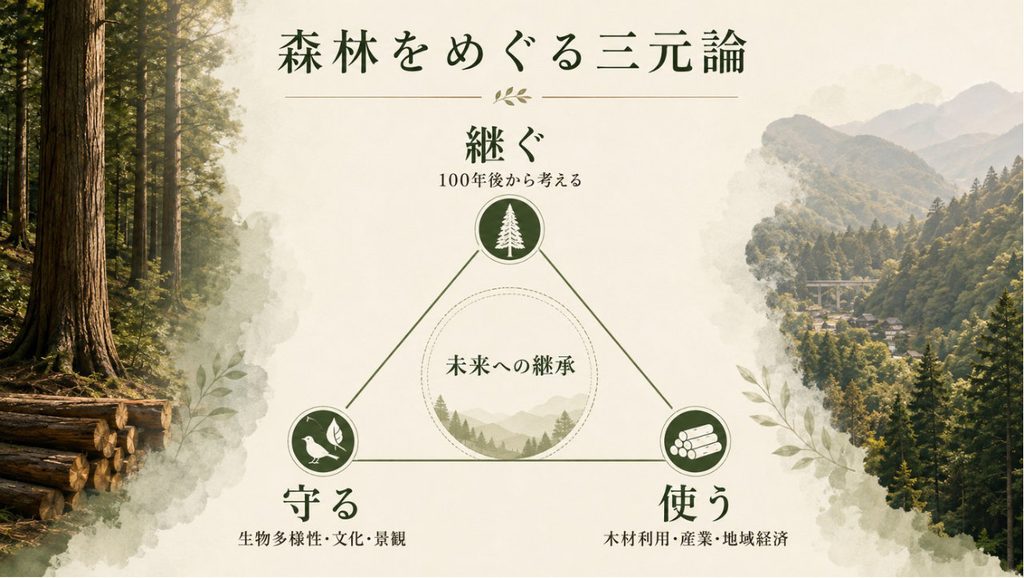
The question isn’t “Should we protect the forest or use it?” but rather, “What kind of forest do we want to pass on 100 years from now?”
Faced with the two choices of “preserve” or “use,” I would like to propose “pass on” as a third perspective.
This does not mean striking a balance between preserving and using.
By looking at the present from 100 years in the future, we reframe both as “means” rather than “ends.”
There are forests that we preserve, leaving them untouched, so that we can pass them on to future generations.
To preserve them for the future, there are forests where trees are cut down, used, and then replanted.
Rather than seeking a compromise between two opposing views, we change the very meaning of the conflict itself by introducing a different timeline or perspective.
I refer to this shift in perspective as “Trinitarianism"We are exploring this from the perspective of..."
The same applies to companies and local governments.
When considering forest-related policies, we must look beyond simply “how much forest we own” and “how much timber we’ve used”; we also need to design these policies to ensure that the value generated by these activities is returned to future forests and communities.
We don't focus on results for a single year; instead, we think in terms of time horizons of 10, 50, and 100 years.
At that moment, the forest ceases to be merely a “resource” or something to be “preserved” and left untouched; instead, it begins to be seen as a relationship to be passed down from one generation to the next.
When we stand before a forest, we can’t help but wonder, “Should we cut it down, or should we not?”
But perhaps what really matters isn't choosing the "right" answer from those two options.
What kind of forest do we want to pass on 100 years from now?
When the question changes, the options you see change.
And as our perceptions change, the future we create will surely change as well.
(President and CEO, WSense Inc. / DELTA SENSE Production Committee, Kazuhiro Aoki)
