


Updated by the Editorial Department of *Forest Circular Economy* on September 15, 2026, at 9:28 p.m. JST
Editorial Board, Forest Circular Economy
Forestcircularity-editor
We aim to realize "Vision 2050: Japan Shines, Forest Circular Economy" promoted by the Platinum Forest Industry Initiative. We will disseminate ideas and initiatives to promote biomass chemistry, realize woody and lumbery communities, and encourage innovation in the forestry industry in order to fully utilize forest resources to decarbonize the economy, strengthen economic security, and create local communities.
In recent years, due to the effects of torrential rains and extreme weather, the risk of sediment-related disasters originating in mountainous areas and forests, damage caused by floating debris, and large-scale wildfires has increased significantly. As disasters become more severe and frequent due to climate change, firefighting efforts are hampered by steep terrain and water shortages, large-scale drifts of driftwood caused by landslides, and the ecological impact of flood control projects—disaster prevention in mountainous and forested areas faces complex challenges. Consequently, government agencies, businesses, and NGOs are working to improve regulatory frameworks, introduce new technologies, and develop approaches that leverage the functions of natural ecosystems. From the Ministry of Land, Infrastructure, Transport and Tourism’s acceleration of “watershed-based flood control” to the presentation of case studies on disaster prevention and mitigation that utilize ecosystems, the development of products to counter driftwood installed on erosion control dams, and the supply and research of fire retardants that quickly contain forest fires—practices that balance forest conservation with ensuring regional safety are emerging one after another across the country.
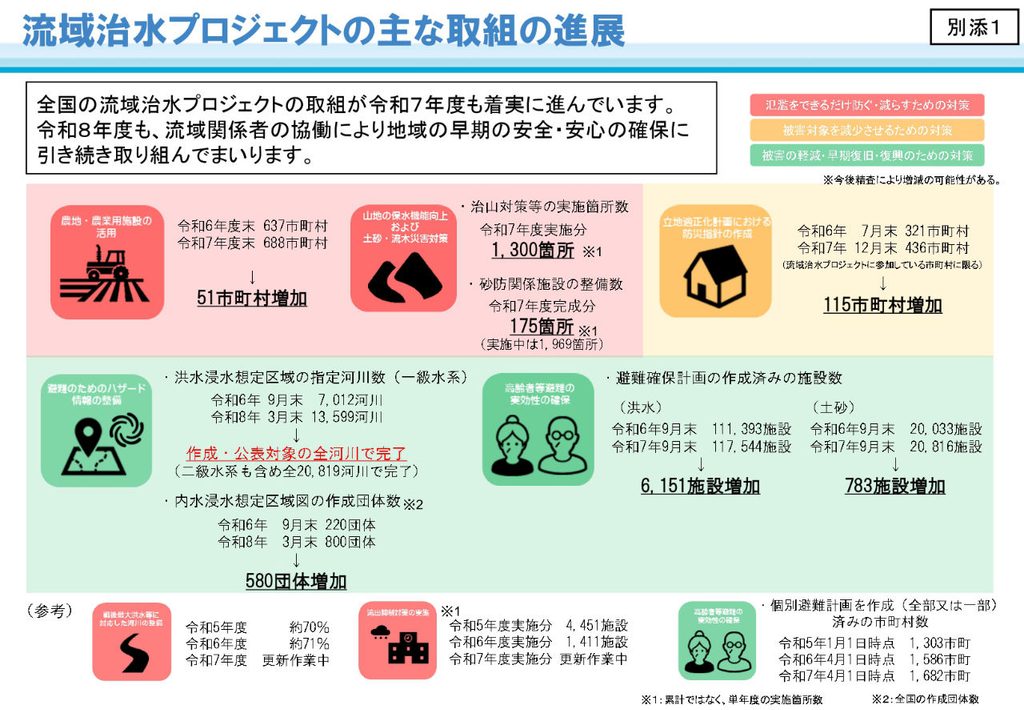
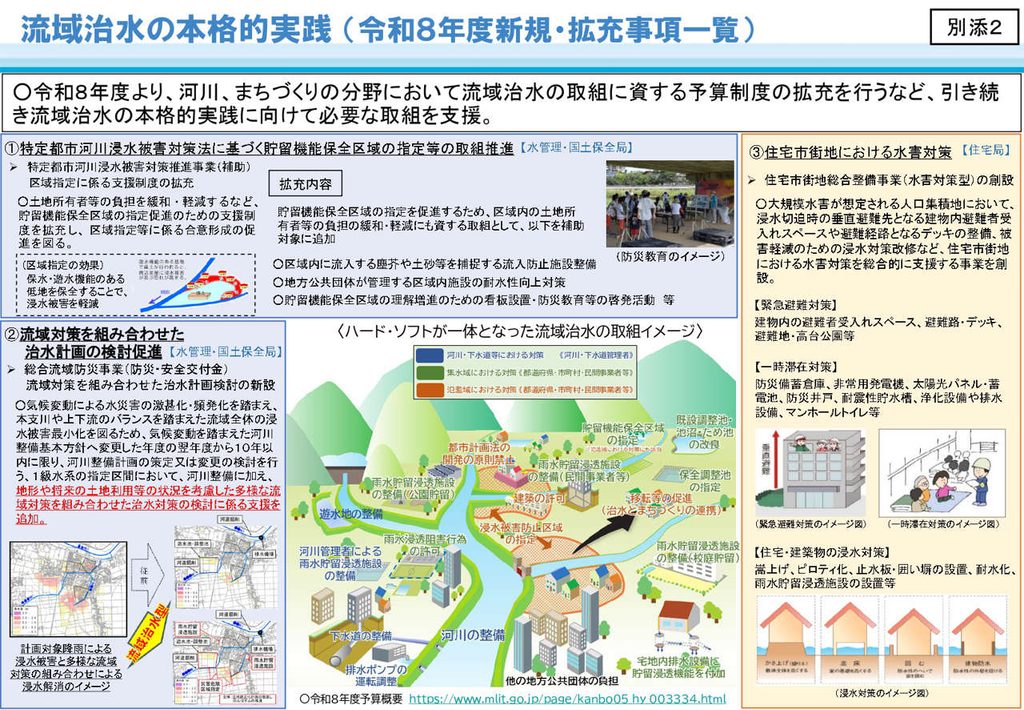
In April, the Ministry of Land, Infrastructure, Transport and Tourism announced the progress made in the Reiwa 7 fiscal year on the nationwide river basin flood control projects it is promoting, as well as its policy for accelerating these efforts starting in the Reiwa 8 fiscal year and beyond. “River basin flood control” refers to efforts in which not only river administrators but also local governments, businesses, residents, and all other stakeholders involved in the river basin collaborate to mitigate flood damage in an integrated manner, from the catchment area to the floodplain. To eliminate gaps in flood risk information, the creation and publication of flood inundation simulation zones—which had been underway based on the 2021 amendment to the Flood Control Act—were completed as planned for all 20,819 Class 1 and Class 2 rivers nationwide where residential and other structures requiring protection are located. Efforts to deepen both hardware and software measures are progressing. In addition to newly designating 88 rivers across 12 river systems—including the Shinano and Arakawa river systems—as “Specified Urban Rivers,” where comprehensive flood countermeasures are implemented across the entire watershed, “Watershed Flood Control Plans” were formulated for 46 rivers across four river systems. As part of flood control measures, preemptive releases were carried out at a total of 41 dams nationwide. Furthermore, draft guidelines for “flood sensors,” which monitor flooding conditions in real time, have been prepared, and demonstration tests are continuing in 233 municipalities nationwide. In Shimonoseki City, Yamaguchi Prefecture, a new project was launched to prioritize the maintenance of erosion control facilities in order to promote disaster-resilient urban development that takes into account the risk of sediment-related disasters. In terms of soft measures, a total of 10 new entries—6 “Excellent” designations and 4 “Certified” designations—were selected for the “NIPPON Disaster Prevention Assets” program, which recognizes activities that convey lessons learned and memories of disasters. Starting this fiscal year, the government plans to expand and establish budgetary systems to support rainwater retention and innovative land use practices within river basins, and is holding working-level meetings with relevant ministries and agencies to strengthen government-wide coordination.
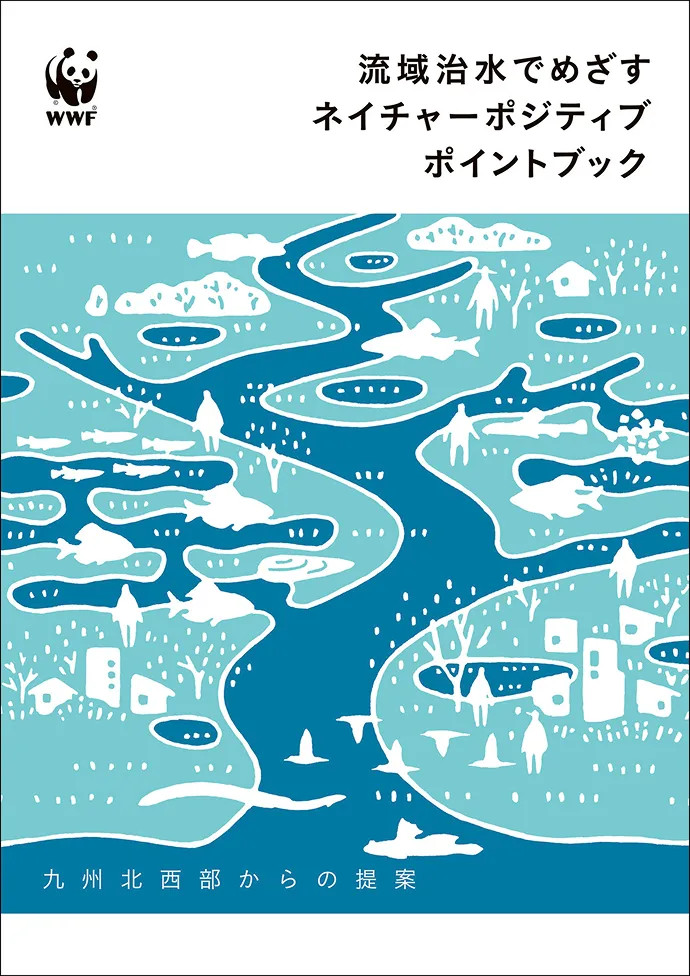
The World Wide Fund for Nature Japan (WWF Japan), a public interest incorporated foundation, in collaboration with Kyushu University, Nagasaki University, and the Fukuoka Prefectural Institute of Public Health and Environment, published *A Nature-Positive Point Book: Aiming for Flood Control in River Basins—Proposals from Northwestern Kyushu* in April. Based on the results of this joint research, the publication systematizes insights on how to simultaneously advance flood control, disaster prevention, and biodiversity conservation. From the perspective of “NbS (Nature-based Solutions),” which balances disaster risk reduction and environmental conservation by leveraging the functions of healthy natural ecosystems, the publication compiles 12 practical case studies from northwestern Kyushu. It presents an approach covering the entire watershed—including forests, farmland, and rivers—and introduces watershed flood control initiatives that take into account local history, topography, and ecosystems, such as the rice paddy dams in the Chikugo River basin and the floodplain areas along the Matsuura River. As water-related disasters become more severe due to climate change, this study—serving as a practical model that encourages a shift from conventional, infrastructure-centric measures to disaster prevention that restores and harmonizes with the natural environment—is likely to provide important insights into the future of watershed flood control and regional disaster prevention.
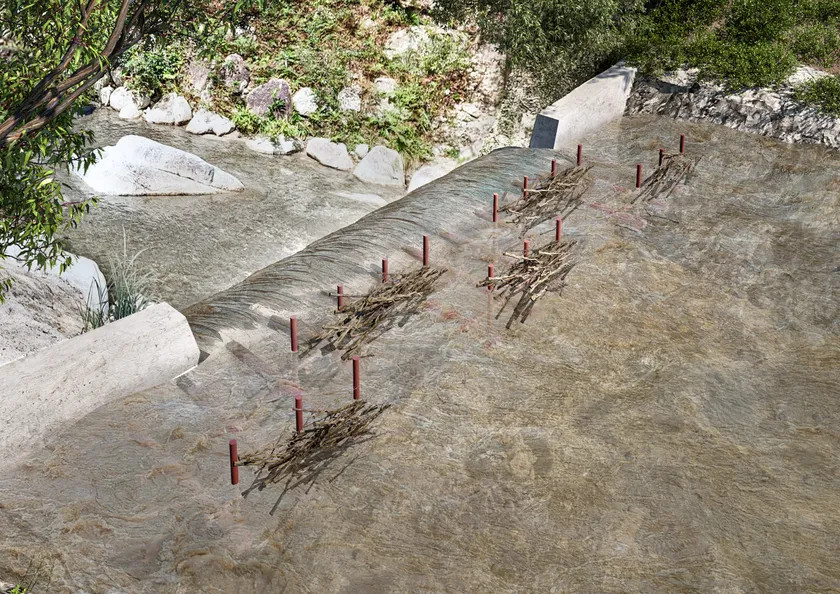
Protech Engineering, a manufacturer of disaster prevention products, launched the “RB Catcher” in May to mitigate damage caused by floating debris during heavy rain events. It is installed directly upstream of impermeable erosion control dams to enhance their ability to capture floating debris. While conventional linear arrangements have faced challenges such as water level rise and overtopping due to clogging, the RB Catcher employs a configuration with gaps between units. By ensuring a clear path for water flow, it suppresses blockages and water level rise caused by driftwood. It reliably continues to capture subsequent driftwood, preventing it from overflowing downstream. Another key feature is that it does not require large-scale renovation work and can be retrofitted not only to new but also to existing check dams. Since large quantities of driftwood washed away by landslides caused by heavy rains are a major factor in bridge blockages and river flooding in downstream areas, the RB Catcher is expected to contribute to disaster prevention and mitigation as a physical flood control measure for river basins.
*Reference link
New Product Launched to Enhance Driftwood Countermeasures for Erosion Control Structures | Protec Engineering Co., Ltd.
Faitec, a manufacturer of firefighting chemicals, donated 500 liters of “FOREST DEFENDER,” a fire suppressant designed for forest fires, to the Kamaishi-Otsuchi District Administrative Association Fire Department as initial emergency support for a forest fire that broke out in Otsuchi Town, Iwate Prefecture. This emergency response was based on the company’s past experience providing support for forest fires in Ofunato City, Iwate Prefecture. Faitec supported the rapid on-site deployment of the agent by conducting a training session on its handling procedures at the local fire station immediately after delivery. This fire suppressant is designed to be diluted with water to a concentration of 1–6% before spraying; its performance remains unchanged whether diluted with fresh water or seawater, and it can be used for aerial firefighting by the Self-Defense Forces and disaster response helicopters. It is also characterized by its ability to form effective firebreaks due to its high flame-retardant properties, as well as its minimal impact on the soil and surrounding ecosystems, achieved by a composition similar to fertilizer that contains no surfactants or PFAS (per- and polyfluoroalkyl substances). The forest fire that broke out in Otsuchi Town on April 22 was extinguished on May 29, but the final burned area expanded to 1,633 hectares. In mountainous areas, securing the equipment and materials necessary to prevent the spread of fire and re-ignition is key to minimizing damage.
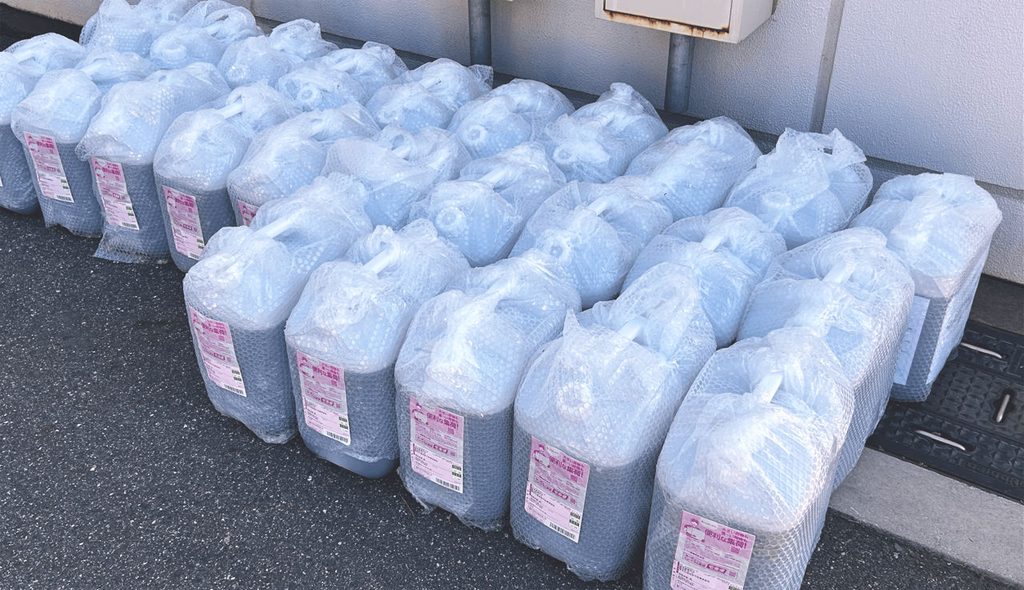
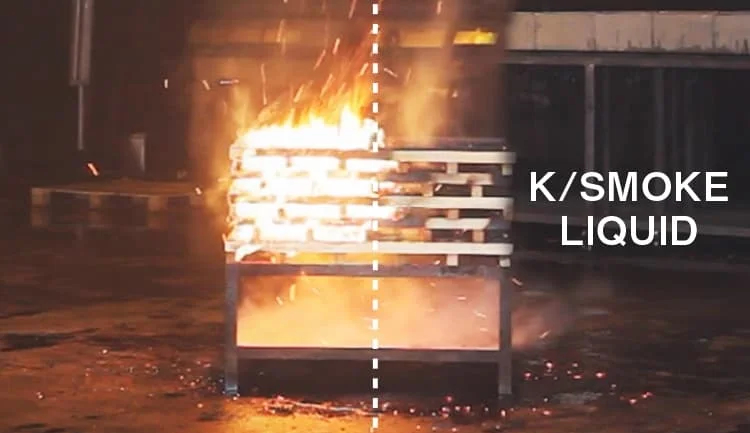
A research project proposed by Yamato Protec, a comprehensive disaster prevention manufacturer—titled “Study on Improving the Fire Extinguishing and Fire Suppression Effects of Fire Suppressants for Forest and Wildland Fires”—has been selected for the Fire and Disaster Management Agency’s “Reiwa 8 Fiscal Year Fire and Disaster Prevention Science and Technology Research Promotion Program (Emergency Category).” The project will utilize the fire extinguishing agent “K/SMOKE LIQUID,” developed by the company, to verify improvements in fire extinguishing performance and fire spread suppression. The agent consists of three main components—water, potassium, and phosphorus—and the adhered phosphorus continuously prevents reignition. Once large-scale forest and wildland fires break out, they are difficult to control and cause immense damage to local communities and the natural environment. In addition to the extreme difficulty of accessing the site and securing water for firefighting, forest and wildland fires present challenges such as loss during aerial spraying, reignition after the fire is extinguished, and the environmental impact on soil and ecosystems caused by the application of fire suppressants. By focusing on naturally occurring components, this technology is expected to minimize environmental impact while improving the efficiency of aerial firefighting operations—such as those conducted by helicopters—and thereby establish a fire suppression method capable of rapidly halting the spread of fires.
*Reference link
Research Begins on Firefighting Technology Using “K/SMOKE LIQUID” to Combat Large-Scale Forest Fires | Yamato Protec Co., Ltd.
