Making Full Use of Forest Resources to Develop Local Industries
Updated by Taro Kamagata on October 5, 2026, at 8:09 p.m. JST
Taro KAMAGATA
(Platinum Initiative Network, Inc.
After graduating from Keio University with a degree in economics in 1982, he joined Toppan Printing Co. In 1988, he moved to Mitsubishi Research Institute, where he was in charge of urban and regional management and public-private partnerships (PPP, PFI, etc.). He later became an executive officer and served as Director of the Regional Management Research Division, Director of the Platinum Society Research Division, and Managing Executive Officer and General Manager of the Research and Development Division, etc. He was seconded to Mitsubishi Research Institute DCS as Senior Managing Director in 2018, retired as an officer of Mitsubishi Research Institute in 2021, and became an advisor to Platinum Initiative Network in 2022. Leader of the Secretariat of the Platinum Forest Industry Initiative.
Japan’s forests are currently at a major turning point. While challenges such as a decline in the workforce in the forestry and lumber industries, stagnation in forest management, and population decline in mountainous and rural areas are becoming increasingly apparent, new expectations for forest resources are also growing—including decarbonization, economic security, the expansion of non-residential wood-frame construction, and biomass chemistry.
With an eye toward 2050, the Platinum Vision Network has been working to realize a forestry and timber industry that grows in a sustainable and self-sufficient manner, as well as forests that are sustainable and possess diverse functions. One of the key initiatives currently under consideration is the “Forest Resource Full Utilization Business Model,” which aims to make full use of local forest resources.
The key feature of the model for fully utilizing forest resources is that it views not only the production of timber from forests but also the entire process—from “planting, growing, harvesting, collecting, using, and recycling”—as a single regional industry.
At the heart of this system is the “stockyard,” where logs produced in the region are collected. The stockyard receives all logs hauled out of the forest, sorts them according to their intended use and quality, and distributes them for use as construction lumber, wood biomass, and even chemical raw materials. Through this process, we aim to enhance the overall value of forest resources by utilizing even low-grade wood, offcuts, and byproducts—materials that were previously difficult to utilize fully.
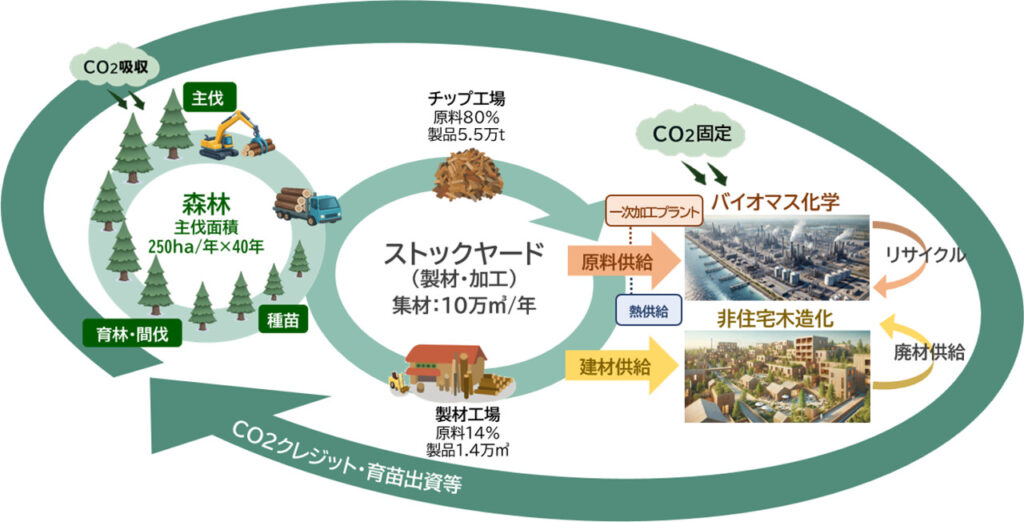
The Platinum Initiative Network is examining this system as a business model that organizes these activities into sectors such as “seedlings and saplings,” “forest cultivation,” “raw material production,” “stockyards,” and “heat supply and biomass chemistry,” while also incorporating the cross-cutting mechanisms of “logistics” and “forest funds.” The key is not simply to produce timber, but to design the entire supply chain from upstream to downstream.
In this model, the baseline case under consideration is a stockyard that handles approximately 100,000 cubic meters of logs per year.
In our analysis to date, we have compared factors such as production feasibility, local demand, CO₂ emissions from transportation, employment, and equipment efficiency across multiple production scales—including 10,000 cubic meters, 50,000 cubic meters, 100,000 cubic meters, and 250,000 cubic meters. As a result, a scale of approximately 100,000 cubic meters per year has been identified as one that allows for a combination of construction materials and energy/biomass utilization while ensuring a certain level of processing efficiency.
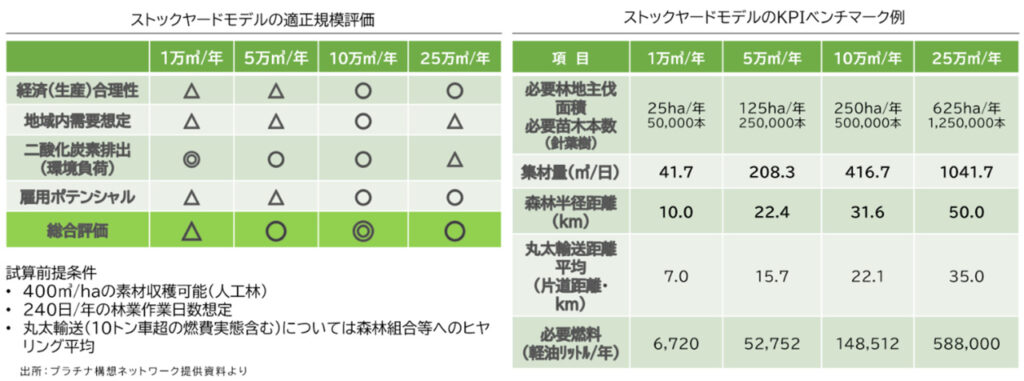
That said, the figure of “100,000 cubic meters” is not intended to be applied uniformly across the country. In reality, factors such as forest resource volume, topography, road conditions, existing sawmilling and processing facilities, timber demand, and transportation distances vary from region to region. Therefore, while using 100,000 cubic meters as a benchmark, it is important to consider the scale and supply chain best suited to each region.
That is why feasibility studies (FS) will become increasingly important going forward.
To launch a project that fully utilizes forest resources in a specific region, it is not enough to simply determine “how much forest resources the region has.” Which forests can provide a stable supply of logs, and in what quantities? What are the costs associated with logging and hauling? Where is the most efficient location for a stockyard? And who can utilize the collected timber—and in what quantities—for construction, energy, chemical raw materials, and other purposes? It is necessary to assess all of these factors holistically.
In FS, we proceed with our analysis in four main stages. First, we assess the region’s forest resource volume, existing supply chains, and raw material production costs to identify the underlying challenges. Next, we examine the appropriate scale, location, and necessary functions of a stockyard for that region. Based on this, we conduct interviews with both the log supply side and the demand side to confirm actual supply-and-demand conditions and identify potential business operators. Finally, taking all of this into account, we develop a business income and expenditure plan and a business framework, and draw up a roadmap for commercialization.
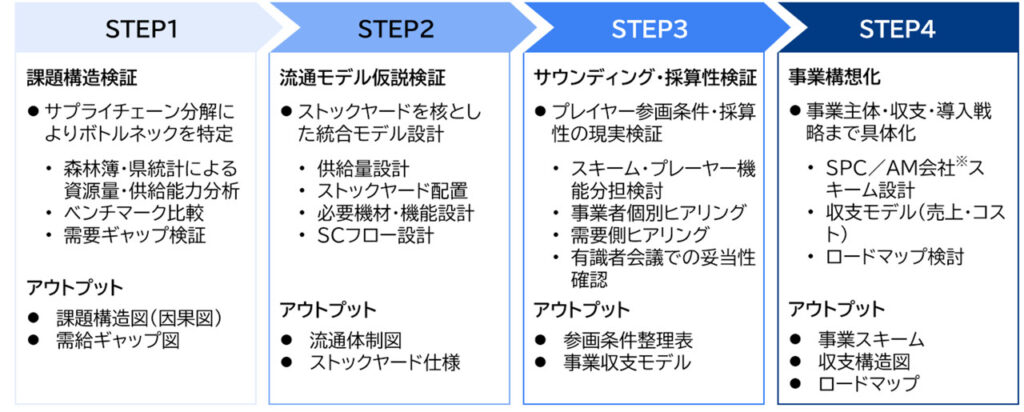
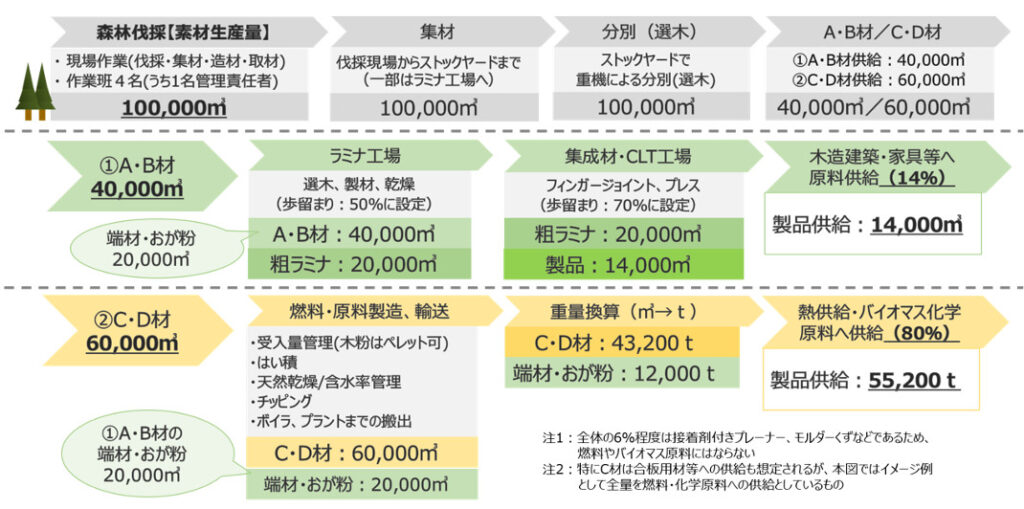
In other words, FS is not merely a survey of forest resource volumes. It is a process that quantifies and visualizes “where resources are located, how much is available, who uses them, for what purposes, and in what quantities,” thereby concretizing the shape of industries based on regional forest resources. The example of a supply chain handling 100,000 cubic meters annually demonstrates an approach that links the entire process—from logging and skidding to log sorting, sawmilling, chipping, and on to wood construction and biomass utilization—in quantitative terms, thereby allowing for a comprehensive assessment of forests and demand as an integrated whole.
The goal of the “Full Utilization of Forest Resources” business model is not merely to increase timber sales. It aims to redefine forests as a sustainable industrial foundation for local communities by integrating forest management, reforestation, timber utilization, local energy, biomass chemistry, logistics, and even the carbon sequestration value of forests and financial aspects. No two regions are exactly alike. That is precisely why it is necessary to first conduct feasibility studies (FS) for each region and establish concrete links between forest resources, demand, businesses, infrastructure, and funding. We will create business models that enable the circular use of forest resources in each individual region and then roll them out across the country. We believe that this cumulative effort will lead to the formation of a “forest circular economy”—one in which we protect forests while using them, and in turn, nurture them anew through that very use. (Taro Kamagata, Advisor to the Platinum Vision Network)
*This article is from the Platinum Initiative Network's“Vision 2050: A Thriving Japan Through a Forest Circular Economy” — Promotion Strategy and Roadmap for Realizing the Vision —Created based on .
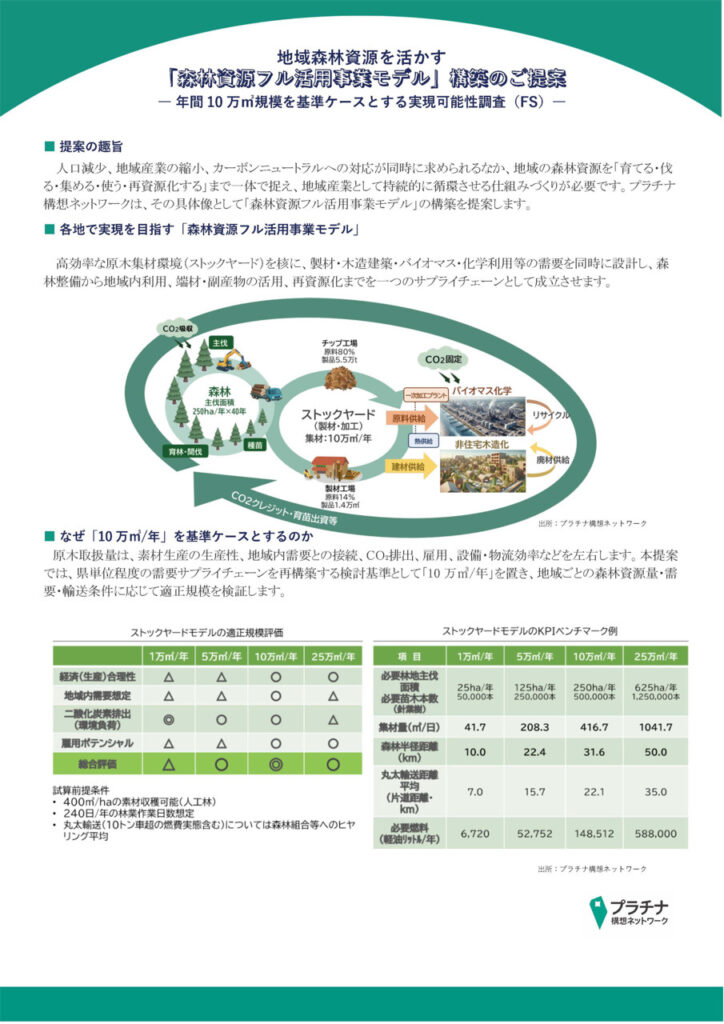
*To download the proposal for the “Feasibility Study (FS) on a Model Project for the Full Utilization of Forest Resources,”Click here