


Image by Unsplash
Updated by the Editorial Department of *Forest Circular Economy* on October 22, 2026, at 9:00 PM JST
Editorial Board, Forest Circular Economy
Forestcircularity-editor
We aim to realize "Vision 2050: Japan Shines, Forest Circular Economy" promoted by the Platinum Forest Industry Initiative. We will disseminate ideas and initiatives to promote biomass chemistry, realize woody and lumbery communities, and encourage innovation in the forestry industry in order to fully utilize forest resources to decarbonize the economy, strengthen economic security, and create local communities.
In recent years, against the backdrop of growing interest in achieving a decarbonized society and promoting well-being, there has been increasing attention on the use of wood and wood-based materials in building construction. At the same time, information regarding leading examples, technologies, and policies—specifically on how the adoption of wood construction is actually progressing in mid- to high-rise apartment buildings, company housing, and employee welfare facilities—is scattered across various media, making it difficult to gain a systematic understanding of the situation.
In this document, the “Platinum Forest Industry Initiative—Wooden Cities Subcommittee” of the Platinum Vision Network, a general incorporated association, has compiled four leading case studies and technologies related to wooden housing and employee welfare facilities, along with concepts, technologies, and institutional trends regarding wooden cities. Please use this document as a resource for planning and proposal development, information gathering, and staying informed about the latest trends in wooden construction and the increased use of wood.
We have systematically organized information that is useful for practical work in wood-frame construction.
・Leading Examples of Wooden Homes and Employee Welfare Facilities
・Technologies and construction methods used in wood-frame construction
・The Concept and Future Vision of a Wooden City
・Overview of Programs and Subsidies to Promote Wooden Construction
・Latest Trends in Wooden Construction
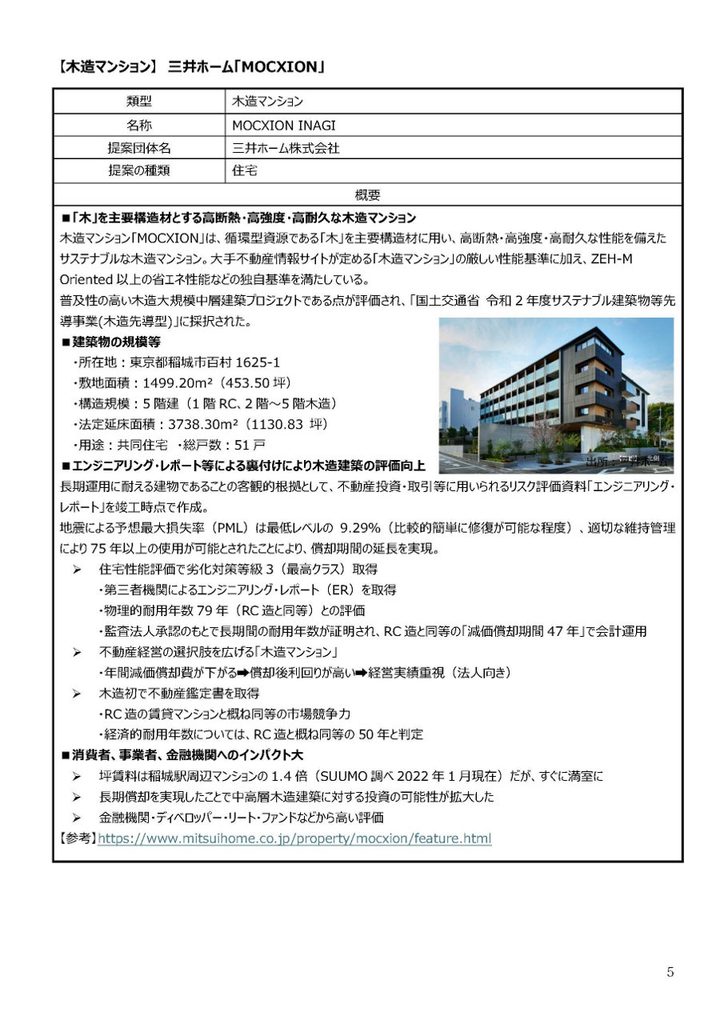
This section highlights cutting-edge projects and technologies in wooden housing and welfare facilities, introducing their respective features, the technologies employed, and key evaluation points.
MOCXION INAGI (Mitsui Home Co., Ltd.)
A five-story wooden apartment building with a reinforced concrete (RC) first floor and wooden floors from the second through fifth floors. It features high thermal insulation, high strength, and high durability, and has been certified as Deterioration Prevention Grade 3. With a physical service life assessed at 79 years, the building has achieved an accounting treatment that sets the depreciation period at 47 years—equivalent to that of reinforced concrete structures. Furthermore, the asset value and marketability of this wooden apartment building have been verified, as evidenced by the acquisition of a real estate appraisal report specifically for a wooden structure.
Research, Development, Design, and Construction of Wooden Houses and CLT Buildings (Life Design Kabaya Co., Ltd.)
This is an example of an initiative to promote CLT construction nationwide by leveraging the company’s track record in the housing business, where it builds 1,000 homes annually. The company established the “Japan CLT Technology Research Institute (NCL)” and has developed proprietary construction methods for non-residential buildings, as well as a unique residential construction method that incorporates CLT load-bearing walls into traditional timber-frame construction. It is actively pursuing research and development through industry-academia collaboration, as well as obtaining construction method evaluations and ministerial certifications regarding fire resistance and durability.
Wooden Cafeteria Building at a Factory (Daiwa House Industry Co., Ltd.)
Here, we showcase our projects featuring wooden cafeteria buildings and cafeteria buildings combining wood and reinforced concrete (RC) construction in factory settings. We aim to alleviate work-related fatigue through the relaxing and rejuvenating effects of wood, thereby providing the energy needed for the next task. At the same time, by creating open, wood-filled spaces in areas where many people gather, we strive to foster interaction.
Midori Company Housing Project (Sumitomo Forestry Co., Ltd.)
A six-story mixed-structure company housing complex built in Tsukuba City, Ibaraki Prefecture, featuring a reinforced concrete (RC) central section and wooden sections at both ends. All structural lumber used in the wooden sections is domestically sourced. The total volume of wood used is 322 cubic meters, and the carbon sequestration amount is 267 t-CO2e bio. The building has achieved BELS ★6 and Nearly ZEH-M ratings, aiming to reduce CO2 emissions both during construction and occupancy.
・For those looking for case studies of wooden homes and employee welfare facilities
・Individuals responsible for planning and proposing apartment complexes, company housing, and employee welfare facilities
・Those who want to stay up to date on the latest trends in wooden cities and medium- to large-scale wooden buildings
・Practitioners from developers, housing companies, general contractors, architectural firms, and wood-related companies
・Researchers and students studying timber-frame construction and urban timber construction
Part 1: Design and Construction Case Studies of Wooden Houses and Welfare Facilities
We highlight cutting-edge wooden homes and employee welfare facilities, introducing their architectural concepts, features, and technical highlights.
Part 2: Basics of Wooden Cities
・What Is a Wooden City?
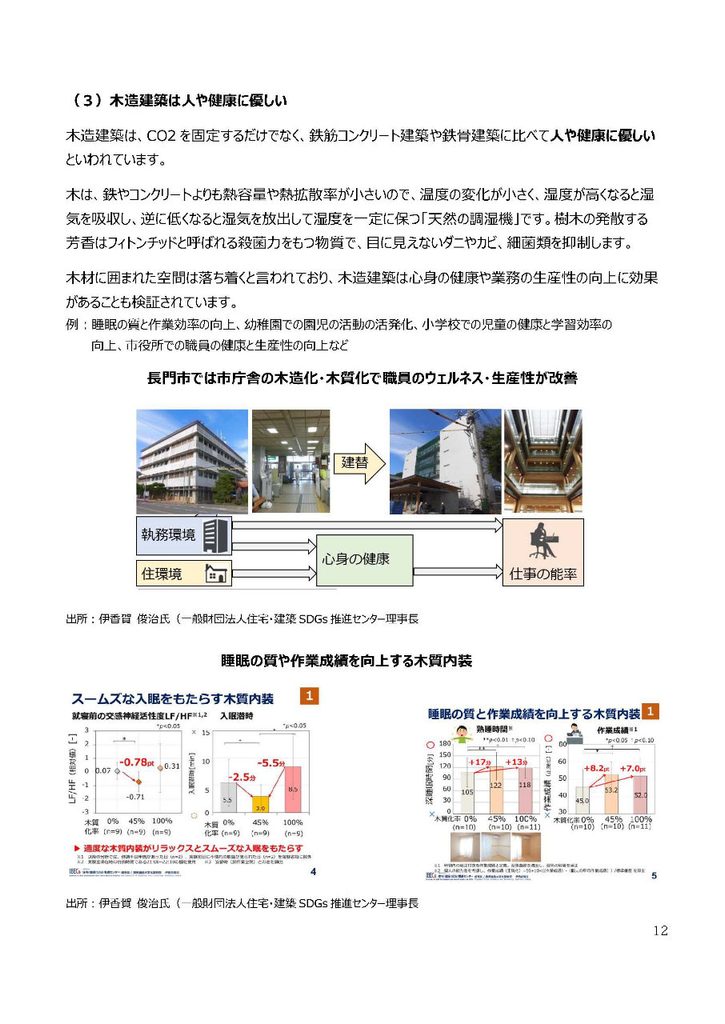
・The Significance of a Wooden City
・Technological Advances and Institutional Support
・The Wooden City That Came to Life
・Creating a wooden city with a sense of spatial expansiveness
You can download the materials for free. Please click the button above, fill out the form with the required information, and submit it.
The URL for the download page and the password will be displayed on the "Send Complete" screen.
[Document Overview]
Format: PDF
Number of pages: 23 pages
Fee: Free
Published by: Platinum Vision Network (General Incorporated Association), Platinum Forest Industry Initiative, Wooden Cities Subcommittee
In addition, we will send registered users a free newsletter from “Forest Circular Economy” that bridges policy, industry, technology, and culture. Regarding the handling of personal information,Terms of Use and Privacy PolicyPlease check the following.
*Related Articles
[Case Studies of Wooden Offices and Commercial Facilities] Understanding Wooden Architecture in the Era of Decarbonization and Well-being Through Leading Examples and Policies
[Case Studies of Wooden Public Facilities and Community Hubs] Understanding Wooden Architecture in the Era of Decarbonization and Regional Revitalization Through Leading Examples and Policies
