


Image by Unsplash
Case Studies on Returning Biomass-Derived Materials to Soil (2): Relevant Laws and Effects on Tree Growth, Soil, and Water Quality in Forest Land Applications
Updated by Yasunori Nakagawa on October 29, 2026, at 7:05 p.m. JST
Yasunori NAKAGAWA
Amaki Editorial Production
Forest Science Advisor / Began researching material cycles in forest ecosystems while in graduate school and earned a Ph.D. in Agricultural Sciences. After completing graduate school, he conducted research on material cycles in wetland forests as a Japan Society for the Promotion of Science (JSPS) Research Fellow. He subsequently worked on nature restoration projects and biomass energy initiatives.
*Previous column is here.
Case Studies on Soil Application of Biomass-Derived Materials (1): Can Pelletization and Drone Technology Reduce the Labor Required for Application in Afforestation Sites?
Removing timber from the forest results in the loss of nutrients. Under the default life-cycle GHG values of the FIT/FIP system, for the time being, final harvests of domestic woody biomass from trees aged 20 years or younger are considered to be for energy purposes (see *Note 1*). If short-rotation harvesting is repeated under this classification, soil nutrient depletion and loss of organic matter are entirely possible. An effective measure to compensate for this is the return of biomass-derived materials to the forest site. In the previous article, we introduced application methods. In this article, we will discuss points to keep in mind when returning these materials to the forest site.
To ensure the safe use of biomass-derived materials, Table 1 summarizes the main relevant laws and regulations and their purposes.
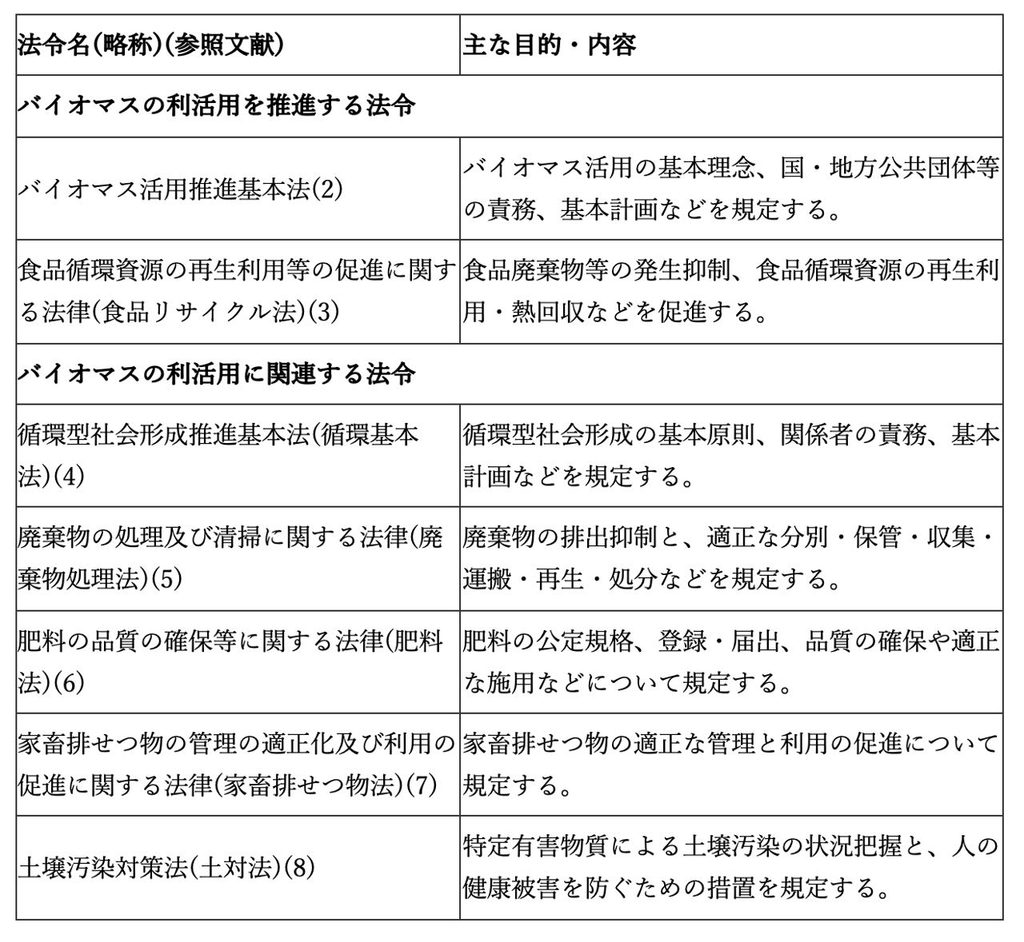
Many biomass-derived materials are generated as waste. When using them, it is necessary to confirm that legal requirements vary depending on the raw material and intended use.
There are regulations governing the content of harmful substances in fertilizers, and some require phytotoxicity testing. On the other hand, the Soil Contamination Countermeasures Act aims to prevent harm to human health and establishes standards for soil concentration and leaching levels. Even if these standards are met, this does not guarantee safety for trees or forest ecosystems. When actually returning fertilizer to forested land, it is necessary to consider not only heavy metals and other substances but also pH, nutrient balance, and the impact on soil organisms and water quality.
The return of combustion ash to forest land is gaining traction in Northern Europe (see *10, 11*). Combustion ash is strongly alkaline, so care must be taken to prevent a sudden rise in soil pH—known as “alkali shock”—and dust emissions (see *12, 13*). Mixing it with materials containing ammonia nitrogen may also cause ammonia to volatilize (See References 12). Some sources recommend limiting its addition to composting materials to 5% or less by volume (See Reference 12).
The heavy metal content in combustion ash may increase due to factors such as the mixing of paint into raw materials (*see References 10 and 11). Nagakura et al. (See *14*) observed growth inhibition in seedling growing media mixed with combustion ash in the 25% Japanese cedar (Sugi) treatment and the 10% and 25% Japanese cypress (Hinoki) treatments (both by volume), and surmised that an increase in pH was the primary cause. When the analytical values of the combustion ash used were compared with the soil standards under the Soil Contamination Countermeasures Act (see *8), the leachable hexavalent chromium exceeded the standard, while other parameters were below the standard values; however, cadmium concentrations in the leaves were significantly higher in the treatment group where the seedling medium was mixed with total ash from Japanese cedar. In some individuals, the concentrations of heavy metals such as Fe, Mn, and Zn, as well as Al, in the leaves also increased. The recommended mixing ratios for seedling growing media were 10% Japanese cedar and 5% or less Japanese cypress. In a survey conducted by Yamada et al. (※Reference 15) during the third growth stage after planting, the 25% Japanese cedar treatment recovered to a level comparable to the other treatments, but the 10% and 25% Japanese cypress treatments showed a high rate of mortality after planting.
Biochar can also raise soil pH, and is expected to improve nutrient retention and soil physical properties (see Reference 16). To prevent drift, it is recommended to avoid application during strong winds and to moisten the material before spreading (see Reference 16). For farmland, there are general guidelines for application rates: when mixing into ridges, furrows, or the topsoil, the recommended rate is approximately 10–30% of the soil volume; for composting, the recommended rate is approximately 20% of the raw material (see Reference 17). In trials using bamboo charcoal on agricultural soil, the upper limit is generally set at a 2% mixture if the soil is immature and a rise in pH to approximately 6.5 is tolerated; application is not permitted if the pH is around 6 (see Reference 18).
In secondary Quercus acutissima forests in Japan, there have been cases where inorganic nitrogen concentrations and the rate of net nitrogen mineralization decreased following biochar application (see Reference 19). There are also cases where long-term observations of soil respiration in the same forest revealed a short-term increase in microbial respiration following biochar application (see Reference 20). A review by Antonangelo et al. (see Reference 21) cites examples of biochar application to fruit trees and forests.
In the United States, the application of treated sewage sludge (biosolids) to farmland is gaining traction (see Note 22). In the forests of Washington State, even approximately 50 years after a single application in 1973, the effects on tree growth and soil continue to be observed in the study area (see Note 23). There are also examples of forest applications in Canada and New Zealand (See References 24 and 25). In New Zealand’s radiata pine forests, the stem volume of trees at 18 years of age in plots where biosolids were repeatedly applied was 27–36% greater than that in control plots, although the density and stiffness of the wood were lower (See Reference 25).
There are many examples in Japan of sewage sludge being used on farmland (see *26), and it is also mixed with livestock manure and urine for co-fermentation. In the case of trees, there are examples of application to red Ezo spruce seedlings (see *27*) and a study investigating changes in soil biota following the application of sludge compost to a seedling nursery (see *28*). Fujita (see Note 29) reported that in a 60-year-old cypress forest, rainfall following application caused an increase in the pH, ammonia nitrogen, and phosphorus concentrations of surface runoff, and concluded that application to steep forested areas is not advisable.
The management of heavy metals is critical in sewage sludge fertilizers, and the Ministry of Agriculture, Forestry and Fisheries has published guidelines for their measurement (see Note 30). The Ministry of Land, Infrastructure, Transport and Tourism also promotes the use of sewage sludge as fertilizer (see Note 31) and revised the “Procedures for the Use of Sewage Sludge Resources as Fertilizer (Draft)” in March 2026 (see Note 32).
There are many examples of digestate application to farmland (see *33). Sixt et al. (see *34) demonstrated that mixing digestate with biochar does not necessarily reduce ammonia volatilization; in some cases, it may actually increase it. The authors speculate that one contributing factor is the inhibition of soil infiltration caused by increases in dry matter content and viscosity. In the case of trees, there are examples of digestate application to willow cuttings (see Reference 35) and greenhouse trials involving the application of a mixture of combustion ash and digestate solids to poplar seedlings (see Reference 36). In the latter study, growth varied depending on the mixing ratio, and the nitrogen concentration in the mixture decreased as the proportion of ash increased. Since more than half of the total nitrogen in digestate is often in the form of ammonia nitrogen (see *37), caution is required when mixing it with high-pH materials (see *12).
In Scotland, there are examples of afforestation carried out on landfill sites and former coal mine sites by mixing compost and the solid fraction obtained by dewatering digested slurry into the soil to a depth of approximately 50 cm (see Reference 38). Although tree growth improved, there was a limit to the effectiveness even when the application rate was increased, and poor drainage and weeds also posed constraints. In Japan, there is a practical example at the Kobe Municipal Forest Botanical Garden where digested slurry was used to improve the soil for cherry and plum trees (See Reference 39).
The application of biomass-derived materials in forests varies by region and material type. While combustion ash is used in Northern Europe and sewage sludge in North America and New Zealand, in Japan, most examples involve their use as seedling growing media or at experimental sites. Based on the findings mentioned above—namely, (1) growth inhibition caused by combustion ash, (2) changes in nitrogen dynamics following biochar application, and (3) increases in timber volume and decreases in wood density associated with repeated application of sewage sludge—it is clear that the impact on trees and the soil environment cannot be determined solely by the nutrient and hazardous substance content of the materials. In short-rotation biomass afforestation, it is necessary to monitor not only pH and water quality but also dry matter production and the effects of repeated application on the soil and trees. (Yasunori Nakagawa, Forest Science Advisor, Amaki Editorial Production)
*See also
(1) Ministry of Economy, Trade and Industry, Agency for Natural Resources and Energy, Biomass Sustainability Working Group (2026)Default Values for Life-Cycle GHG Emissions from Biomass Fuels under the FIT/FIP Program. (Accessed October 13, 2026)
(2) Basic Act on the Promotion of Biomass Utilization (Act No. 52 of Heisei 21). e-Gov Laws and Regulations Search. (Accessed October 13, 2026)
(3) Act on the Promotion of the Recycling and Other Utilization of Food-Derived Resources (Act No. 116 of Heisei 12). e-Gov Laws and Regulations Search. (Accessed October 13, 2026)
(4) Basic Act on the Promotion of a Recycling-Oriented Society (Act No. 110 of Heisei 12). e-Gov Laws and Regulations Search. (Accessed October 13, 2026)
(5) Act on Waste Management and Public Cleaning (Act No. 137 of Showa 45). e-Gov Laws and Regulations Search. (Accessed October 13, 2026)
(6) Act on the Assurance of Fertilizer Quality, etc. (Act No. 127 of Showa 25). e-Gov Laws and Regulations Search. (Accessed October 13, 2026)
(7) Act on the Proper Management and Promotion of the Utilization of Livestock Manure (Act No. 112 of Heisei 11). e-Gov Laws and Regulations Search. (Accessed October 13, 2026)
(8) Soil Contamination Countermeasures Act (Act No. 53 of Heisei 14). e-Gov Laws and Regulations Search. (Accessed October 13, 2026)
(9) Ministry of the Environment. Overview of the Legal Framework Governing the Utilization of Waste-Derived Biomass. (Accessed October 13, 2026)
(10) Hannerz, M. (2019)NORDASH takes a broad view of ash recycling. News & Views, Silvinformation AB. (Accessed October 13, 2026)
(11) Pitman, R. M. (2006)The Use of Wood Ash in Forestry: A Review of Environmental Impacts. Forestry. 79(5), 563–588.
(12) Saunders, O. (2018)Guide to Using Wood Ash as an Agricultural Soil Amendment. University of New Hampshire Cooperative Extension. (Accessed October 13, 2026)
(13) Emilsson, S. (2006)International Handbook: From the Extraction of Forest Fuels to Ash. Swedish Forest Agency. (Accessed October 13, 2026)
(14) Junko Nagakura, Mayumi Ogasawara, Tsuyoshi Yamada, and Keizo Hirai (2018)The Effects of Mixing Wood Biomass Combustion Ash into Growing Media for Sugi and Hinoki Container-Grown Seedlings on Seedling Growth and Nutrient Status. Research Reports of the Forestry and Forest Products Research Institute. 17, 75–84.
(15) Takeshi Yamada, Junko Nagakura, and Keizo Hirai (2021)Post-Planting Growth of Container-Grown Japanese Cedar and Japanese Cypress Seedlings Raised in a Medium Mixed with Wood Biomass Combustion Ash. *Forest Location*. 63(2), 31–38.
(16) Edited by the Consortium for Environmental Research in Agriculture and Forestry toward Decarbonization (2025)Case Studies on the Agricultural Use of Biochar and a Guidebook for Its Application. (Accessed October 13, 2026)
(17) Japan Biochar Promotion Association. Guidelines for Applying Biochar for Soil Improvement. (Accessed October 13, 2026)
(18) Ministry of Agriculture, Forestry and Fisheries website. Guidelines for the Maximum Application Rate of Biocharinterpoint (interword separation)A Study on the Effects of Applying Charcoal with Soil Carbon Sequestration Properties on Crop Growth. (Accessed October 13, 2026)
(19) Yasuki, N., Saso, W., Koizumi, H., Iimura, Y., Ohtsuka, T., & Yoshitake, S. (2024)Decrease in Inorganic Nitrogen and Net Nitrogen Transformation Rates Following Biochar Application in a Warm-Temperate Broadleaf Forest. Forests. 15, 572. https://doi.org/10.3390/f15030572
(20) Yoshitake, S., Enichi, K., Tsukimori, Y., Ohtsuka, T., Koizumi, H., & Tomotsune, M. (2025)Long-Term Effects of Biochar Application on Soil Heterotrophic Respiration in a Warm–Temperate Oak Forest. Forests. 16, 489. https://doi.org/10.3390/f16030489
(21) Antonangelo, J. A., Sun, X., & Eufrade-Junior, H. J. (2025)The Impact of Biochar on Soil Health and Tree-Based Crops: A Review. Biochar. 7, 51. https://doi.org/10.1007/s42773-025-00450-6
(22) U.S. Environmental Protection Agency. Land Application of Biosolids. (Accessed October 13, 2026)
(23) BioCycle. Application of Newly Generated Biosolids to Existing Forest Stands. (Accessed October 13, 2026)
(24) Government of British Columbia. Biosolids for Forest Fertilization: A Complementary Mid-Term Timber Booster? (Viewed: October 13, 2026)
(25) Wang, H., Kimberley, M. O., & Wilks, P. J. (2013)Economic Analysis of a Pine Plantation Receiving Repeated Applications of Biosolids. PLOS ONE. 8(2), e57705. https://doi.org/10.1371/journal.pone.0057705
(26) Ministry of Agriculture, Forestry and Fisheries website. Case Studies on the Use of Fertilizers Derived from Domestic Resources(2. Sewage Sludge Resources). (Accessed October 13, 2026)
(27) Masao Ujiie, Masahiko Kadomatsu, Sadao Sugata, and Akihiro Kamata (1987). Application of Sewage Sludge to Seedbeds. Annual Report of the Hokkaido University Experimental Forest. 4, 16–17.
(28) Keiko Niijima, Keiji Fujita, and Makoto Ogawa (1993)Changes in Soil Biota Associated with the Application of Sludge Compost and Their Effects. Research Reports of the Forestry and Forest Products Research Institute. 365, 109–130.
(29) Keiji Fujita (1988) Application of Organic Sludge and Related Issues. Forest Sites. 30, 17–21.
(30) Ministry of Agriculture, Forestry and Fisheries website. Guidelines for the Management of Heavy Metals in Sludge Fertilizers: Revised 1st Edition. (Accessed October 13, 2026)
(31) Ministry of Land, Infrastructure, Transport and Tourism website. Use of Sewage Sludge as a Fertilizer Resource. (Accessed October 13, 2026)
(32) Ministry of Land, Infrastructure, Transport and Tourism website. Procedures for the Use of Sewage Sludge as Fertilizer (Draft) (Revised March 2026). (Accessed October 13, 2026)
(33) Japan Organic Resources Association (General Incorporated Association). Collection of Best Practices in the Use of Bio-Liquid Fertilizers. (Accessed October 13, 2026)
(34) Sixt, T., Pacholski, A., Winkhart, F., Jaufmann, E., Schmid, H., & Hülsbergen, K.-J. (2025)Does woody biochar mixed with liquid organic fertilizer reduce ammonia volatilization after field application? Nutr. Cycl. Agroecosyst. 131, 165–184. https://doi.org/10.1007/s10705-025-10415-7
(35) Holm, B. and Heinsoo, K. (2014)Suitability of Biogas Digestate for Fertilizing Young Salix Plants. *Baltic Forestry*. 20, 263–271.
(36) Zuševica, A., Adamovičs, A., Dūmiņš, K., Vendiņa, V., Žīgure, S., & Lazdiņa, D. (2023)Improving soil fertility with mixtures of wood ash and biogas digestate enhances leaf photosynthesis and extends the growing season for deciduous trees. Plants. 12, 1152. https://doi.org/10.3390/plants12051152
(37) Masato Nakamura, Fumiko Oritate, Mutsumi Fujita, Iwao Kitagawa, and Akane Yoshihara (2025)Characteristics and Utilization Systems of Methane Fermentation Digestate as a Fertilizer. National Agriculture and Food Research Organization Research Report. 20, 11–20.
(38) Wall, M. (2016)Forestry Trials of Compost and Anaerobic Digestion in Central Scotland. Technical Development Report TDJR130.
(39) Kobe Tree Research Association (NPO). March 1, 2026: Sustainable Soil Improvement Experiment. (Accessed October 13, 2026)
