



How Forest Management and Use Reshaped the Image of Robin Hood
Updated by Kotaro Nagasawa on November 4, 2026, at 1:37 p.m. JST
Kotaro NAGASAWA
(Platinum Initiative Network, Inc.
Born in Tokyo in 1958. Former Senior Managing Executive Officer of Mitsubishi Research Institute. During his tenure, he was mainly engaged in research and studies on infrastructure and social security. During his first few years with the company, he was involved in projects related to flood control, and learned from many experts on river systems at the time to think about the national land on a 100- or 1,000-year scale. Currently, he is an auditor of Jumonji Gakuen Educational Corporation. He is also a part-time lecturer at Tokyo City University. Co-authored "Introduction to Infrastructure" (Nikkei BP, 2017), "New Strategies from the Common Domain" (Diamond, 2021), and "40 Years After the Return" (Heibonsha, 2023). D. (Engineering).
Even if you travel to the UK and venture out into the countryside, you rarely get to see forests. According to statistics, forests cover about 13% of the country’s land area. There are many planted coniferous forests, and it is said that only a small amount of virgin or natural forest remains in its original state. This is quite different from Japan.
本書によれば、5〜6世紀のイングランドの地はかなりの範囲が深い森に覆われていました。在来の森は広葉樹林であり、森の王者といえるオーク、他にはニレ、ブナ、ライムツリー、ポプラ、メイプル、白樺などが見られたようです。
川崎寿彦『森のイングランド』は、その豊かな森が社会の変化や産業の発達によって長期的に破壊されていく中で、イギリス人たちがどのように森と向き合ってきたかを、主に文学作品を参照しながら描き出しています。著者は英文学を専門とする大学教授。「古代世界」から「現代」まで、合計8つの章で構成されています。以下では、私の印象に残った数章を中心に紹介したいと思います。
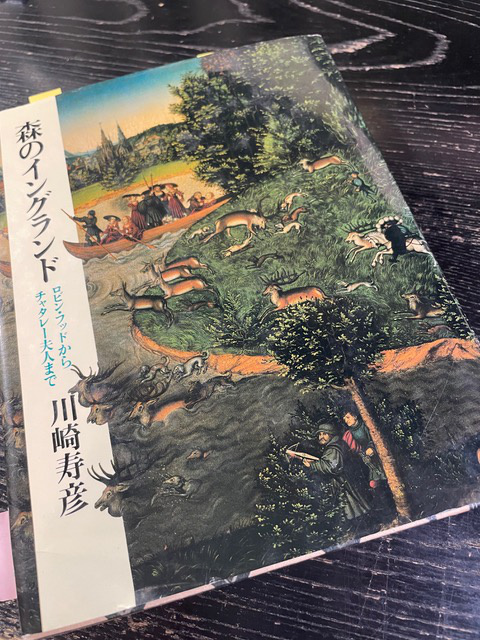
According to the author, English speakers distinguish between ”wood(s)” and ”forest” in much the same way that we Japanese make a subtle distinction between “mori” and “hayashi.” “Forest” is of Latin origin; in addition to having a phonetic quality that is light and bright—similar to the Japanese term “林”—it also conveys a sense of human intervention. For this reason, the term “forest” is used rather than “wood(s)” in fields such as forestry, forest products, and forestry science.
The word “forest” shares the same etymology as “foreign” (meaning “outside” or “of another country”) and is derived from the Latin phrase meaning “outer forest.” This book argues that there is a relationship between rulers and the ruled inherent in this concept. The area enclosed by the rulers around a specific forest was called a “park,” and the areas outside that boundary—even if designated by the ruling class as hunting grounds reserved exclusively for themselves—were precisely what constituted the “forest.” Based on this, the author declares that “forest” should be translated as “imperial hunting grounds.”
当時の狩猟(ハンティング)は、王様や宮廷の貴族たちが、猟犬を走らせ、馬に乗って鹿を追い詰めて狩る遊びでした。この遊びは、土着のアングロサクソンの間では盛んではなく、11世紀にイングランドを征服したノルマン人のウィリアム一世らがもたらしたものだとされます。ウィリアム王は、イングランドを版図に収めると直ちに全国のめぼしい森林をフォレスト(御猟林)に指定し、それに関する特別な法「フォレスト・ロー」(御猟林法)を施行しました。この法律は、もちろん、一般庶民の森林利用を制限します。フォレストは最盛期である13世紀末から14世紀初頭の頃には全国に68ヶ所あり、その合計面積は国土の2割あるいは5割に及んだとの推計があります。
All deer in the forest were considered the king’s property, and commoners were not permitted to lay a finger on them. Anyone who killed a deer was sentenced to death or had their arm cut off. If a peasant’s dog accidentally chased and killed or injured a deer, the owner was severely punished; to prevent such mistakes, it was mandated that the tendons in the dogs’ hind legs be severed before they were raised. While Tokugawa Tsunayoshi’s “Edict on Compassion for Living Creatures” is famous in Japan, medieval England was truly an era of “His Deer Majesty”—not “His Dog Majesty.”
Even I knew the name Robin Hood. However, it wasn’t until I read this book that I finally understood when he lived and what he did (if anything).
Robin Hood is the leader of a band of outlaws numbering over a hundred, who lives in hiding in Sherwood Forest and is portrayed as a dashing hero who has given the corrupt sheriff of Nottingham (a city in central England located just south of Sherwood Forest)—a dashing hero who gave the corrupt sheriff and the wicked monks at the abbey a run for their money. Many stories remain of him showing compassion toward women and children, taking from the rich to give to the poor. Starting around the 14th century, the story spread among the common people in the form of ballads sung by minstrels, and 500 years later, in the 19th century, it was adapted into a novel by a writer of that era and became known throughout the world.
He is not a real person, but rather a character built upon a wealth of folklore. This book identifies three factors behind the emergence of this heroic figure. First, the harsh Royal Forest Laws mentioned earlier; second, the high-handed authority of the magistrates who enforced them; and third, the amassment of wealth by corrupt monks in the Archabbey. There was a demand for the image of a “righteous thief” who embodied the common people’s grievances against these issues. Furthermore, since these various problems occurred primarily during the period between the Magna Carta (1215) and the reign of Edward I (reigned 1272–1307), the book notes that the story of Robin Hood likely emerged as a reflection of the conditions surrounding the forests of 13th-century England.
Even into the 14th century, the story of Robin Hood continued to evolve. Then, around the 16th century—after the harsh enforcement of the 13th-century Royal Forest Laws had peaked— stories began to include episodes in which Robin Hood befriended Edward I, lost a fight with his companions, or was revealed to be of noble birth, accelerating the shift away from his original image as a Robin Hood-style hero.
御猟林法の運用が緩くなった原因の一つは、木材需要の増大だと本書は言います。人口の増大、暖房用、製塩業やガラス製造業、製鉄業などの燃料需要、そして世界の海に乗り出したイギリスの艦船建造に由来する需要。王室の姿勢も、貴族の趣味である狩猟の場として森林を守るのではなく、国家の発展のための資源として木材を活用する方向に変化しました。乱伐が進行し、ある地域ではオークの森の本数が30年間で9割減少というような事態も起きたようです。
This book argues that Robin Hood, who was originally conceived as a hero fighting against the harsh rule of the aristocracy—who treated vast forests as their private property—saw his significance as a “Robin Hood-type” figure fade as national policy shifted toward the commercial exploitation of forests, and that his image inevitably oscillated between being trivialized and glorified. = To be continued in Part 2 (Platinum Concept Network, Kotaro Nagasawa)
*Honorifics omitted in the text.
*Note: As this book was published in 1997, the theories and statistics presented herein are based on research findings and insights available at that time.
*Reference link
England's Forests – Heibonsha
