


Updated by the Editorial Department of *Forest Circular Economy* on November 13, 2026, at 6:21 p.m. JST
Editorial Board, Forest Circular Economy
Forestcircularity-editor
We aim to realize "Vision 2050: Japan Shines, Forest Circular Economy" promoted by the Platinum Forest Industry Initiative. We will disseminate ideas and initiatives to promote biomass chemistry, realize woody and lumbery communities, and encourage innovation in the forestry industry in order to fully utilize forest resources to decarbonize the economy, strengthen economic security, and create local communities.
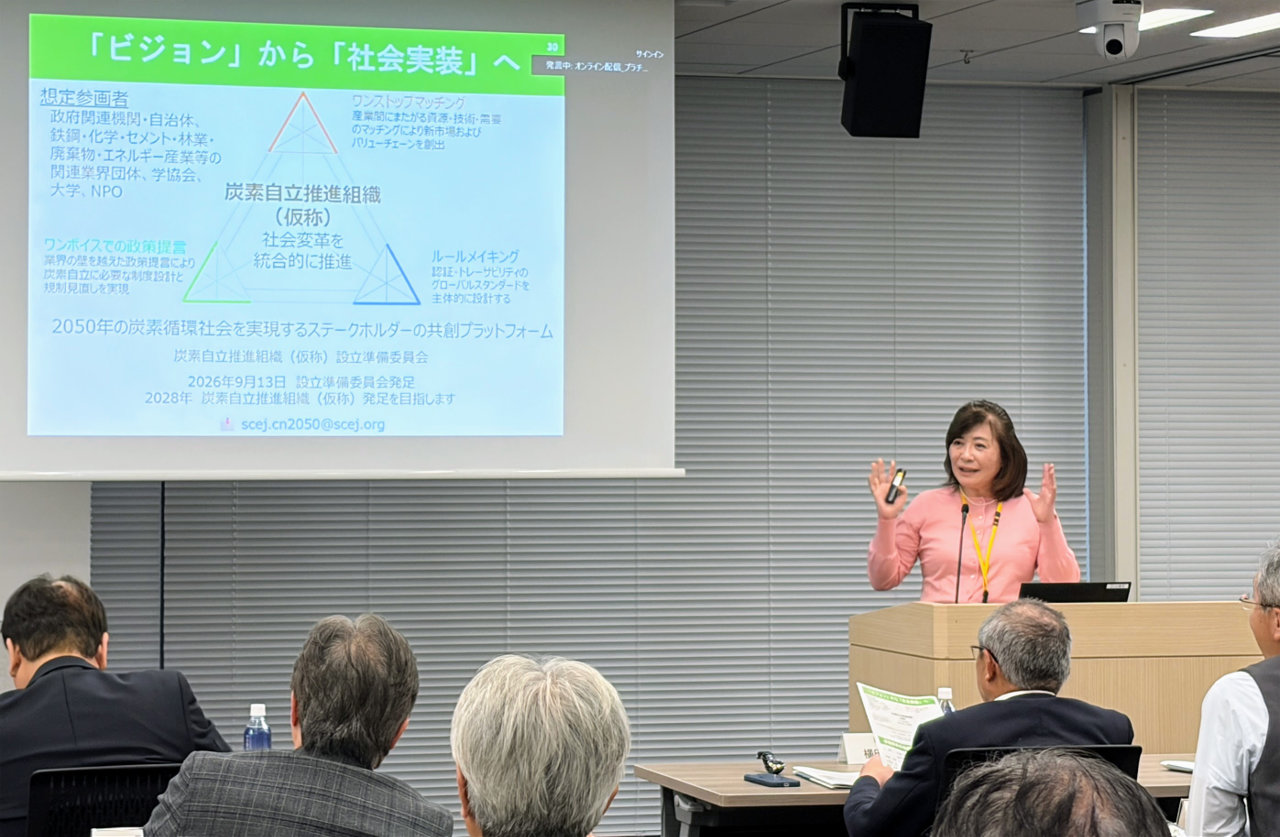
From a society that imports and consumes fossil resources from overseas to one that recycles domestic waste, forest resources, and CO₂— The “Platinum Forest Industry Initiative,” led by the Platinum Vision Network—a general incorporated association working toward the realization of a forest circular economy—held its Phase 5 plenary meeting on October 30. Ms. Yoshiko Tsuji (Professor at the University of Tokyo’s Center for Environmental Safety Research), Chair of the Society of Chemical Engineers, Japan’s “Regional Collaboration Committee for Promoting Carbon Neutrality,” delivered a presentation. Ms. Tsuji introduced the “Carbon Self-Sufficiency Vision,” which estimates that achieving carbon neutrality in the chemical industry will require 19.1 trillion yen in domestic capital investment, and emphasized the need for societal implementation through collaboration between the chemical industry and sectors such as forestry. The presentation highlighted the concept of prioritizing the use of woody biomass as a raw material rather than as fuel, a plan for 88 plants nationwide to be co-located with sawmills, and efforts toward establishing a promotional organization by 2028.
To achieve a decarbonized society, efforts are underway to “decarbonize the energy sector” through measures such as the adoption of renewable energy and the use of hydrogen. However, modern society cannot function simply by solving energy problems. This is because the building blocks of the materials and chemical products that surround us—ranging from plastics and synthetic fibers to paints and pharmaceuticals—are composed of “carbon.”
In his lecture, Mr. Tsuji emphasized the fundamental difference between energy policies and industrial materials.
"While the transition away from fossil fuels is certainly necessary, the carbon required by industry cannot be resolved by that alone. Apart from energy, carbon itself is becoming an indispensable raw material."
In developed countries like Japan, cities and infrastructure are already saturated with “man-made objects.” There is an urgent need to move away from the conventional model of disposing of naphtha—refined from crude oil—and transition to a system that recycles carbon throughout society.
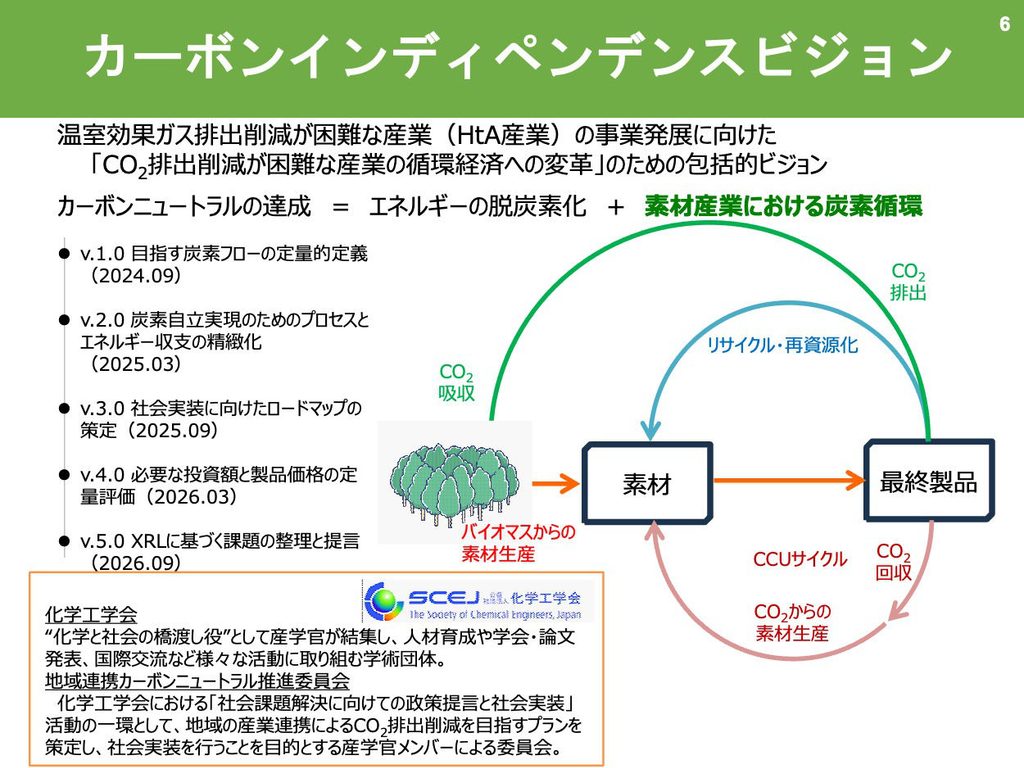
In response to this challenge, the Society of Chemical Engineers, Japan has been updating its quantitative models since 2024 and has proposed a “Carbon Independence” initiative. This concept aims to secure the carbon necessary for industry domestically by reducing dependence on imported fossil resources and recycling domestic post-consumer plastics, woody biomass, local organic resources, and CO₂ contained in industrial exhaust gases. Since waste recycling alone cannot cover the required amount of carbon, the shortfall will be made up through woody biomass and carbon capture and utilization (CCU).
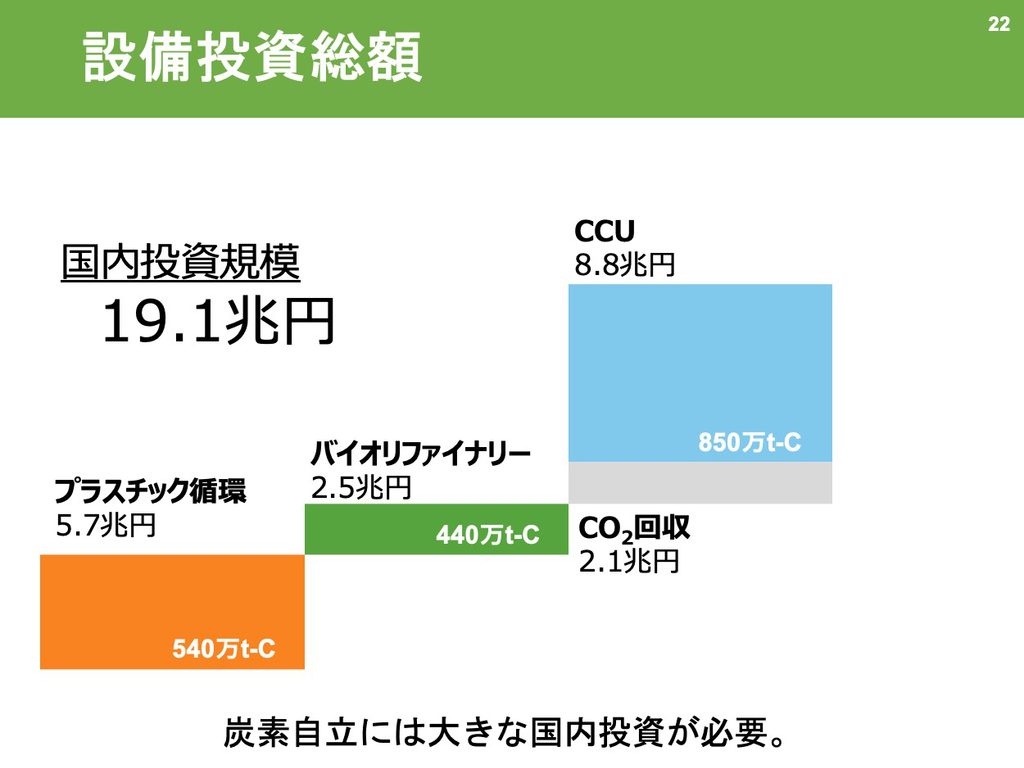
The transition to a carbon-cycling society is not merely a matter of introducing conversion technologies; it is an economic structural reform that involves massive capital investment and a shift in capital flows. Mr. Tsuji presented estimates of capital investment based on the “Carbon Self-Sufficiency Vision” currently being formulated by the Society of Chemical Engineers, Japan. Focusing on the chemical industry—one of the sectors considered “hard to abate”—the estimates put the total domestic capital investment required to achieve net-zero by 2050 at 19.1 trillion yen.
This capital investment consists primarily of four initiatives. First, 5.7 trillion yen (targeted carbon volume: 5.4 million metric tons of carbon per year) will be allocated to the plastic circular economy to develop advanced sorting and recycling facilities. Second, 2.5 trillion yen (targeted carbon volume: 4.4 million metric tons of carbon per year) will be invested in biorefineries to construct plants integrated with sawmills, as well as large-scale saccharification, fermentation, and gasification plants. Third, 2.1 trillion yen will be allocated for investment in CO₂ capture, and 8.8 trillion yen (targeted carbon volume: 8.5 million metric tons of carbon per year) will be budgeted for investment in the introduction of equipment to separate and capture CO₂ from exhaust gases and the development of plants to synthesize chemical raw materials from the captured CO₂.
Meanwhile, when assessing the profitability of a business, factors such as operating expenses, appropriate corporate profits, tax burdens, the costs of industrial water, chemicals, and enzymes, as well as transportation costs, are all taken into account. Regarding cost pass-through, Mr. Tsuji stated, “While efforts to reduce costs through technology are certainly necessary, some costs are unavoidable. We need to start thinking now about a system to appropriately pass on these costs and circulate that money throughout society as a whole,” he urged.
Mr. Tsuji also touched on the economic benefits of the carbon cycle.
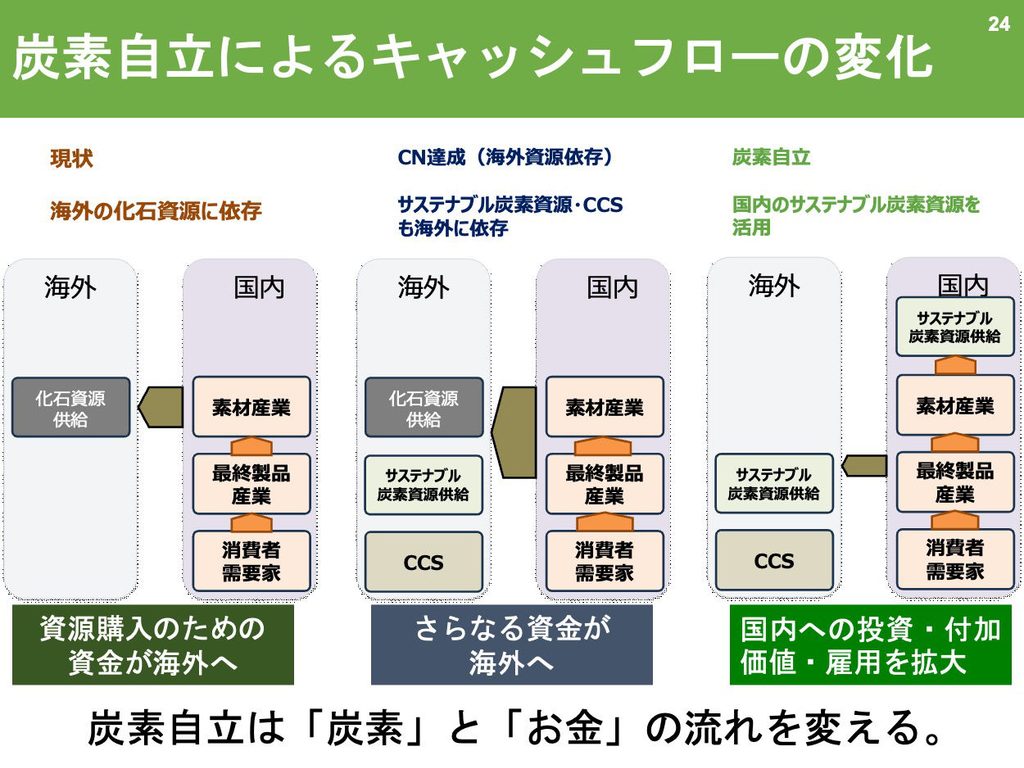
"We need to reduce the cash flow going overseas and ensure that funds are directed—for example—to domestic forests and sawmills. Initiatives related to the carbon cycle will not only change the flow of carbon but also the 'flow of money.'"
This shift in the flow of funds has the potential to create new business opportunities for the domestic recycling industry, the forestry and lumber industries, and plant manufacturers, among others, and to revitalize regional economies.
While biomass power generation is currently widespread, Mr. Tsuji presented a simulation model showing that if woody biomass is used to generate electricity as a substitute for coal-fired power, it would take approximately 120 years for CO2 emission reductions to materialize across the entire cycle of logging, combustion, and reforestation. On the other hand, he noted that if wood is used as a raw material for plastics, chemicals, and other products—and then sent through recycling processes after use—carbon emissions can be reduced, and CO₂ emission reductions could be achieved sooner than when wood is used for power generation.
In its vision, the company has established “priority use of raw materials” and “cascade utilization” as the overarching principles for the use of woody biomass. We produce construction lumber—such as posts—from logs, thereby sequestering carbon for the long term. At the same time, the system is designed to utilize offcuts generated during the sawmilling process, as well as warped lumber unsuitable for construction, as chemical feedstocks.
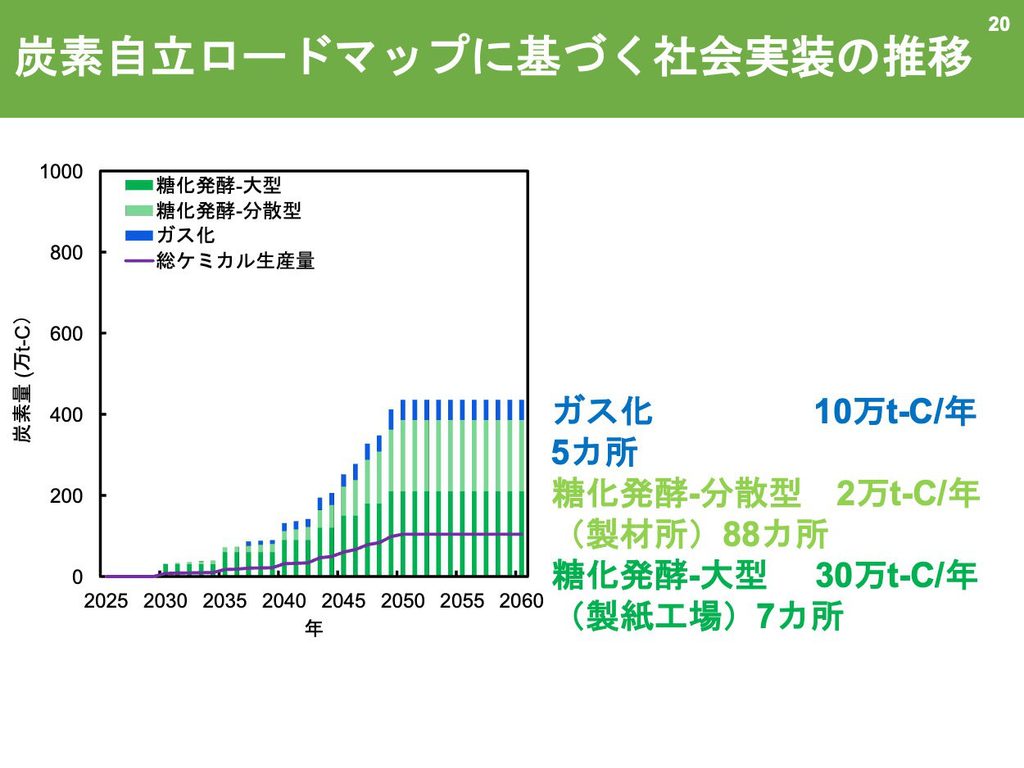
At the core of the 2.5 trillion yen investment in biorefineries is a plan to establish “sawmill-integrated saccharification and fermentation plants” (with an annual carbon processing capacity of 20,000 metric tons: 20,000 t-C/year) distributed across 88 locations nationwide. Since woody biomass is bulky and long-distance transportation increases costs and CO₂ emissions, these plants will be decentralized and built adjacent to local sawmills within their respective collection areas. This will be combined with plants attached to large paper mills (300,000 t-C/year × 7 locations) and gasification plants (100,000 t-C/year × 5 locations).
To turn this concept into increased profits for the forestry and lumber industries, ensuring the project’s profitability is essential. While preliminary calculations assume a procurement price of 12,000 yen per metric ton for biomass feedstock, key challenges remain: whether stable procurement at this price is actually feasible, and to what extent collection and transportation costs can be minimized. Furthermore, a system is needed to sell wood-based biomass chemicals at appropriate prices and to channel the resulting profits back to the forestry and sawmilling industries.
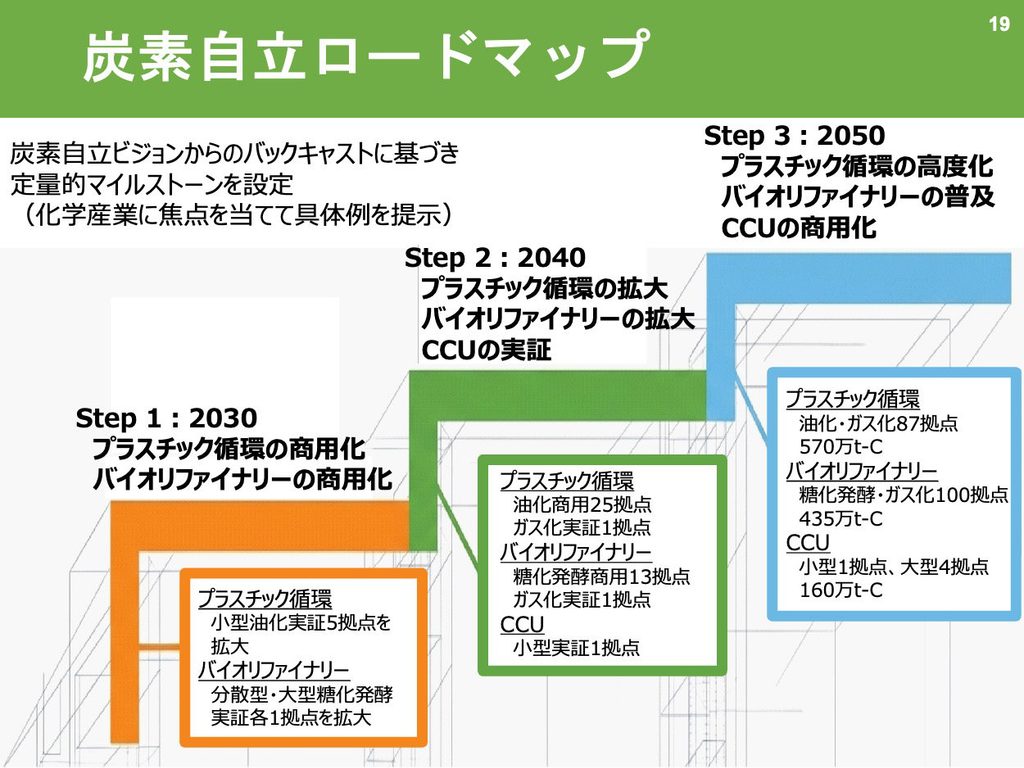
A quantitative roadmap has been established to build a carbon-neutral society. During the launch phase in 2030, we will advance the commercialization of used plastic recycling while also beginning operations at decentralized plants co-located with sawmills and initial-phase biorefineries. During the expansion phase in 2040, we will roll out biorefineries nationwide, begin operations at large-scale plants co-located with paper mills, and work to demonstrate and disseminate large-scale CCU technology. Finally, during the completion phase in 2050, we aim to achieve an 80% recycling rate, fully implement biorefineries, and reach net-zero emissions through the commercialization of CCU.
This concept places a strong emphasis on reducing external energy input. Over-reliance on CCU technology—which synthesizes chemical products from CO₂ and hydrogen—would require vast amounts of renewable energy. On the other hand, prioritizing the use of woody biomass and local organic resources as feedstocks allows for the direct utilization of high-concentration carbon sources, thereby significantly reducing both the amount of hydrogen required and the overall external energy input.
During the Q&A session, a discussion took place regarding the “cost of hydrogen supply,” which is critical to achieving carbon self-sufficiency. From the audience, it was pointed out that while the estimated hydrogen price is “100 yen per normal cubic meter,” there is clear evidence that if production scale expands 10,000-fold by 2050, economies of scale could reduce the price to as low as 45 yen or even 30 yen per normal cubic meter. If hydrogen costs fall, corporate investment appetite and the optimal ratio of CCU to biomass will change significantly. Mr. Tsuji also noted that the optimal energy flow changes in response to fluctuations in hydrogen prices and mentioned that they are conducting sensitivity analyses in line with technological advancements.
The social implementation of the Carbon Self-Sufficiency Initiative requires not only technological development but also institutional reforms and cross-industry collaboration. During the question-and-answer session, questions were raised regarding the potential for utilizing municipal solid waste, industrial waste, sewage sludge, and livestock manure, as well as the necessary legal framework. Mr. Tsuji pointed out that the current Waste Management and Public Cleansing Act is centered on the management of collection and disposal, and he emphasized the need to update the legal framework to align with an era in which waste is recycled as a valuable resource. He also explained that ensuring strict traceability is essential for enabling local resources to circulate safely in the market.
To move the initiative from concept to practical implementation, Mr. Tsuji and his colleagues launched the “Preparatory Committee for the Establishment of the Carbon Self-Sufficiency Promotion Organization (tentative name)” on September 13. They plan to formally launch the organization in 2028. The founding members include leaders from organizations in the forestry, chemical, engineering, and economic sectors, such as the Society of Chemical Engineers, Japan; the Platinum Vision Network; the Organization for Promoting the Transition to a Decarbonized Growth-Oriented Economic Structure; the Japan Chemical Industry Association; the Japan Petrochemical Industry Association; the Japan Forestry Association; and the Japan Society of Engineering. Furthermore, discussions are underway to establish partnerships with sectors such as finished goods manufacturing, construction and architecture, and finance.
The promotion organization is expected to fulfill three main functions. First is “policy advocacy with a unified voice,” which involves making recommendations to the government regarding the deregulation and institutional frameworks necessary for the value chain as a whole. Second is “rule-making and standardization,” which involves establishing certification systems for regional biomass and recycled materials, market rules that enable the passing on of costs to products, and traceability standards. Third is “one-stop matching,” which directly connects the forestry and lumber industries with chemical manufacturers and consumer companies to create commercialization projects through cross-industry collaboration.
As we move toward the launch of a promotional organization in 2028, how can the forestry, chemical, construction, financial, and government sectors build collaborative relationships that transcend silos? The challenge of transforming the flows of carbon and money is entering a new phase, moving from conceptualization toward societal implementation.
*Reference link
Preparatory Committee for the Establishment of the “Carbon Self-Sufficiency Promotion Organization (tentative name)” – The Society of Chemical Engineers, Japan, Regional Collaboration Committee for Promoting Carbon Neutrality
A column by Yoshiko Tsuji, a professor at the University of Tokyo’s Center for Environmental Safety Research, isthis way (direction close to the speaker or towards the speaker)
