
Image by Unsplash
Why Do Forest Owners Trust Austrian Foresters? — Building Relationships Based on Personal Connections, Not Just Knowledge
Updated by Yasunari Kobayashi on July 2, 2026, at 9:53 p.m. JST
Yasuhisa KOBAYASHI
Alpha Forum, Inc.
President of Alpha Forum, Inc. and Steering Committee Member of the Platinum Forest Industry Initiative. Ltd. in 2001, taking advantage of the company's venture support program. In September 2023, he received the Wood Use System Research Association Award.
In Austria, foresters (forestry technicians) are a regulated profession defined by law. Under the Forest Act of 1975, they are recognized as professionals responsible for sustainable forest management and conservation.
In general, the following qualifications are required to work as a forester.
・Completion of a specialized forestry school (a five-year vocational college)
・Or completion of a bachelor’s degree program in forest science at a university
・At least two years of work experience after completing the program described above
・Passed the national exam (Forest Management Exam)
There is also a “qualification recognition” procedure in place to have qualifications obtained in other countries—such as the EU, the EEA, and Switzerland—recognized in Austria. While Europe is a landmass where national borders are defined for practical purposes with regard to forests, European countries can be said to maintain cooperative and collaborative relationships regarding forest management, based on the concept of a single, contiguous forest resource. In Austria, it is generally accepted that one forester manages every 1,000 hectares of forest, while one senior forester oversees every 10,000 hectares.
The definition is included in the “Basic Textbook for Comprehensive Forestry Supervisors (Foresters)” published by the Forestry Agency. Since it’s such excellent content, I’ve included it below.
A Comprehensive Forestry Consultant is defined as “a person who possesses specialized and advanced knowledge and skills regarding forests and forestry, as well as field experience; who, from a long-term and broad-scale perspective, outlines the overall vision for regional forest management; and who provides appropriate technical support to municipalities and local forestry stakeholders.” (as defined in “Guidelines for the Registration and Public Disclosure of Comprehensive Forest Management Advisors” (Notification No. 25-Rin-Seiken-286 from the Commissioner of the Forestry Agency, dated April 1, Heisei 26)), the Commissioner of the Forestry Agency registers individuals who have passed the Regional Comprehensive Forest Management category of the Forestry Extension Officer Qualification Examination.
Forest Management Supervisors are expected to take a broad and long-term perspective; based on regional forest management and road network development, they are to devise plans for the sustainable use of forest resources and regional revitalization through forest management and conservation. To realize these plans, they are expected to play a central role in promoting consensus among regional forestry stakeholders from a neutral standpoint, forestry stakeholders to realize these visions, while utilizing relevant systems and budgets to advance concrete initiatives. To this end, Comprehensive Forest Management Advisors are required to possess scientific expertise in forest management and fundamental knowledge of the entire process from timber production to utilization, as well as the vision to link these elements to regional revitalization and the presentation skills necessary for consensus-building.
Forest Management Supervisors are expected to carry out their duties regardless of their affiliation, provided they have passed the “Regional Forest Management Supervisor” category of the Forestry Extension Instructor Qualification Examination. This includes not only prefectural and national government employees, but also municipal employees responsible for forestry administration—as municipalities are the administrative bodies most closely tied to local communities—as well as experienced private-sector technical experts with deep local knowledge.(Source: Reiwa 7 Comprehensive Forestry Inspector (Forester) Basic Textbook (Forestry Agency)
It excites me to think that there are more foresters in Japan with the knowledge, skills, and scope of expertise described above.
Both in Austria and Japan, foresters emphasize the importance of forest management, assessing the current state of managed forests, and long-term planning.
・The textbook covers mapmaking, forest surveys, and the development of forest management plans.
・Forest Surveys and Data Collection: Possesses the skills to appropriately select sampling methods and techniques for measuring individual trees. Records tree diameter, height, and growth rates to assess forest resources. Forest Resource Assessment and Management: Tracks changes in forest stock volume and growth rates.
・Strategy for Sustainable Forest Use: To prevent erroneous decisions, we analyze timber volumes and growth rates by age class through monitoring and observation. We propose methods to maximize forest structure and timber value.
・Logging and Forest Management: It is necessary to develop plans that take profitability and risk into account, while also incorporating expertise in appropriate logging methods and the selection of timber species.
・Forest Risks and Conservation: This section outlines measures to minimize damage caused by wildlife and natural disasters, and explains policies designed to maintain the health and safety of forests.
In particular, the assessment of forest resources is important, and in both Austria and Japan, analysis and organization based on laser measurement data (objective data) have become the mainstream approach.
The following materials are from a presentation by a forester in Austria that I attended in December 2025.
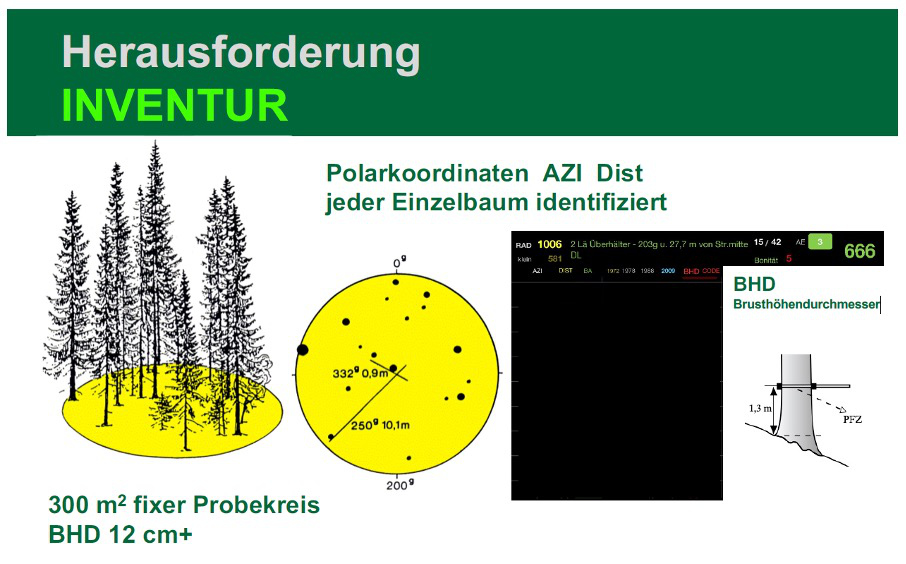
According to the presentation, the status of forest monitoring in Austria is as follows.
Challenge (Herausforderung): An inventory (survey) is necessary to accurately assess the current state of the forest. Inventory (INVENTUR): To assess the quantity and quality of forest resources, data is collected from 300-square-meter fixed sample plots (300 square meter fixer Probekreis). BHD 12 cm+: Trees with a breast height diameter (BHD) of 12 cm or more are included in the survey. Polar coordinates (Polarkoordinaten AZI Dist): The position of each tree is recorded using azimuth (AZI) and distance (Dist). Identification of All Individual Trees (jeder Einzelbaum identifiziert): Each tree within the survey area is individually identified, and data is recorded. BHD (Brusthöhendurchmesser / Diameter at Breast Height): The diameter of the tree measured at a height of 1.3 m above ground level.
Example: In a forest inventory, fixed sample plots of 300 square meters are established, and all trees with a breast-height diameter of 12 cm or more are recorded using polar coordinates (azimuth and distance). This allows for an accurate understanding of each tree’s location and growth status. This method is essential for assessing the current state of the forest and formulating future management plans.
It’s true that having a solid understanding of the relevant knowledge is important. Certification programs are also a good thing. Ultimately, however, what really matters is whether we have a relationship with forest owners and the people living in the area where we can “see each other’s faces, talk to one another, and consult with one another.” There are people like that even among the staff of forest cooperatives—people who are rooted in the community, share daily life with the locals, and implement improvements that take the forest into account and make effective use of it.
When I hear stories from foresters in Austria, they say they have a personal relationship with the forest owners in their areas. Admittedly, there are fewer owners than in Japan, but they are on such friendly terms that they talk to each other on a daily basis.
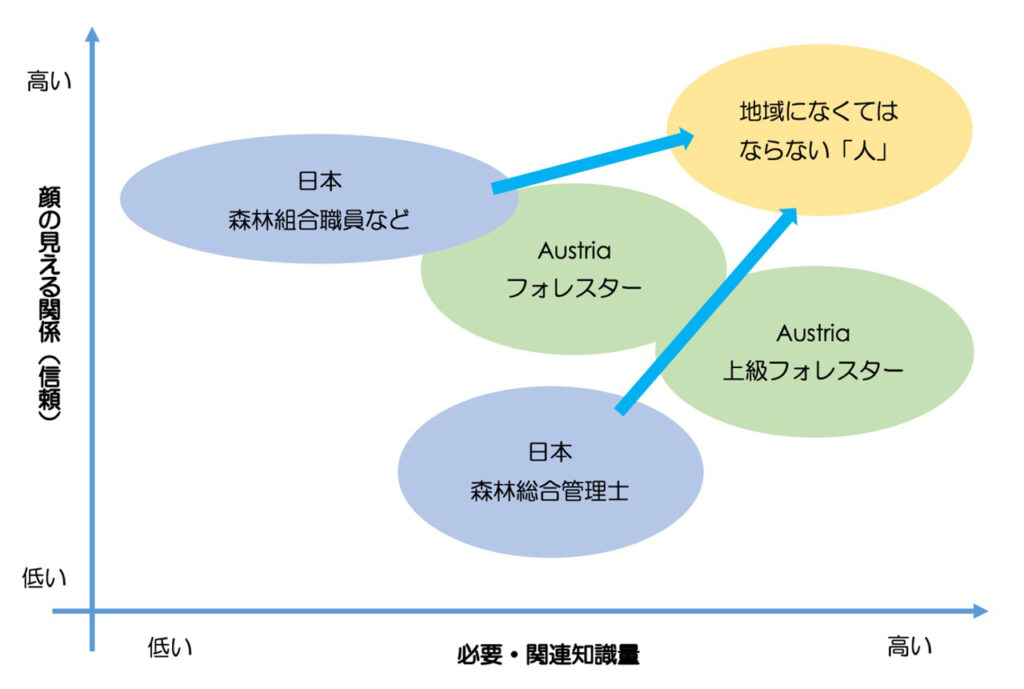
In Japan, there seems to be a strong emphasis on “certification systems ≒ whether or not one has the necessary knowledge,” which leads to a sense that communication with local residents is lacking. Occasionally, I hear people say, “When it comes to forests, we leave it to Mr./Ms. X…” These individuals are the linchpins of forest consolidation and intensification—and are indispensable to the community. Of course, they also possess the skills to enhance the public value of forests from a long-term perspective.
When carrying out forest management practices such as thinning or clear-cutting and reforestation, “How much value (money) can be returned to the forest owner?” is also an important consideration. In Austria, it is not mandatory to entrust forests to foresters. The logic is that because there is a proven track record that entrusting forests to foresters yields a solid financial return, foresters are entrusted with their management and operation. In Japan, too, I believe we need a relationship where multiple options are proposed regarding “how much money can be returned to forest owners?” and where stakeholders engage in healthy competition to improve their approaches.
The institutional framework for promoting forestry has now been established. I would like to move forward with these projects alongside those who understand and act upon the intent behind them. There is still much we can learn from Austria’s forestry sector. I hope to deepen our cooperation with the leading experts in Japan who are actively engaged in their local communities. (Yasunari Kobayashi, President and CEO, Alpha Forum Co., Ltd.; Member, Platinum Forest Industry Initiative Steering Committee)