Image by Adobe Stock
Paper Companies Take on the Commercialization of Wood-Based Biorefineries
Updated by Taro Kamagata on July 9, 2026, at 10:12 a.m. JST
Taro KAMAGATA
(Platinum Initiative Network, Inc.
After graduating from Keio University with a degree in economics in 1982, he joined Toppan Printing Co. In 1988, he moved to Mitsubishi Research Institute, where he was in charge of urban and regional management and public-private partnerships (PPP, PFI, etc.). He later became an executive officer and served as Director of the Regional Management Research Division, Director of the Platinum Society Research Division, and Managing Executive Officer and General Manager of the Research and Development Division, etc. He was seconded to Mitsubishi Research Institute DCS as Senior Managing Director in 2018, retired as an officer of Mitsubishi Research Institute in 2021, and became an advisor to Platinum Initiative Network in 2022. Leader of the Secretariat of the Platinum Forest Industry Initiative.
Amid declining demand for paper, major paper manufacturers are promoting biorefinery operations as a new business venture, utilizing the facilities at their existing paper mills and their supply chains—including wood chips—to produce fuel and chemical products.
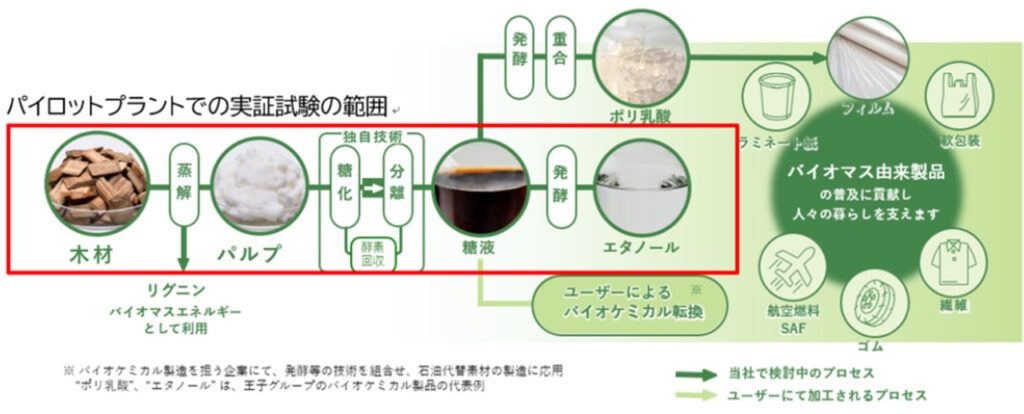
At paper mills, lignin is separated from cellulose and hemicellulose in wood through pulping (a method of component separation), and pulp is produced from the cellulose. A portion of the lignin and hemicellulose is recovered as black liquor, which has traditionally been used as an energy source within the mill.
Building on these existing processes, a plan is taking shape to produce ethanol by saccharifying and fermenting pulp and other materials, with the goal of utilizing the resulting ethanol as sustainable aviation fuel (SAF) or chemical feedstock in the future.
Oji Holdings is working to develop “new wood-derived materials” with the goal of replacing manufacturing processes for plastics, fuels, and other products—which currently rely on fossil resources—with biomass-based alternatives. In particular, the company has identified “wood-derived sugar solutions,” which are expected to have a wide range of applications, and “wood-derived ethanol,” which can be used in the production of sustainable aviation fuel (SAF) and basic chemicals, as core raw materials for its bio-based manufacturing.
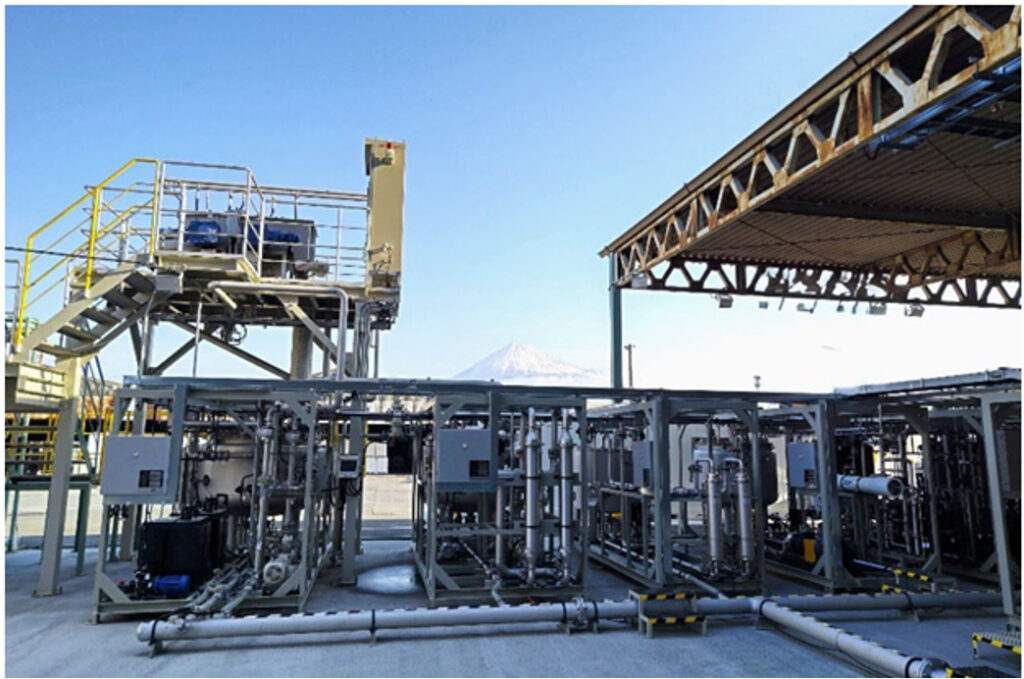
Oji Holdings constructed a pilot plant for wood-derived sugar syrup and ethanol at the Oji Paper Yonago Mill, which was completed in May 2025. As one of the largest facilities of its kind in Japan, the plant has an annual production capacity of 3,000 metric tons of wood-derived sugar syrup and 1,000 kiloliters of wood-derived ethanol. The company plans to conduct demonstration tests at the plant and accelerate its efforts toward commercialization by fiscal year 2030.
In addition, we are working to strengthen our biorefinery business through the acquisition of AustroCel (Austria), a leading company that utilizes woody biomass to manufacture and sell dissolving pulp and bioethanol.
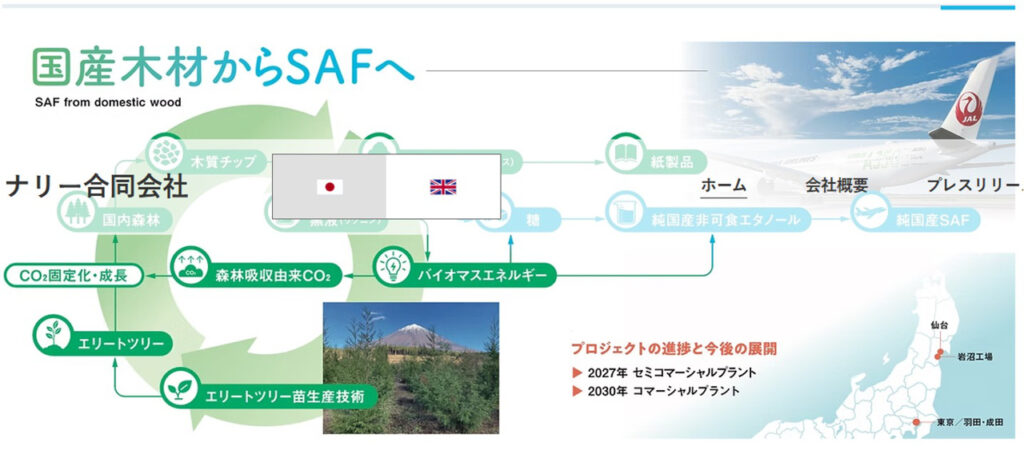
Nippon Paper Industries, Sumitomo Corporation, and the Green Earth Institute (GEI) are working to produce and sell bioethanol made from domestically sourced wood. This initiative, named the “Mori-Sora Project (R),” aims to establish Japan’s first commercial system for the stable supply of raw materials for sustainable aviation fuel (SAF) derived from non-edible cellulose-based biomass.
In July 2025, the three companies jointly established a joint venture called “Mori-Sora Biorefinery LLC.” They plan to construct a semi-commercial-scale plant within Nippon Paper’s Iwanuma Mill in Miyagi Prefecture and begin producing more than 1,000 kL of cellulosic bioethanol annually starting in 2027. The plant will use forest resources that can be sustainably secured in the Tohoku region as feedstock and will employ a low-cost, low-carbon fermentation process developed by GEI. Furthermore, the companies are considering expanding to a full-scale commercial plant with an annual production capacity of tens of thousands of kL by 2030.
The bioethanol produced is expected to be converted into SAF in the future, and Japan Airlines (JAL) and Airbus are also participating in this initiative.
Daiko Paper, a member of the Rengo Group, is working on a project to produce bioethanol using construction waste.
As part of this project, in collaboration with Sumitomo Forestry, Rengo and Sumitomo Forestry jointly established “RS Wood Refinery Co., Ltd.” in April 2026. We aim to produce bioethanol—a feedstock for sustainable aviation fuel (SAF)—by utilizing kraft pulp produced from underutilized biomass resources, such as construction waste generated during the construction, renovation, and demolition of Sumitomo Forestry Group homes.
We plan to proceed with the development and demonstration of bioethanol production technology using enzymes produced by industrial microorganisms, with the goal of beginning annual production of 20,000 kL of bioethanol by 2028. In addition to collaborating with Biomaterial in Tokyo, the company is receiving support from NEDO (New Energy and Industrial Technology Development Organization) for its technology development efforts.
The bioethanol produced will be converted into SAF by the fuel companies to which it is sold and is scheduled to be used as aviation fuel.
As such, paper manufacturers are actively pursuing biorefinery initiatives. However, at this stage, the costs are higher than those of petroleum-based products, and challenges remain regarding the construction of commercial plants.
The recent instability in the Middle East surrounding the Strait of Hormuz has once again highlighted Japan’s vulnerability due to its reliance on imported fossil fuels. For this reason, it is essential to promote the domestic production of fuels and raw materials for chemical products—that is, to utilize biomass and recycled resources—and to build a resource-recycling industrial structure that does not depend on imports. It is imperative that the nation as a whole work together to overcome challenges such as high costs and an underdeveloped market—for example, by implementing regulations requiring paper manufacturers to use a certain percentage of domestically produced bioethanol as they consider commercialization, and by providing investment support for production infrastructure—so that the domestic production of fuel and chemical feedstocks can be successfully implemented as a viable business. (Taro Kamagata, Advisor to the Platinum Initiative Network)