
Image by Unsplash
Updated by "Forest Circular Economy" Editorial Board on April 13, 2026, 9:30 AM JST
Editorial Board, Forest Circular Economy
Forestcircularity-editor
We aim to realize "Vision 2050: Japan Shines, Forest Circular Economy" promoted by the Platinum Forest Industry Initiative. We will disseminate ideas and initiatives to promote biomass chemistry, realize woody and lumbery communities, and encourage innovation in the forestry industry in order to fully utilize forest resources to decarbonize the economy, strengthen economic security, and create local communities.
Efforts to switch to biomass-derived fuels and chemical feedstocks are progressing on the business, supply, technology, and institutional fronts. Sumitomo Forestry and Rengo have stepped into the bioethanol business using construction waste as a raw material, and are considering using it as a raw material for SAF (Sustainable Aviation Fuel). Idemitsu Kosan is considering building a methanol supply network for use as marine fuel, and ENEOS has begun supplying paraxylene derived from bionaphtha. Furthermore, catalyst development related to SAF production and support for bio manufacturing by NEDO are also underway. These developments indicate that biomass-derived resources are being considered and implemented for use not only in conventional applications, but also in the fuel and chemical fields. The utilization of resources depends not only on the amount of supply, but also on the value added depending on which industries are linked to the greening of the resource.
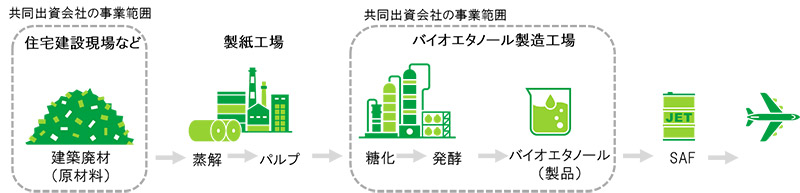
Sumitomo Forestry and Rengo established a joint venture company, RS Wood Refinery Co., Ltd. on April 1 to promote a bioethanol production business using construction waste and other materials, with the goal of commercial production of 20,000 kL per year by 2028. The project is characterized by its effective use of construction waste generated at Sumitomo Forestry Group housing construction, renovation, and demolition sites. The waste wood, which has been mainly used as fuel (thermal use), will be converted into second-generation bioethanol made from inedible wood resources using Rengo's technology, and then supplied to petroleum wholesalers as a raw material for SAF. This is a new attempt to extend the value chain of forest resources from "construction" to "aviation energy," and is intended to accelerate Sumitomo Forestry's "wood cycle" to maximize added value and decarbonization.
*Reference link
Sumitomo Forestry Signs Basic Agreement with Rengo to Produce Wood-based Bioethanol - Utilization of Construction Waste for Sustainable Aviation Fuel SAF - | Sumitomo Forestry
Establishment of RS Wood Refinery Co.
Idemitsu Kosan has started a joint study with Consort Bunkers, a Singapore-based bunkering company with extensive experience, to establish a supply chain for methanol used as marine fuel. Against the backdrop of the International Maritime Organization's (IMO) target of virtually zero greenhouse gas (GHG) emissions by around 2050, methanol is attracting increasing attention as a low-carbon fuel that can replace heavy oil. The current study aims to establish a system to supply methanol procured by Idemitsu Kosan to major ports in Singapore and East Asia through the Consort Bunkers network. Currently, "dual-fuel-fired" vessels, which can use both methanol and fuel oil, are being introduced, and the company is also considering the future introduction and spread of e-methanol, which is derived from renewable energy, and biomethanol (green methanol), which is made from biomass.
*Reference link
Joint Study with Consort Bunkers Begins to Establish Supply Chain for Methanol Used as Ship Fuel
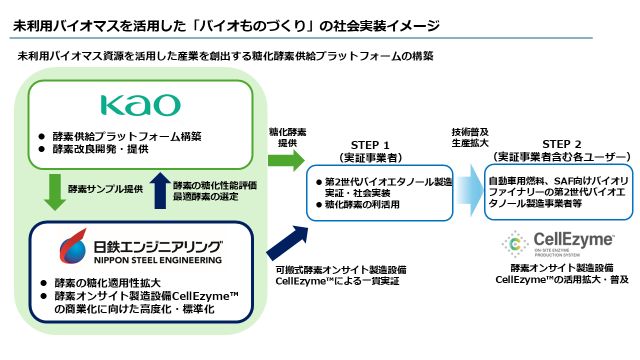
Nittetsu Engineering announced that it will participate in the New Energy and Industrial Technology Development Organization (NEDO)'s "Bio Manufacturing Revolution Promotion Project. The company, in collaboration with Kao, will accelerate the construction and demonstration of a "saccharification enzyme supply platform" to efficiently utilize unused biomass resources. The project aims at social implementation through a shift from conventional chemical processes to bioprocesses utilizing microorganisms and enzymes. Nittetsu Engineering will promote the establishment of production processes for second-generation bioethanol and SAF feedstock, etc., by utilizing its proprietary enzyme on-site production facility, CellEzyme(TM).
*Reference link
Participation in NEDO's "Bio Manufacturing Revolution Promotion Project|NITTETSU ENGINEERING, LTD.
ENEOS, in cooperation with Mitsubishi Corporation, supplied Sony with paraxylene (PX) produced from bionaphtha derived from waste cooking oil and other resources. This bio-PX will be used as a raw material for polyethylene terephthalate (PET resin) used in Sony's audio/visual products. By adopting the mass balance method (a management method that assigns the properties of biomass feedstock, etc., to a portion of the product in proportion to the amount of input), Sony was able to effectively utilize existing facilities at the petrochemical complex while maintaining the same performance as conventional products and making the product greener.
*Reference link
ENEOS to Supply PX Derived from Bio-Naphtha to Sony
JFE Engineering Corporation, in collaboration with the University of Toyama, has developed a new catalyst that can efficiently produce SAF. This catalyst is used in Fischer-Tropsch (FT) synthesis, which synthesizes fuels from feedstock gas. In the conventional process, another process called "hydrogenolysis" is required after synthesis, and the yield of SAF has been limited to about 25%. However, the new catalyst reduces the hydrogenolysis step, allowing SAF to be produced in a single step. This will double the yield of SAF to more than 50%, and will also reduce the need for large capital investment and new hydrogen input. This technology is expected to make a significant contribution to the cost reduction and diffusion of SAF production from biomass, municipal solid waste, and even recovered CO2 in the future.
The destabilization of the Middle East over the Strait of Hormuz has once again highlighted the vulnerability of Japan's energy and economic security due to its dependence on overseas sources of fossil fuels. Amid the urgent need to secure resources and make a drastic structural shift toward decarbonization, a concept to utilize Japan's abundant "forest resources" as raw materials for fuels and chemical products and to build a domestic production base is gaining momentum in earnest.
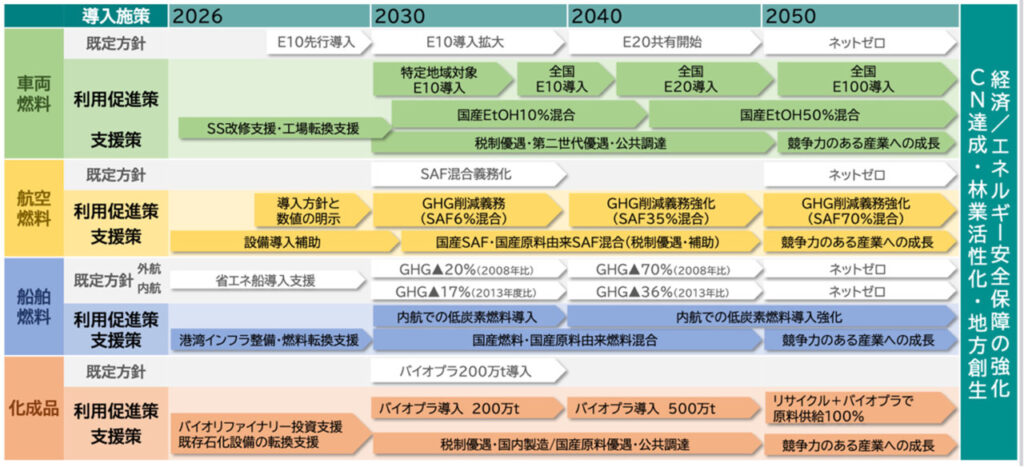
Platinum Initiative Network (Chairman: Hiroshi Komiyama) released "Promoting a Growth Strategy-oriented Bioeconomy Utilizing Domestic Forest Resources" on April 2. After presenting a vision of a "circular forest economy" that combines decarbonization and economic growth, the report presents a realistic roadmap for how to overcome the challenges of high costs and lack of a market, and how to implement it as a business in society.Read the full story