


Image by Adobe Stock
Waribashi Are More Than Just "Disposable" — Rethinking Their Evolving Role Through Hospitality Culture and the Reuse of Wood Offcuts
Updated by Tomoko Ogura on September 28, 2026, at 9:04 p.m. JST
Tomoko OGURA
Total Food Corporation / Japan Chopstick Culture Association
(Representative Director of Total Food Co., Ltd. and General Food Consultant / Visiting Professor at Miyagi University / Outside Director of a Tokyo Stock Exchange-listed company / Concurrent Lecturer at Asia University, Toyo University, and Tokyo Seitoku University / President of Shoku Kijuku / Representative of Japan Chopstick Culture Association, etc. / After working at Toyota Motor Corporation's Public Relations Department, he became Director of International Conference and studied overseas before assuming his current position. After working for Toyota Motor Corporation's Public Relations Department, he worked as a director of an international conference and studied abroad before assuming his current position. With "food and mind" as his main focus, he is well versed in all areas of food, from trends (analysis and development) to food culture, manners, nutrition, health management, food environment and mental health, and has a wide range of specialties. He has written academic papers on "chopstick culture and rituals," "Japanese chopsticks and peculiarities," and "waribashi and the food service industry," and has authored and supervised numerous books on chopsticks. He is said to be the only researcher of Japanese chopstick culture in the world.Total Food official website Japan Chopstick Culture Association website
More than 90 percent of the disposable chopsticks used in Japan are now imported from overseas. However, because disposable chopsticks are deeply connected to forests and embody a spiritual culture unique to the Japanese, this is the third time we’ve featured them on this site. This article is based on a paper I researched on disposable chopsticks and presented to the Japan Foodservice Society in 2016.
I previously wrote on this site that disposable chopsticks originated in Japan. While disposable chopsticks are still used in some ramen shops, Japanese restaurants, and—for hygiene reasons—at some high-end restaurants, they are not considered common in countries where chopsticks are not used on a daily basis. Even in countries where chopsticks are used, it is common to see coated wooden chopsticks, as well as those made of resin, plastic, or metal. Furthermore, even in countries where cutlery such as knives and forks is primarily used, there is no custom of using a new, unused pair of chopsticks every time, as is the case with Japanese disposable chopsticks.
So what about Japan? In Japan, chopsticks have traditionally been highly personal items, with each person having their own set. As the sayings “Chopsticks are a person” and “Chopsticks reveal one’s character” suggest, people have used them in a way that makes them an extension of their own hands. For this reason, lacquered chopsticks—rather than disposable ones—are the norm in Japanese households. Coated with lacquer—which also acts as a natural antibacterial agent—these chopsticks can be reused many times. People even brought their own chopsticks with them when traveling. From this perspective, it can be said that the use of disposable chopsticks in Japan signifies a role distinct from that of everyday family meals at home.
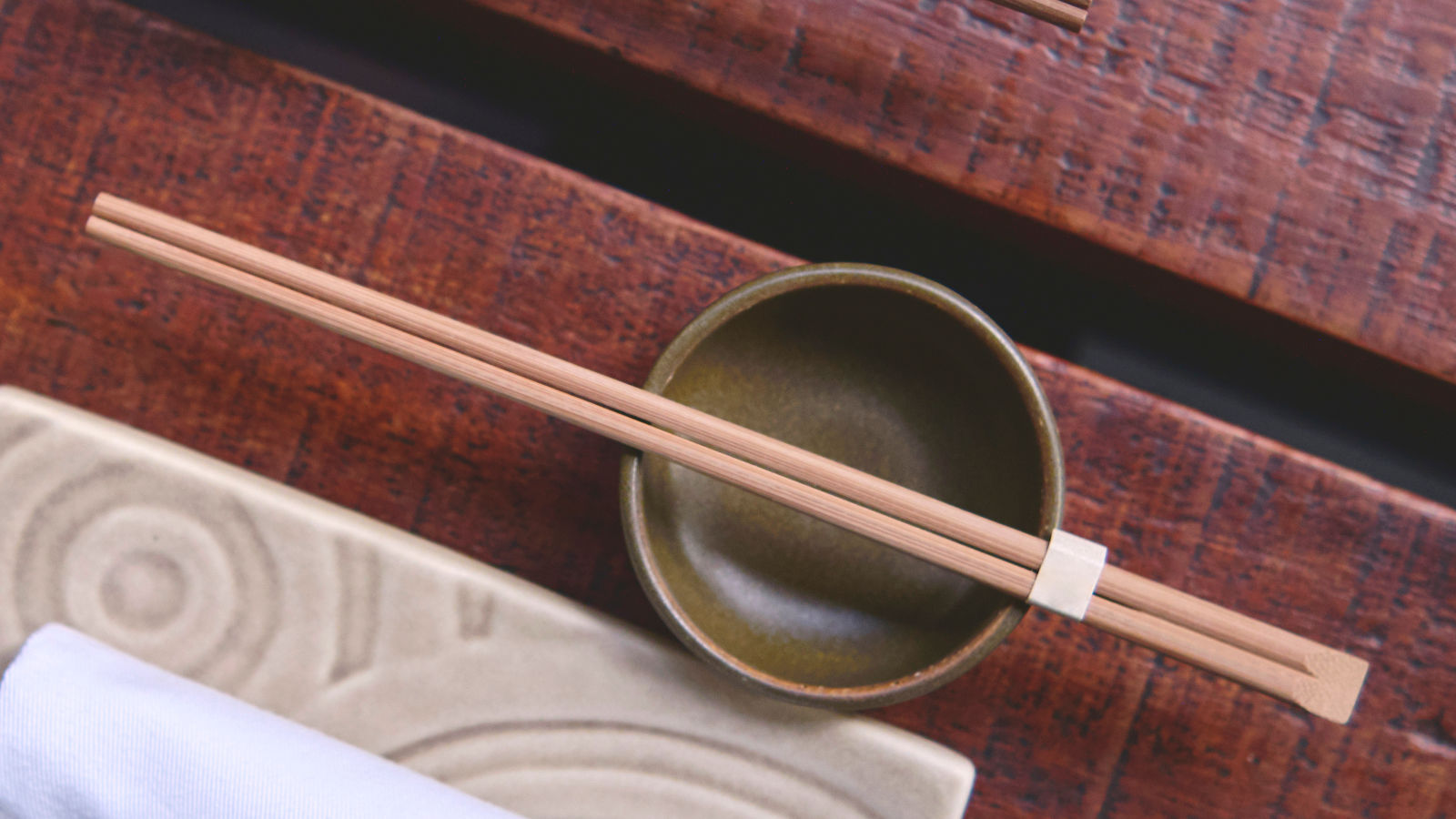
One example of how foreign visitors to Japan are moved by the hospitality of Japanese restaurants is the “oshibori.” The fact that these seasonally appropriate oshibori—hot in winter and chilled in summer—are served even at casual izakayas is a thoughtful gesture unique to Japan that leaves a lasting impression. Disposable chopsticks carry the same significance. By having the diner “break” them before use, it clearly indicates they are unused, and this act embodies the spirit of hospitality.
While disposable chopsticks are meant to express hospitality toward guests, their use is considered taboo on auspicious occasions such as New Year’s and weddings. It is said this is to avoid “breaking the bond” (a play on words meaning “to sever ties”). For this reason, on such auspicious occasions, people use a pair of chopsticks that are separated at the base (known as “celebratory chopsticks”). Although you occasionally see high-end disposable chopsticks being used on such special occasions, this is not their intended use. Disposable chopsticks are not considered “celebratory chopsticks.”
Disposable chopsticks are broadly categorized into five shapes. The most common type is called “Chōroku,” named for its exact length of six sun; these are the shortest of all disposable chopsticks. They are characterized by their unchamfered edges and the absence of a groove between the two sticks. As a result, they are difficult to break apart and do not feel smooth in the mouth, but they were commonly found in the Showa era as the disposable chopsticks included with ekiben (station boxed lunches). The splinters that sometimes form when breaking them are due to the fact that they are made of uncoated wood.
I remember times when I’d drop my disposable chopsticks or forget to bring them, so I’d break a single pair in half so two of us could share them. They were short and awkward to use, but they managed to do the job. This was only possible because the disposable chopsticks were made of wood and weren’t coated. While disposable chopsticks are readily available at convenience stores and other places today, they were much harder to come by back then.
Disposable chopsticks originally developed rapidly for two reasons: as a way to reuse waste materials and as a form of service to customers in the Edo-period food service industry; however, the fact that Japanese chopsticks are made of wood is the root cause of this trend. Because they are made of wood, they never return to their original, unused condition even after washing. For this reason, it became customary not to share personal chopsticks within the household. Furthermore, Japanese cuisine generally does not make heavy use of strongly flavored sauces or spices—such as chili peppers or turmeric—that easily stain the wood. The use of wooden chopsticks is intrinsically linked to the nature of Japanese cuisine.
Now that disposable chopsticks are available for free at convenience stores and supermarkets, it is no longer uncommon for people to eat with disposable chopsticks at home rather than using their own, and they are gradually ceasing to be considered an unusual item. Furthermore, many people use chopsticks made of materials other than wood at home, reserving wooden chopsticks solely for when they purchase food from outside. We have entered an era where tableware also serves as cooking utensils. Individual meals are made possible by pouring hot water into disposable containers or heating them in the microwave, and then discarding both the disposable containers and the disposable chopsticks.
In an era where the lines between home-cooked meals, dining out, and takeout have blurred, the original purpose of disposable chopsticks is gradually changing. Although disposable chopsticks are strongly associated with “disposability,” when we explain their original background—the use of waste materials and the spirit of hospitality—to people overseas, they are just as moved as they are by the “oshibori” (wet hand towels). Chopsticks embody not only the unique qualities and characteristics of wood but also the Japanese spirit. Perhaps there is great value to be found in moving beyond the “disposable” mindset. (Tomoko Ogura, Representative Director of Total Food and Representative of the Japan Chopstick Culture Association)
*Related Articles
The Historical Significance of Disposable Chopsticks Originating in Japan: The Edo Period Eating-Out Culture Supported by the Use of Sugi (Japanese Cedar)
The Future of Utilization of Domestic Timber and Forest Circulation, as Questioned by Familiar Waribashi Chopsticks Originating in Japan
