Image by PhotoAC
Sustaining Biomass Silviculture in the Era of Short-Rotation Harvesting: The Potential for Returning Biomass-Derived Materials to the Forest Floor
Updated by Yasunori Nakagawa on July 21, 2026, at 7:55 p.m. JST
Yasunori NAKAGAWA
Leaf Rain Co.
He has been conducting research on material cycles in forest ecosystems since his graduate school days and earned a Ph.D. in Agricultural Sciences. After completing his graduate studies, he served as a Japan Society for the Promotion of Science (JSPS) Research Fellow, conducting research on material cycles in wetland forests. He subsequently worked on nature restoration projects and biomass energy initiatives.
Biomass afforestation is expected to be increasingly promoted to achieve carbon neutrality and secure raw materials for biomass-derived products. In biomass afforestation, short-rotation harvesting using fast-growing tree species is generally required. However, it has been pointed out that repeated short-rotation harvesting leads to the loss of soil organic matter and the depletion of nutrients. Therefore, we propose that returning materials derived from other biomass resources to forest land may be an effective means of preventing the loss of forest soil functions or restoring those that have been lost.
First, I have compiled a list of the various types of biomass resources in a table.
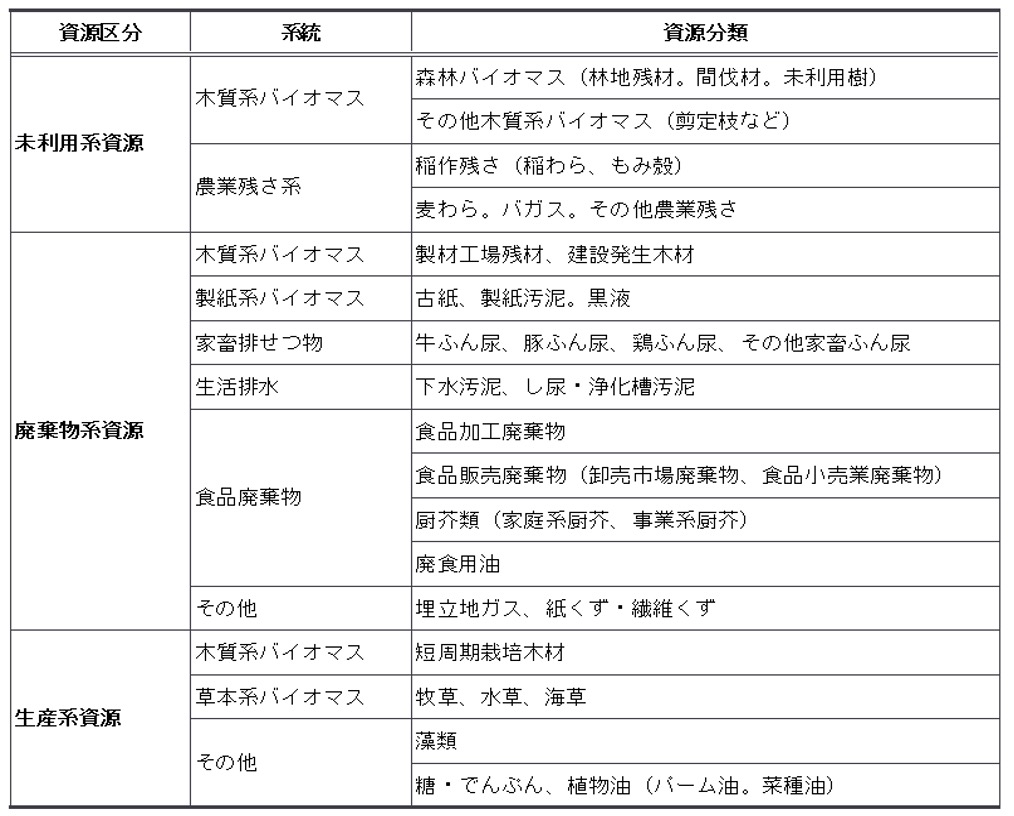
In this table, biomass resources are broadly categorized into three groups: untapped resources, waste-based resources, and production-based resources. A notable feature of woody biomass is that it falls into all three categories. In this table, woody biomass derived from biomass afforestation is classified as a production-based resource.
In the biomass power generation sector, woody biomass is classified separately. When the FIT program (Feed-in Tariff system for renewable energy) was launched in 2012 (see Note 2), it was categorized into three groups: “unused wood such as thinned timber,” “general wood such as factory offcuts,” and “recycled wood such as construction waste.” Subsequently, as the number of woody biomass power plants increased, demand for fuel wood expanded (see Note 3). Under the current (2026) FIT/FIP system (a system that adds a premium to the market price of renewable energy) (See Note 4), in the definitions for life-cycle GHG default value categories, woody biomass is classified as “sawmill residues, etc.” “forest residue, etc.,” and “other harvested timber.” Among these, “other harvested timber” is defined as “woody biomass generated by harvesting for energy purposes,” and for the time being, final harvesting of trees aged 20 years or younger is considered to be for energy purposes. Furthermore, the Forestry Agency supports the utilization of branches and twigs through whole-tree harvesting to ensure a stable supply of fuel wood (see Reference 3).
Based on the above, woody biomass should not be viewed merely as the utilization of wood waste, but rather as part of a cycle that includes production, utilization, and recycling.
In Japan’s forestry sector, branches and roots have traditionally been left on the forest floor, and forest soils have been sustained through the material cycle resulting from their decomposition. However, repeated short-rotation harvesting may prevent forest soils from adequately retaining organic matter and nutrients. Since many forests in Japan are located on sloping terrain, this could also increase the risk of soil erosion and sediment runoff.
In addition, repeated short-rotation harvesting increases the frequency of forestry machinery use, which in turn increases the frequency of soil disturbance and accelerates the loss of organic matter from the soil (see *5, 6*). The whole-tree harvesting method described above (see *3*) has the potential to exacerbate this trend.
Therefore, when establishing biomass plantations, it is preferable to select flat or gently sloping land in order to minimize the impact of repeated short-rotation harvesting. Even on flat land, areas near rivers should be preserved as riparian buffer zones for the sake of water quality conservation, sediment control, and disaster prevention; therefore, it is preferable not to convert them into biomass afforestation sites. Given these considerations, the zoning of suitable areas for biomass afforestation must be carried out with great care.
It is believed that supplying organic matter and nutrients to forest land is necessary to prevent the loss of forest soil functions caused by repeated short-rotation harvesting, or to restore those functions. Therefore, the utilization of materials derived from other biomass resources is an effective approach.
In agricultural fields, materials obtained after processing and converting biomass resources are widely used as fertilizers and soil conditioners (see Note 7). Depending on the raw materials, conversion process, and the form and properties of the resulting materials, these are referred to as combustion ash, biochar, compost, digestate, and so on. While there are numerous examples of such materials being returned to forest land overseas, they are rare in Japan. One reason why this practice has not taken hold in Japan is that, unlike farmland, Japanese forests often consist of sloping terrain, which imposes significant constraints in terms of labor and cost.
In future articles, we will introduce the types of biomass-derived materials that can be returned to the soil, along with actual case studies of their application, and examine their potential for use in Japan’s forests.
*See also
(1) New Energy and Industrial Technology Development Organization (NEDO) (2014), NEDO White Paper on Renewable Energy Technologies, 2nd Edition
(2)Ministry of Economy, Trade and Industry Procurement Price Calculation Committee (2012) Opinion on Procurement Prices and Procurement Periods for Fiscal Year Heisei 24.
(3)Forestry Agency, Ministry of Agriculture, Forestry and Fisheries (2026), Reiwa 7 White Paper on Forests and Forestry, Part 1, Chapter 3, Section 2 (3) Use of Woody Biomass.
(4)Ministry of Economy, Trade and Industry, Agency for Natural Resources and Energy, Biomass Sustainability Working Group (2026), Default Values for Life-Cycle GHG Emissions from Biomass Fuels under the FIT/FIP Systems.
(5) Griffiths, N. A., Rau, B. M., Vaché, K. B., Starr, G., Bitew, M. M., Aubrey, D. P., Martin, J. A., Benton, E., Jackson, C. R. (2019) Environmental effects of short-rotation woody crops for bioenergy: What is and isn’t known. GCB Bioenergy, 11, 554–572.
(6) McKay, H. (ed.). (2011) Short Rotation Forestry: A Review of Growth and Environmental Impacts. Forest Research Monograph, 2, https://cdn.forestresearch.gov.uk/2022/02/frmg002_short_rotation_forestry-1.pdf.
(7)Ministry of Agriculture, Forestry and Fisheries, Agricultural Products Bureau, Technology Dissemination Division, Production Materials Policy Office. Case Studies on the Use of Fertilizers Derived from Domestic Resources.