


Image by PhotoAC
From Visualizing Nature to Market Creation: Accelerating the Debate on Natural Value — Insights from the Global Nature Positive Summit 2026, Kumamoto
Updated by Takanobu Aikawa on August 5, 2026, at 7:46 p.m. JST
Takanobu AIKAWA
PwC Consulting Godo Kaisha
Senior Manager, PwC Intelligence, PwC Consulting LLC / With a background in forest ecology and policy studies, he has been extensively engaged in research and consulting for the forestry and forestry sectors for the Forestry Agency and local governments. In particular, he contributed to the establishment of human resource development programs and qualification systems in the forestry sector in Japan, based on comparisons with developed countries in Europe and the United States. In the wake of the Great East Japan Earthquake, engaged in surveys and research for the introduction of renewable energy, particularly biomass energy; participated in the formulation of sustainability standards for biomass fuels under the FIT system; since July 2024, in his current position, leads overall sustainability activities with a focus on climate change. He holds a master's degree in forest ecology from the Graduate School of Agriculture, Kyoto University, and a doctorate in forest policy from the Graduate School of Agricultural Science, Hokkaido University.
The “Global Nature Positive Summit 2026” was held in Kumamoto City on July 14 and 15, with approximately 2,700 people attending the main conference and more than 14,000 visiting the concurrent “NATURE TECH!” exhibition. I attended both days and could really feel the very positive atmosphere.
The release of the “State of Nature” report by the Nature Positive Initiative, originally scheduled for an earlier date, has been postponed and will now be released in conjunction with COP17, to be held in Armenia in October. Discussions regarding methods for measuring natural capital and evaluation indicators are still ongoing, and this has once again highlighted the lingering challenge of “how to measure nature.”
On the other hand, I believe a major challenge is the need to accelerate discussions on creating a “market for natural values”—which should lie beyond the mere measurement of those values. To achieve this, it is important to draw on the carbon market, which is already somewhat developed, while identifying the specific characteristics of other natural values—such as water source conservation and biodiversity preservation—and designing appropriate institutional frameworks. To put it simply, unlike the carbon market, trading in natural values will likely be based on local units using a landscape approach.
*This column was written in mid-July. We would like to express our heartfelt condolences and sympathies to all those affected by the earthquake that struck Kumamoto Prefecture on July 28.
A key phrase that came up frequently at this summit was “Nature on the Balance Sheet.”
Under the traditional economic system, the benefits provided by forests, water, soil, and biodiversity have been treated as “externalities.” For example, while the revenue from selling timber is recorded when a forest is logged, the loss of functions such as water conservation and flood prevention is given almost no accounting value.
In contrast, the concept of “natural capital theory”—which views nature as an “asset” that supports economic activity—is gaining traction. This has two implications. First, it aims to position nature as capital and an asset necessary for economic activity, just like production facilities such as factories. Second, it views forests not merely as sources of timber, but as assets that provide a variety of ecosystem services—such as sequestering carbon, storing water, preventing floods, and maintaining biodiversity. Consequently, proper management enhances the value of forests as assets, whereas improper management diminishes that value.
On the other hand, some of you in the forestry and timber industry who are reading this column may be thinking, “Aren’t corporate-owned forests already treated as assets?”
In fact, this is true: forestry and timber companies—such as those in the paper industry—that own corporate forests, both domestically and internationally, recognize their value on their balance sheets. However, current accounting practices primarily value these assets as the sum of land value and the value of standing timber (timber value), meaning that many of the ecosystem services provided by forests remain outside the scope of accounting.
It is true that in the development of large-scale plantation forests in Latin America and Southeast Asia, protected areas are often established within company-owned forests; however, this is merely a “cost” incurred to comply with regulations and does not generate value for the companies. Therefore, the initiatives of the ISFC (International Sustainable Forestry Coalition)—which I introduced in a previous column—aim to expand this scope.
It should be noted that in the United States and other countries, vertically integrated companies that once handled everything from forest management to the lumber and paper industries once existed; however, due to demands from investors seeking capital efficiency, many of these companies ended up selling their company-owned forests. While reflecting on this history, we need to consider mechanisms that enable responsible forest management.
While many companies exhibited at the summit, there have been remarkable advancements in recent years in technologies for measuring and “visualizing” the value of natural resources, such as satellite data. However, the key is to accelerate the discussion on “commercialization” that lies beyond that.
For example, even if a company measures the biodiversity of a forest it owns, converts it into monetary terms, and assesses its value at 100 million yen, that figure is merely a point of reference unless there is a “buyer” willing to purchase that value. This is because investors are truly interested in only two things: whether it generates cash flow or reduces the cost of capital.
In that sense, if sound forest management and operations can, for example, reduce disaster risks, this could potentially lower the cost of capital (interest rates) and make it easier to raise capital.
The discussion within the insurance industry follows a similar line of thought. Partly due to the effects of climate change, the global insurance industry—which is facing an increase in insurance payouts as natural disasters become more frequent and severe—is seeking to quantify natural hazards and encourage policyholders to take appropriate measures to mitigate risk.
On the other hand, generating cash flow requires new sales. To achieve this, it is necessary to thoroughly assess the characteristics of forest ecosystem services and launch initiatives to “create a market” (*Table 1). While it is likely that even conventional timber can reach certain customers through marketing that emphasizes its eco-friendly nature, such a market is likely to remain a niche one.
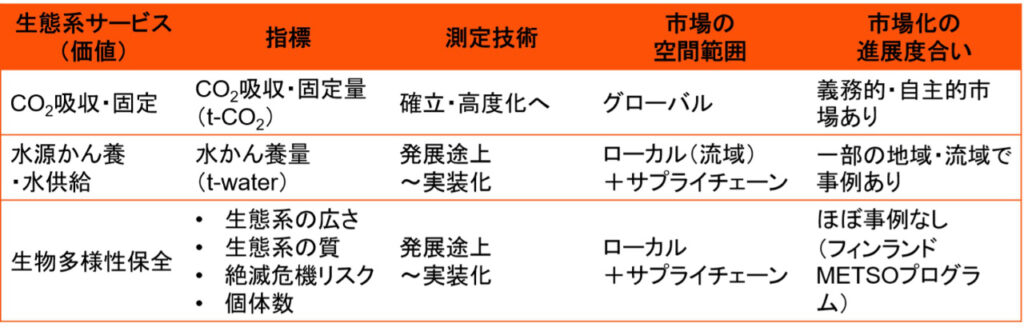
The carbon market is growing because there is a clear group of buyers—companies required to reduce their CO2 emissions. Furthermore, since CO2 serves as a common unit of measurement, the impact on the global environment remains the same regardless of where in the world emissions reductions are achieved.
In contrast, the situation is different for other ecosystem services, such as water and biodiversity. For example, water is a typically local resource, and the groundwater issues in Kumamoto cannot be resolved through forest management in Hokkaido. Similarly, biodiversity is highly region-specific. Consequently, water and biodiversity markets are unlikely to develop into global markets like the carbon market; rather, they are likely to center on watershed-level markets or barter transactions.
Water deserves special attention. In recent years, there has been an increase in large-scale water users, such as semiconductor factories, AI data centers, and beverage manufacturers. Compounded by the effects of climate change, the United Nations University has published a shocking report titled “Water Bankruptcy.” Furthermore, as the TNFD (Task Force on Nature-related Financial Disclosures) gains traction and disclosure of water risks becomes mandatory, companies will take a greater interest in ensuring the stable supply of water resources within river basins. If that happens, a system in which downstream users bear the costs of managing upstream forests—in addition to the costs of developing and operating water infrastructure, which they have traditionally borne—will become a realistic possibility.
When it comes to the value of biodiversity, the starting point is a discussion about which species in a given region are considered valuable and whose habitats should be preserved. In Finland, the government has published a “shopping list” of ecological elements that should be conserved in each region and is implementing the METSO program, which provides compensation to landowners who carry out conservation efforts. In Japan, the Forest Environment Grant Tax can be utilized to become the first “buyer of value.” Furthermore, local governments could invest in education for the general public and forestry workers, as well as in the creation of value-trading platforms and the development of apps. Furthermore, we can envision a system where forestry workers share information about wildlife they encounter in their daily work, and where companies and consumers connected through the supply chain—not just within the watershed—make “environmental payments” for broad-leaved trees that have been preserved rather than harvested, similar to a “matching gift” program.
The Global Nature Positive Summit held recently in Kumamoto was a groundbreaking international conference that will serve as a catalyst for future social change. Looking ahead to its implementation, I believe it is essential to involve forestry professionals who actually manage forests in the discussions on market creation outlined in this column and to initiate these efforts from the local level.
In that sense, what the forestry and timber industry needs going forward is a shift in mindset from “forestry” to “forest capital management.” It is essential for stakeholders to understand that we are transitioning from an era focused solely on timber prices to one in which forests are valued in terms of carbon prices, water value, and biodiversity value. (Takanobu Aikawa, Senior Manager, PwC Intelligence, PwC Consulting LLC)
References:
・ The University of Tokyo Center for Future Vision Research, Global Commons Center (2025), “Making Natural Capital Count: An Investment Agenda」
・ United Nations University Institute for Water, Environment, and Health (2026), “Global Water Bankruptcy: Water Use Beyond Limits in the Post-Crisis Era」
・ Takanobu Aikawa, “Forest-based landscape approach - defining "nature positive" in the watershed"(Forest Circular Economy, March 25, 2026 article)"
・ Takanobu Aikawa, “Economic Value from Water Source Cultivation - Quantifying and Evaluating the Effects of Forest Management with Tools"(Forest Circular Economy, April 22, 2026 article)"
